What was life like in Scotland after the Romans left?
Although the Romans didn't stay in Caledonia for very long they certainly left their mark, including on what you eat now! Find out more below:
Find out about how the Romans continued to influence Scotland.
ANITA: The Romans in Scotland, when the Romans left.
Hello, my name’s Anita, my mum's a history professor and my dad’s an engineer, who knows all about building things. I’ve got a project for school about the Romans and I’ve got a question.
What’s the point in learning about the Romans in Scotland if they weren’t here for very long.
MUM: The Romans tried to invade and control what we now call Scotland, three times.
First under the Roman governor Agricola in 79 AD, then under governor Urbicus in 139 AD and finally under Emperor Severus in 209 AD. Each time they only stayed for 10, 20 or 30 years at the most.
But in between these times, and long after, the Roman Empire was our neighbour to the south and, through its wealth and power, it still changed the way people here in Scotland lived.
Scottish tribes, from way up the top of Caledonia to tribes in the south, had lots of fancy things the Romans made, like cups, bowls and jewellery - especially the Votadini of Traprain Law in what’s now East Lothian.
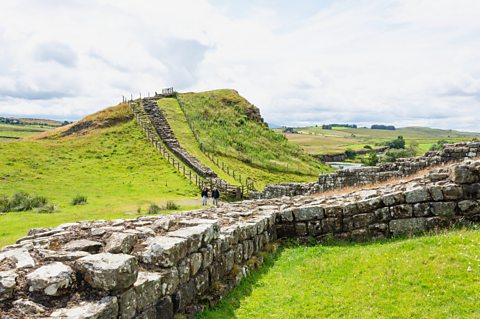
Some of this would have been things that were traded. Some would have been gifts, or even payment from the Romans for keeping things quiet north of Hadrian's Wall, which marked the edge of the Empire until 383 AD.
As soon as the first stone was laid in 122 AD, it chopped the island of Great Britain in two. People to the south of the wall were subjects of the Roman Empire, people north of the wall were not.
The people that lived here, especially in the south of Scotland, also took on Roman beliefs. Parts of England and Wales were still ruled by the Romans until 410 AD.
By that time, Christianity was the official religion of Rome and that’s how it spread to Scotland. The Romans changed Scotland.
DAD: And the world, they were great builders. Made roads and buildings from stone and concrete that still stands 2000 years after they were built. Across Europe, the Middle East and Africa. Just, not here.
MUM: We still use a lot of English words that come from Latin, the language the Romans spoke. Even some months are named after Roman emperors.
July after Julius Caesar, and August after the Emperor Augustus. You still see the numbers Romans used on clock faces, Roman numerals. The Romans also brought new foods to Britain. Cabbages, onions and cucumbers to name a few.
DAD: I know one thing the Romans brought to this tropical paradise isle to keep themselves cool. And I’ll take you for one now…
Ice Cream!
ANITA: I love the Romans!
Why did the Romans leave Scotland?
The Romans finally left Scotland in 210 AD. They had attempted several invasions before and all of them had failed.
In 210 AD, Emperor Severus died while attempting the last invasion.
The new emperor, Caracalla, decided that Rome had bigger problems than Scotland.
Rome was under threat from German tribes and it needed soldiers to defend it. Soldiers were pulled from Scotland and sent back to protect Rome.
The Romans may have left Scotland, but they still controlled most of Britain for almost two hundred years.
So, even though Scotland was free from Romans, they still had them as neighbours for a very long time.
What happened after the Romans left?
While the Roman army officially left Scotland by 210 AD, the influence of the Romans lasted far longer.
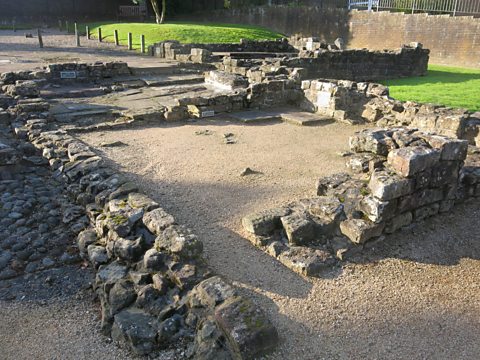
The buildings, forts and walls they left behind in Scotland were pulled down and left in ruins but their influence continued in other ways.
Hadrian’s Wall would continue to be the northern boundary of the Roman Empire for another 200 years until the Romans finally withdrew from Britain in 410 AD.
During this period many of the Scottish tribes would have continued to trade Romans and also with the tribes of northern England on the other side of the wall.
How did the Romans influence Scotland?
The Romans did continue to have some influence on Scotland even after they left - just not as much as they did in England and Wales.
Scotland was never a part of the Roman Empire and it had no long-lasting Roman settlements or cities.
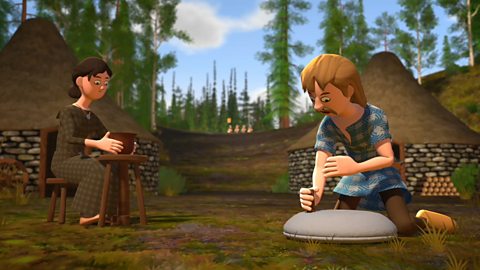
The tribes of Scotland did have to live nearby to the Romans for a very long time, however, so it’s not surprising that some of the Roman ways would have rubbed off on them.
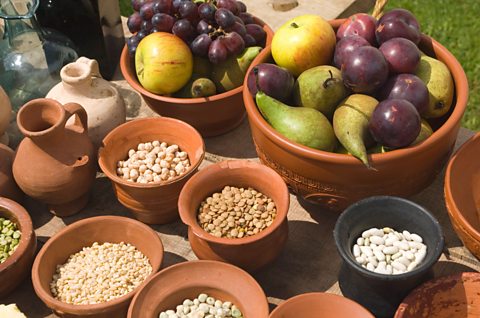
One of the longest lasting influences is some of the food that the Romans brought with them and that we still eat today in Scotland.
These ‘Roman’ foods include:
- Cabbages
- Turnips
- Onions
- Celery
- Cucumbers
- Pears
- Cherries
- Plums
The Romans also introduced goods such as wine, herbs and spices from across the empire that were new to Britain. These would have been valuable items and the tribes would have been keen to trade with the Romans for them.
More on Romans
Find out more by working through a topic
- count9 of 9

- count1 of 9
- count2 of 9
- count3 of 9

