Erosional landforms
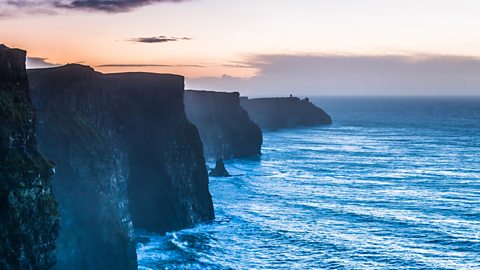
One of the most common features of a coastline is a A high, steep wall of rock that can be eroded by the sea.. Cliffs are shaped through a combination of erosion and weathering - the breakdown of rocks caused by weather conditions.
Soft rock, e.g. sand and clay, erodes easily to create gently sloping cliffs. Hard rock, e.g. chalk, is more resistant and erodes slowly to create steep cliffs.
Formation of a wave-cut platform
- The sea attacks the base of the cliff between the high and low tide marks.
- Erosion processes of hydraulic action and abrasion, create a An area of erosion at the base of a cliff formed by the waves. .
- Over time the notch increases in size and the upper A high, steep wall of rock that can be eroded by the sea. is unsupported, while weathering weakens the upper cliff.
- These processes cause the cliff to collapse.
- A An erosion feature that is left behind as a cliff is eroded backwards over time. is the gently sloping area of bedrock that is left behind as the cliff retreats.
- Breaking waves move the collapsed cliff sediment smoothing the wave-cut platform through abrasion.
- The erosion and cliff collapse sequence is repeated and the cliff continues to retreat.
Headlands and bays
A stretch of the coast made of rock that juts out into the sea. It is usually made of harder rock and is left because the surrounding softer rock has been eroded away. are formed when the sea attacks a section of coast with alternating horizontal bands of hard and soft rock.
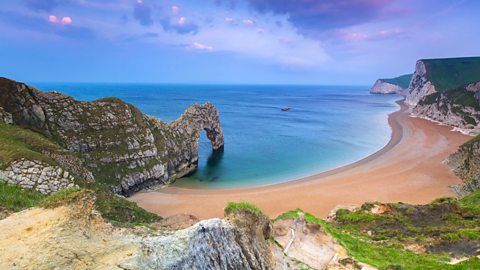
The bands of soft rock, such as sand and clay, erode more quickly than those of more resistant rock, such as chalk. This leaves a section of land jutting out into the sea called a headland.
The areas where the soft rock has eroded away, next to the headland, are called bays.
Caves, arches, stacks and stumps
Erosion can create Erosion from water will widen any cracks in the rock and widen them to become caves., Erosion from water will continue to erode a cave in a headland until eventually it cuts through the whole way through the rock., Erosion from water will continue to erode an arch and the weight of rock will become too heavy and the roof of the arch will fall into the sea. and stumps along a headland.
- Cracks in the rock erode through abrasion.
- Caves occur when waves force their way into cracks in the cliff face. The water contains sand and other materials that grind away at the rock until the cracks become a cave. Hydraulic action and abrasion are the predominant erosion processes.
- If the cave is formed in a headland, it may eventually break through to the other side forming an arch.
- The arch will continue to be eroded by abrasion and hydraulic action. It will gradually become higher and wider until the roof can no longer be supported. When the arch collapses, it leaves an isolated column of rock or stack standing in the sea.
- The stack will be attacked at the base in the same way that a An area of erosion at the base of a cliff formed by the waves. is formed. This weakens the structure and it will eventually collapse to form a stump.
Depositional landforms
Beaches
A coastal landform which usually contains sand, shingle or pebbles. are a common feature of a coastline. Beaches are made up of eroded material that has been transported from elsewhere and deposited by the sea.
Waves that help to build up a beach. They are flat, gentle and low and there are only a few waves per minute. help to build up beaches. The material found on a beach (i.e. A beach where strong swash waves move sandy material up the beach with a spilling wave. Backwash will be weaker. or A beach where strong swash waves will be assisted by windy and stormy conditions to throw larger pieces of shingle up the beach. ) depends on the geology of the area and wave energy.
A cross-section of a beach is called a beach profile.
The material found on a beach varies in size and type as you move further away from the shoreline. The smallest material is deposited near the water and larger material is found nearer to the cliffs at the back of the beach.
Large material is deposited at the back of the beach in times of high energy, for example during a storm. Most waves break on the shore between the high and low tidelines. Sediment here is effectively broken down and smoothed by attrition.
Shingle beach

This is a beach where strong swash waves will be assisted by windy and stormy conditions to throw larger pieces of shingle further up the beach. Shingle beaches will usually contain many different ridges across their profile.
The smallest material will be found on the beach face and larger pieces of shingle/ pebble will be thrown to the back of the beach. Shingle beaches usually have much steeper profiles. This is because the wave will percolate through the shingle, making the backwash too weak to remove the material.
Sandy beach
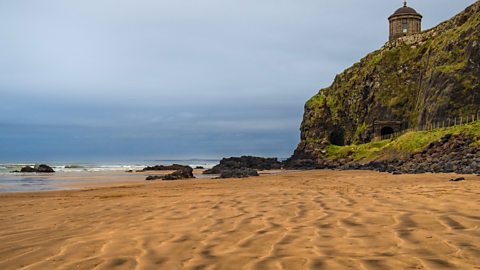
This is a beach where strong swash waves move A beach where strong swash waves move sandy material up the beach with a spilling wave. Backwash will be weaker. material up the beach with a spilling wave. Backwash will be weaker. The coarsest/ biggest pieces of sand will be found at the wave limit – further up the beach. Sandy beaches usually have a gently sloping profile. This is because there is less percolation of water and with sand being a lighter material, the backwash can remove it more easily.
Spits
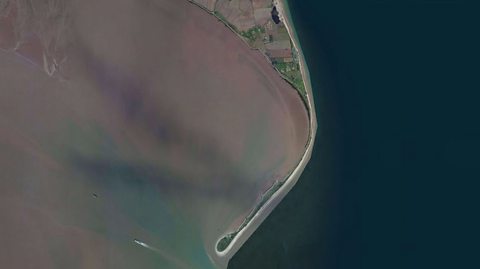
Spits are also created by deposition. A spit is an extended stretch of beach material that projects out to sea and is joined to the mainland at one end.
Spits are formed where the prevailing wind blows at an angle to the coastline, resulting in When eroded material in the sea is carried along the beach in a zig zag course. . An example of a spit is Spurn Head, found along the Holderness coast in Humberside.
The development of Spurn Head
- Longshore drift moves material along the coastline in the direction of the prevailing wind. The angled swash brings material onshore, while the backwash removes the material in a straight line, perpendicular to the coastline.
- This continues in a zig zag movement along the coast.
- If the coast changes direction, material will continue to be deposited in the original direction in a shallow sea.
- This build up of material is called a A long, narrow ridge of land that is formed due to deposited material along a coastline.
- A spit needs a constant supply of material, or it can be eroded by storm waves.
- Over time, the spit grows further out and changes in wind direction may form a hook at its tip.
- A spit will create a sheltered area between it and the land, here fine silt is deposited and mud flats or salt marshes form.
Activity: Take the test
More on Coastal environments
Find out more by working through a topic
- count3 of 4
- count4 of 4
- count1 of 4

