What are the key points about selecting materials?
When selecting materials and surface finishes for a product, consider its intended use and the required properties like strength, durability and appearance.
Stock forms are standard material shapes for easier manufacturing.
Timber comes rough or planed, sold in various sections and sheets.
Metal is in sheets, rods, bars, tubes, joined with rivets, bolts, screws.
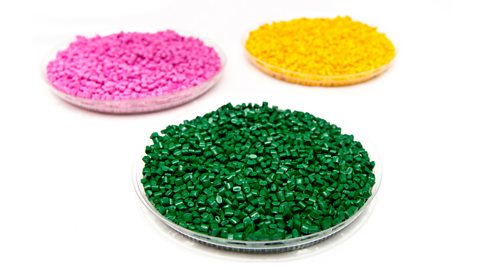
Plastic stock includes sheets, granules, foams, films, filaments.
Area calculations determine how many smaller pieces fit within larger stock, minimising waste.
It might be useful to look at What are the properties and applications of wood and plastics? and What are the properties and applications of metals, alloys and graphene? before studying this topic.
Stock form and cross sections
Stock forms refer to the standard shapes and sizes in which materials are supplied, such as sheets, bars, tubes, angles, U-shaped channels and Ɪ-shaped sections. These forms make manufacturing easier and reduce the need for excessive cutting or reshaping.
Wood
All designers need to know the The standard sizes that material is processed into and is generally available in. that timber and man-made boards are available in. If stock sizes are known, then designs can be manufactured more economically to reduce waste.
Once timber has been cut at a sawmill, it is referred to as ‘rough cut’, and no further process is done to improve the quality of the timber faces. Uses include garden fence posts and some building work. Timber that is sold at DIY shops or from a timber merchant can often be bought with smooth, To smooth with a sharp-bladed tool. edges.
If planed timber is bought, the price will be higher because of the care taken to process the length of wood. PSE is a term used to indicate that the timber has a ‘planed square edge’. This means that one edge will be planed smooth. PAR is a term used to indicate that the timber is planed all round, meaning that both the edges and sides have been planed. Planed timber is used for interior work where the timber is likely to be seen.
Hardwood and softwood are normally sold in lengths called:
- regular sections
- A piece of timber that has a decorative pattern along its length.
- A cylindrical rod, usually made of wood, used to align and fasten pieces together.
- sheets
Regular sections and sheets refer to the proportional dimensions of the timber, whereas moulding refers to a decorative pattern that has been cut using a A rotary cutter used to add a decorative pattern to a length of timber.. Moulded timber can be used for skirting boards and dado rails. Dowels have a round cross section that is available in different diameters.
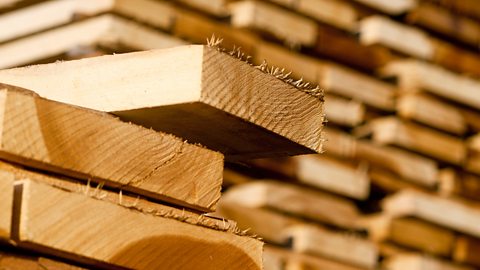
Image caption, Regular sections
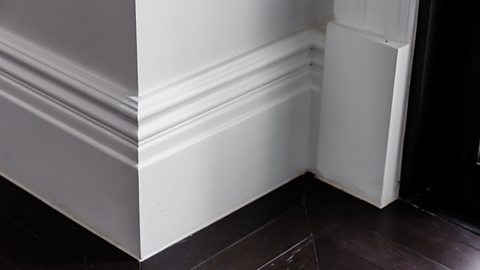
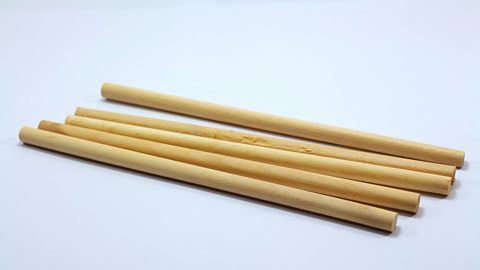
1 of 3
Manufactured boards are usually sold in standard sized sheets of 2,440 mm × 1,220 mm. However, these are often too large for customers to transport, so part sheets can be sold, such as 1,220 mm × 610 mm (half the size).
Example:
Calculate how many can be cut out of a 2,440 mm × 1,220 mm sheet of MDF.
Convert sheet to centimetres:
2,440 mm = 244 cm
1,220 mm = 122 cm
Work out how many can fit horizontally:
244 ÷ 75 = 3.253 or 3 whole signs
Work out how many can fit vertically:
122 ÷ 40 = 3.05 or 3 whole signs
3 × 3 = 9
Therefore, 9 whole signs can be made from 1 sheet.
Alternatively, the areas can be calculated and compared:
Area of sheet = 244 cm × 122 cm = 29,768 cm²
Area of sign = 40 cm × 75 cm = 3,000 cm²
29,768 ÷ 3,000 = 9.9226 or 9 whole signs
A medium-density fibreboard (MDF) plaque has the following measurements:
Calculate how many can be cut out of a 1,220 mm × 610 mm sheet of MDF.
Convert sheet to metres:
1,220 mm = 1.22 m
610mm = 0.61 m
Area of sheet = 1.22 m × 0.61 m = 0.7442 metres²
Area of plaque = 0.12 m × 0.24 m = 0.0288 metres²
Area of sheet ÷ area of plaque = 0.7442 ÷ 0.0288
= 25.84 or 25 whole plaques
Metal
All designers need to know the stock sizes that metals and An alloy is a mixture of two or more elements, at least one of which is a metal. are available in. If stock sizes are known, designs can be manufactured more economically to reduce waste. Metal is available as a stock form in A way to describe that a material is normally much thinner than it is long or wide., A solid cylindrical form., A rectangular length and A hollow cylindrical form., and it is sold by length, width, thickness and diameter.
Steel rod is a solid round piece of metal, and the diameter and length are needed when ordering. Steel bar can come in many cross sections, such as square and rectangle, and the dimensions of the cross section and the length are needed when ordering.
Using steel as an example: the thickness of sheet steel is measured using a scale called ‘standard wire gauge’ (SWG). Conversion tables allow the purchaser to understand SWG sizes in millimetres (mm), eg a 2 mm-thick piece of sheet steel has a SWG size of 14. When buying steel tube, the wall thickness is measured using the SWG scale and the outer diameter and length are needed when ordering.
When buying sheet metal, the SWG size gives the thickness measurement, but the length and width measurements are also needed. Bulk buying metal, as with most items, can save money.
Example:
1 m² aluminium at 3 mm thick (SWG 11) = £29.00 per m²
Twice the thickness would cost:
1 m² aluminium at 6 mm thick (SWG 4) = £44.00 per m²
The percentage increase in the cost for the thicker aluminium can be calculated:
Increase in cost = £44.00 - £30.00 = £14.00
This needs to be calculated as a percentage of the thicker aluminium:
(14 ÷ 44) × 100 = 32%
This shows that 100% more steel has been bought for just 32% of the cost.
Question
If 1 m² steel at 2 mm thick (SWG 14) = £45.00 per m²
Twice the thickness would be:
1m² steel at 4mm thick (SWG 8) = £57.00 per m²
What is the percentage increase in the cost for the thicker steel?
Increase in cost = £57.00 - £45.00 = £12.00
Calculate £12.00 as a percentage of the thicker steel:
(12 ÷ 57) × 100 = 21
So it is 21% more expensive.
Each material group has its own preferred set of standard components to fasten and join them together - metal is no exception.A metal plug used to hold sheet material together. They expand when the central plug is pulled upwards through the body of the rivet., nuts, bolts and screws are all common standard components to fix metal into place.
A rivet is often used to hold sheet material to another metal structure, eg some ‘off-road’ cars have their body held to the structure using a rivet. Nuts and bolts work by tightening a nut along a threaded bolt so that the sheet material is compressed in place. Screws work in a very similar way - as a screw is turned it drives deeper into one material as it compresses another in place.
Angle steel is an L-shaped piece of metal commonly used in construction for structural support. When ordering, the dimensions needed are the length, the width of each side and the thickness of the metal. Angle steel provides strength with minimal material and is often used in frames, brackets or reinforcements.
The thickness of angle steel is often measured in millimetres (mm) and can vary depending on the application. Like other stock forms, angle steel is sold by length and thickness and bulk purchasing can reduce costs.
Example:
1 metre of angle steel at 3 mm thick = £17.00 per metre
Twice the thickness would cost:
1 metre of angle steel at 6 mm thick = £25.00 per metre
The percentage increase in cost for the thicker angle steel can be calculated:
Increase in cost = £25.00 - £17.00 = £8.00
This is calculated as a percentage of the thicker angle steel:
(8 ÷ 25) × 100 = 32%
This shows that doubling the thickness only increases the cost by 32%.
Question
If 1 metre of angle steel at 4 mm thick = £20.00 per metre
Twice the thickness would be:
1 metre of angle steel at 8 mm thick = £29.00 per metre
What is the percentage increase in the cost for the thicker angle steel?
Answer:
1 metre of angle steel at 4 mm thick = £20.00 per metre 1 metre of angle steel at 8 mm thick = £29.00 per metre
Increase in cost = £29.00 - £20.00 = £9.00
Percentage increase. This is calculated as a percentage of the thicker angle steel: (9 ÷ 29) × 100 = 31.03%
The percentage increase in cost for doubling the thickness of the angle steel is approximately 31%.
Ɪ-section steel, also known as an Ɪ-beam, is shaped like the letter "Ɪ" and is commonly used in construction due to its strength and ability to support heavy loads. When ordering, the dimensions needed are the depth (height), A rim, lip, or ridge on an object to increase strength, help attach to other items, prevent movement or even decoration width, web thickness and length. Ɪ-section steel provides excellent strength to weight ratio and is often used in beams and columns.
Using steel as an example: the dimensions of Ɪ-section steel are measured in millimetres (mm) and vary depending on the application. Like other stock forms, Ɪ-section steel is sold by length and dimensions and bulk purchasing can reduce costs.
Example:
1 metre of I-section steel at 10 mm thick = £50.00 per metre
Twice the thickness would cost:
1 metre of I-section steel at 20 mm thick = £72.00 per metre
The percentage increase in cost for the thicker I-section steel can be calculated:
Increase in cost = £72.00 - £50.00 = £22.00
This is calculated as a percentage of the thicker I-section steel:
(22 ÷ 72) × 100 = 31%
This shows that doubling the thickness only increases the cost by 31%.
Question
If 1 metre of I-section steel at 8 mm thick = £42.00 per metre
Twice the thickness would be:
1 metre of I-section steel at 16 mm thick = £60.00 per metre
What is the percentage increase in the cost for the thicker I-section steel?
Answer
Cost of 1 metre of I-section steel at 8 mm thick = £42.00 Cost of 1 metre of I-section steel at 16 mm thick = £60.00
Increase in cost = Cost of thicker steel - Cost of thinner steel
= £60.00 - £42.00 = £18.00
The percentage increase is calculated by dividing the increase in cost by the cost of the thicker steel and then multiplying by 100 to convert it to a percentage.
Percentage increase = (Increase in cost ÷ Cost of thicker steel) × 100
Percentage increase = (£18.00 ÷ £60.00) × 100 = 30%
Plastic
Plastics are long chains of polymers. A polymer is a large molecule formed from many identical smaller molecules (monomers). Polymers can be natural or synthetic. are available in many stock forms. This availability in a variety of convenient forms can reduce the cost of final products and help them reach the market quicker. However, it can restrict designers, compromising a product’s aesthetic or form. The table below identifies some of these stock forms and their uses alongside polymers commonly available in that stock form, although they can also be available in other forms:
| Common stock form | Polymer | Common use |
|---|---|---|
| Sheet | Acrylic | Menu holders in bars and restaurants |
| Granules | PET (polyethylene terephthalate) | Drinks bottles |
| Foams | Polyurethane | Varnish |
| Film | PVC (polyvinyl chloride) | Food wrapping |
| Filament | PLA/ABS (polylactic acid/acrylonitrile butadiene styrene) | 3D prints |
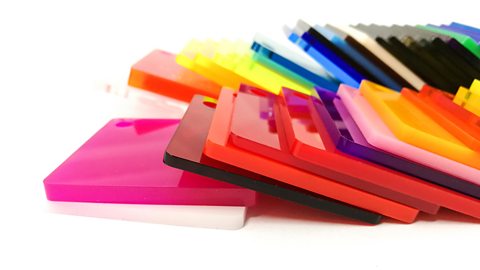
Image caption, Acrylic sheets


1 of 4
Calculating cross-sectional area and sizes
Calculating the amount of material needed can be done by using simple measurements to work out the cross-sectional area of shapes. This will, along with the length, help to calculate how much material is needed to make a product, as well as how much space would be available inside the product.
Example
How many 20 cm × 20 cm squares can be cut from a larger sheet that measures 41 cm × 22 cm?
Calculate the area of the two shapes:
20 × 20 = 400 cm²
22 × 41 = 902 cm²
Divide the two numbers:
902 ÷ 400 = 2.25
Round down to the nearest whole number = 2
From the larger sheet, two pieces that measure 20 cm × 20 cm can be cut.
Calculate the area of a 55 cm × 30 cm piece of acrylic, and how many pieces could be cut from a larger sheet measuring 175 cm × 100 cm.
Area of a rectangle = length × width
55 × 30 = 1,650 cm²
Area of the larger sheet = 175 × 100
= 17,500 cm²
17,500 ÷ 1,650 = 10.6
From the larger sheet, ten pieces that measure 55 cm × 30 cm can be cut.
Test yourself
More on Materials, components and fabrication
Find out more by working through a topic
- count3 of 8

- count4 of 8

- count5 of 8