Language
Shakespeare is renowned for the language he used and often invented new words, many of which we still use today. Explore the way he uses rhythm and rhyme and imagery and metaphor in The Tempest.
Language overview
The way we write and speak has changed a lot over the past 400 years since Shakespeare wrote his plays, so don’t be put off if you find Shakespeare’s words difficult.
Shakespeare used the following aspects of language in The Tempest to present his themes and characters:
- imagery and metaphor
- rhythm and rhyme
Imagery and metaphor
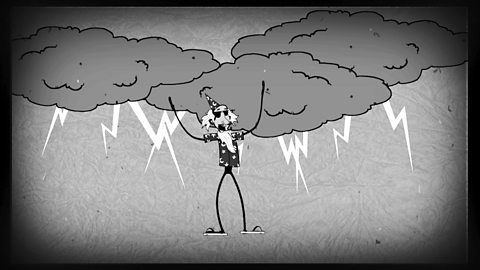
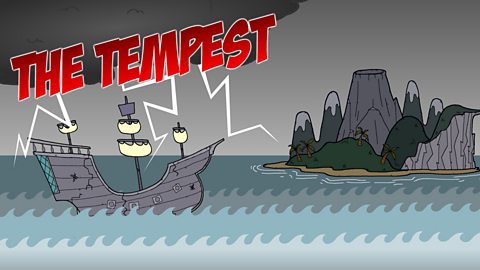
There are many repeated images and A comparison made without using 'like' or 'as', eg 'sea of troubles' and 'drowning in debt'. in The Tempest, perhaps the most obvious of which is the storm itself. The play opens with a ship caught in a terrible storm and the men on board are in a state of upheaval and panic. The A supervisor on a ship, pronounced ‘bo’sun’. shouts that the waves do not care who is king and who is not, they will drown everyone. In this sense the tempest represents a disturbance of the social order. It also seems to represent Prospero’s anger, as he is responsible for the storm. At the end he asks Ariel to make sure the waves are calm on the way home, reflecting Prospero’s own internal calm.
Another clear metaphor is the island setting. An island is set apart physically from the mainland, and we can see that many of the characters in this play are also isolated in other ways. Caliban is separated by being the only native islander, whereas Ariel is isolated through his spirit form. Miranda is the only female in the play and Prospero is the only human character to have magical powers.
Images of the island and its beauty are presented by Caliban and Ariel. These two creatures seem to appreciate the natural wonders of the island more than the human characters. They are each closely associated with different natural elements. Ariel is linked with the air and Caliban with the earth.
Analysis of imagery and metaphor in the play
Question
What does the island represent?
The island represents the isolation of the characters. Even Ariel, who loves the island, acknowledges that it is remote and wild when he says:
ARIEL
this most desolate isle.
Act 3 Scene 3
Question
What does Prospero mean when he says, 'We are such stuff/As dreams are made on" Act 4 Scene 1?
Prospero is making the point that Ariel and the spirits are connected with the air. He tells Ferdinand that the spirit actors from the masque have 'melted into air'. He makes a comparison between the airy spirits and humans, emphasising that our lives too are fragile and brief.
Listening task
In Act 4 Scene 1, Prospero asks Ariel to work with his spirit friends to present a celebration in honour of Ferdinand and Miranda. When the masque ends, he explains to Ferdinand that nothing is permanent.
The Tempest language - imagery and metaphor
PROSPERO
You do look, my son, in a moved sort,
As if you were dismayed. Be cheerful, sir,
Our revels now are ended; these our actors,
As I foretold you, were all spirits, and
Are melted into air, into thin air;
And, like the baseless fabric of this vision,
The cloud-capped towers, the gorgeous palaces,
The solemn temples, the great globe itself,
Yea, all which it inherit, shall dissolve,
And like this insubstantial pageant faded
Leave not a rack behind. We are such stuff
As dreams are made on; and our little life
Is rounded with a sleep. Sir, I am vexed.
Bear with my weakness, my old brain is troubled.
Be not disturbed with my infirmity.
If you be pleased, retire into my cell,
And there repose. A turn or two I'll walk
To still my beating mind.
Question
What does Prospero say the actors are?
Spirits which 'are melted into air'.
Question
How does he say 'our little life' will end?
'with a sleep.'
Rhythm and rhyme
As with many of Shakespeare’s plays, characters are distinguished by the formality of their speech. One way that you can notice this is by looking at whether a character speaks in A type of spoken or written language that has no rhythm or rhyme., rhyme or A type of poetry with a regular rhythm but no rhyme. Shakespeare’s characters often speak in blank verse, especially if they are intelligent characters or are speaking with emotion.,. It tends to be the case that characters of a lower social status, such as Trinculo and Stephano in The Tempest speak in prose and those of a higher status use blank verse. If they’re being romantic, or philosophical, they might also use rhyme. However, pay attention to when these ‘rules’ are broken. It might show that a character is upset, or perhaps unexpectedly sensitive.
Question
How is Ariel’s spritely nature emphasised by his songs?
Ariel lures Ferdinand to Prospero’s cell by singing invisibly to him:
ARIEL
Come unto these yellow sands,
And then take hands.
Curtsied when you have, and kissed,
The wild waves whist…
Act 1 Scene 2
His song uses short lines and rhyming couplets which add to the magical effect.
Question
How does Caliban’s speech about the island differ from his usual way of speaking?
Although his social status is low, Caliban speaks poetically of the island:
CALIBAN
The clouds methought would open and show riches
Ready to drop upon me, that when I waked
I cried to dream again.
Act 3 Scene 2
We might expect Caliban, as an enslaved person, to speak in prose. However, when he describes the island, his talk is poetic and rich in imagery.
Listening task
The Tempest language - rhythm and rhyme
STEPHANO
Come on your ways. Open your mouth; here is.that which will give language to you, cat. Open.your mouth; this will shake your shaking, I can tell.you, and that soundly. You cannot tell who's your.friend: open your chaps again.
TRINCULO
I should know that voice. It should be - but he is
drowned, and these are devils. O defend me!
STEPHANO
Four legs and two voices; a most delicate monster!
His forward voice now is to speak well of his
friend; his backward voice is to utter foulspeeches, and to detract. If all the wine in my.bottle will recover him, I will help his ague.
Come. Amen. I will pour some in thy other.mouth.
TRINCULO
Stephano!
STEPHANO
Doth thy other mouth call me? Mercy, mercy!
This is a devil, and no monster. I will leave him;
I have no long spoon.
TRINCULO
Stephano! If thou beest Stephano, touch me, and.speak to me; for I am Trinculo - be not afeard -
thy good friend Trinculo.
STEPHANO
If thou beest Trinculo, come forth! I'll pull.thee by the lesser legs. If any be Trinculo's legs,
these are they. Thou art very Trinculo indeed!
How cam’st thou to be the siege of this moon-calf? Can he vent Trinculos?
TRINCULO
I took him to be killed with a thunder-stroke. But
art thou not drowned, Stephano? I hope now thou.art not drowned. Is the storm over-blown? I hid me.under the dead moon-calf's gaberdine for fear of
the storm. And art thou living, Stephano? O
Stephano, two Neapolitans 'scaped!
Question
When Stephano says 'open your chaps', what does he mean?
Open your mouth.
Question
What does Trinculo ask Stephano repeatedly?
Whether or not he has drowned.
Activity
More on The Tempest
Find out more by working through a topic
- count5 of 5
- count1 of 5
- count2 of 5
- count3 of 5