Themes
There are many themes in The Tempest. Explore the main themes of freedom, empathy and forgiveness and nature versus nurture looking at how they affect characters and influence the story.
Key themes
There are many ideas and concepts that run through The Tempest. Depending on your reading of the text, you might think one or another is more significant. For example, in recent years critics have examined how Caliban might represent colonised people, even though Shakespeare was writing long before the world of empire building had begun.
You could also say that this is a play about love in its different forms – parental, romantic, brotherly, An appreciation of beauty. The themes are often connected and you will notice links between many of the key ideas.
Some of the main themes include:
- freedom
- empathy and forgiveness
- nature versus nurture
Freedom
Throughout the play, we see examples of characters seeking their freedom and often experiencing the opposite, ie imprisonment. The island setting for the play makes everyone trapped to a certain extent. Following the shipwreck (and before Ariel steps in) there is no immediate escape from the island for any of the characters.
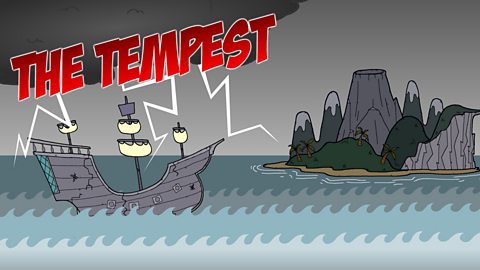
‘The Tempest’ theme - freedom
Everyone loves a Disaster movie.
It’s not just because of the action.
It’s because of the freedom!
Imagine if zombies attacked you now.
You could run around with a cricket bat
and do all the things you normally can’t do,
because the old rules wouldn’t apply!
The Tempest is a disaster for the people on board the ship.
But in the chaos, people try to rip up the old rules.
Sebastian and Antonio try to kill King Alonso.
Caliban tries to free himself from Prospero by plotting
with Trinculo and Stephano.
Which is odd, because Caliban has already
agreed to be Stephano’s slave.
Maybe Caliban is afraid of freedom?
But Prospero, who summoned the Tempest,
is on a mission to free himself.
Not just from the island he was marooned on.
But from his own past, and need for revenge.
He frees himself, and all his servants.
In this play Shakespeare suggests that
to forgive and be forgiven is the greatest freedom
that we can have.
The big softie.
Prospero and Miranda have been trapped on the island for twelve years. When they first arrived, Prospero rescued Ariel from a prison that the witch Sycorax had locked him in. Ariel becomes Prospero’s servant and asks early on in the play when he might be granted his freedom.
Caliban is another character who lacks freedom. Prospero threatens him with punishments if he does not do his work. However, Caliban seems destined to be enslaved. When he meets Stephano, he bows down at his feet and promises to be his loyal servant.
Prospero’s very last words in the play are 'set me free' (Act 5 Epilogue) which shows the importance of this theme to all the characters.
Analysis of freedom in the play
Question
How does the theme of freedom relate to Ariel?
Ariel longs for freedom. He pleads with Prospero:
ARIEL
Let me remember thee what thou hast promised,
Which is not yet performed me.
Act 1 Scene 1
Ariel reminds Prospero that he has promised to grant him his 'liberty'.
Question
What are Miranda’s thoughts on freedom?
Miranda believes that imprisonment is a suitable punishment for immoral behaviour. She says:
MIRANDA
therefore wast thou
Deservedly confined into this rock
Act 1 Scene 2
When she speaks to Caliban, Miranda calls him an 'abhorred slave' and suggests that this entrapment is deserved. This seems to suggest that freedom must be earned through good behaviour rather than being an entitlement.
Question
Is Caliban destined to be enslaved forever?
It certainly seems so. Caliban is very quick to put himself in the role of servant. He says:
CALIBAN
I’ll swear upon that bottle to be thy true subject
Act 2 Scene 2
When he first meets Stephano, Caliban thinks he must be a god, and worships him. He shifts his servitude from Prospero to Stephano.
Did you know? The speech in Act 1 Scene 2 that begins 'Abhorred slave' is sometimes attributed to Prospero and sometimes to Miranda. Some editors feel that the speech is too harsh for Miranda and others suggest that it shows her as a more rounded character.
You can find the theme of freedom in other plays by Shakespeare:
- As You Like It – in this comedy, two female characters are 'banished' from the court and brothers are exiled to a forest
- Romeo and Juliet- the young lovers in this play are not free to love each other due to their families’ disagreements
Empathy and forgiveness
Empathy is the ability to put yourself in someone else’s shoes and understand how they might be feeling. In order to forgive someone it is quite useful to be able to feel empathy. Some characters in The Tempest seem skilled at this, whilst others struggle to think of anyone but themselves.
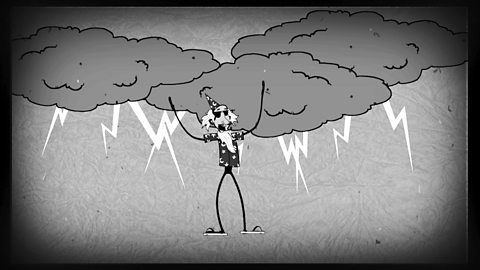
‘The Tempest’ theme - empathy and forgiveness
Empathy is the ability to feel what somebody
else might be feeling.
Like if we see someone hurt, we can feel how they might feel.
Our ability to put ourselves in other people’s shoes means that we’re likelier to treat them as we ourselves would like to be treated.
Or to put it simply, empathy makes us kind. Shakespeare knew that people can be unkind.
Prospero begins the play pretty hard hearted. He uses Ariel like a slave, ignoring the spirit’s pleas for freedom.
Prospero treats Caliban badly.
Certainly, Caliban is no saint, but he was here first!
However, Prospero begins to empathise with his old foes, and in doing so, learns to empathise with his servants.
Someone who didn’t have to learn is Prospero’s daughter Miranda.
She naturally empathises with everyone.
Shakespeare knew that it’s hard to be kind and forgiving to selfish people.
We just have to hope they learn their lesson.
Before they meet someone as bad as them.
Miranda seems to have a very natural sense of empathy. When she sees the ship caught in the storm she shows empathy for the crew. She gets upset about the suffering that she imagines they must have gone through.
Prospero on the other hand seems to learn empathy as the play progresses. When we first see him with Ariel, the spirit is asking for his 'liberty' which Prospero has promised. However, instead of showing understanding for his servant, Prospero seems to become angry. He reminds Ariel that he rescued the spirit from his prison in a tree.
Later in the play, Prospero becomes softer in his manner towards Ariel, calling him 'dainty' and 'chick'. When Ariel tells him he should feel sorry for the king and his followers, Prospero takes his advice. Instead of taking revenge Prospero offers forgiveness.
Analysis of empathy and forgiveness in the play
Question
Which particular character shows a natural empathy and compassion for others?
Miranda. She is an innocent girl who has been brought up away from society. Perhaps Shakespeare is suggesting that compassion is an instinctive human emotion. Miranda feels the suffering of others because she has not been exposed to society’s greed and jealousy. She says:
MIRANDA
O, I have suffered
With those that I saw suffer!
Act 1 Scene 2
Question
How does Prospero feel towards his servants?
Prospero lacks empathy for his servants. Caliban complains that Prospero was kind to him when he first arrived on the island:
CALIBAN
When thou cam’st first,
Thou strok’st me and made much of me
Act 1 Scene 2
Now though, Caliban is imprisoned even though he claims the island is rightly his. Prospero has no compassion for Caliban and accuses him of lying.
Question
Does Caliban show empathy and forgiveness to others?
Caliban shows no compassion or forgiveness. When Stephano beats Trinculo, Caliban offers to join in. He says:
CALIBAN
Beat him enough; after a little time
I'll beat him too.
Act 3 Scene 2
This cruel aspect of his character makes him seem even more of a 'monster'.
Question
At the end of the play, Prospero’s attitude begins to change. How?
In the end Prospero learns to forgive. He says:
PROSPERO
For you, most wicked sir, whom to call brother
Would even infect my mouth, I do forgive.
Thy rankest fault
Act 5 Scene 1
He will forgive even the worst of Antonio’s faults. However, he does refuse to call him 'brother' so perhaps his forgiveness is less thorough than it appears!
You can find evidence of empathy and compassion in many other plays by Shakespeare. However, you can also find lots of plays that deal with the opposite themes of jealousy and revenge.
- 'The Merchant of Venice' – Portia gives a speech about the 'quality of mercy' in Act 4.
- 'King Lear' - This is a dark play about cruelty and betrayal. There is some sense of forgiveness in there towards the end though!
Nature versus nurture
The theme of nature versus nurture is presented on a number of levels in The Tempest. There is the natural beauty of the island, that Caliban tells us about with the 'sounds and sweet airs' (Act 3 Scene 2). Then there is the comparison between what is natural and what is civilised. Miranda represents a natural innocence and naivety, whereas Caliban represents something savage, uncivilised and 'unnatural'.
‘The Tempest’ theme - nature verses nurture
Ooh. The cinema. I want a choc ice.
Nature versus Nurture? I hope this is educational.
It’s the age-old question. Whether our character is more influenced by what we are born with?
Or by the environment in which we are raised?
For example, are some people naturally bad,
like Shakespeare’s Caliban? Certainly Prospero thinks so.
Other people seem to be naturally good, like Prospero’s daughter Miranda.
Nature itself is mastered and controlled by Prospero through magic.
Whereas Gonzalo suggests that we would be much happier if we lived in harmony with nature.
So what is more important? Nature or Nurture? The answer is… Well, Mr Shakespeare. What do you think?
You don’t know. That’s why you wrote the play.
Explore the issues about the positive and negative in both nature and civilisation.
And whether we can change nature for the better? Or are we stuck with what we’re born with?
Get me a choc-ice. I’m hungry. On you go. I can’t help it! It’s my nature!
And find out what’s on next! That last film was rubbish!
Gonzalo, in Act 2 Scene 2, talks about a commonwealth where nature and man would work together more harmoniously. At the same time the supposedly civilised men, shipwrecked on the island, are mostly shown as greedy drunkards and traitors.
Did you know? Gonzalo’s speech is based on an essay by a writer called Montaigne. In his essay On Cannibals Montaigne compares a Native American tribe’s society and culture with Western society.
Question
What does Gonzalo long for?
Gonzalo argues for a more natural and peaceful society. He has a vision for a kingdom where everything would work together, with no need for fighting or effort. He says:
GONZALO
All things in common nature should produce
Without sweat or endeavour.
Act 3 Scene 1
This 'natural' society he dreams of does not seem to be reflected in the behaviour of the other characters however.
Question
What does Prospero suggest when he says, 'A devil, a born devil, on whose nature/Nurture can never stick' Act 4 Scene 1?
Prospero suggests that some creatures are evil by nature. He thinks that no amount of education or kindness will change Caliban’s basic evil nature. Perhaps this also relates to his brother Antonio, who later seems unmoved by Prospero’s forgiveness.
Question
Why is the theme of nature versus nurture important to Ariel?
Ariel looks forward to being free in nature. As he prepares to leave Prospero, Ariel sings about the blossom and bees that he longs to be part of again. He highlights the innocence and beauty of the natural world.
ARIEL
Merrily, merrily shall I live now
Under the blossom that hangs on the bough.
Act 5 Scene 1
Shakespeare examines the natural state of man in a number of plays:
- Macbeth – this is a tragedy that examines greed and power. Perhaps Shakespeare is suggesting this is the natural state of humans!
- A Midsummer Night’s Dream – this is another play with lots of magic…you could compare the natural with the supernatural.
Activity
More on The Tempest
Find out more by working through a topic
- count2 of 5
- count3 of 5
- count4 of 5
- count5 of 5