Introduction
This study guide covers the following:
Managing money properly - these are RESPONSIBILITIES.
Taking care with money and budgeting to ensure there is enough to cover necessities – this is about making the RIGHT CHOICES.
Remember these key terms:
RESPONSIBILITIES – RIGHT CHOICES
Responsibility
Making sense of financial matters
Learning how to manage money is an important part of becoming an adult.
It can seem a bit daunting at first.
There are many common financial terms such as mortgage, pension, or APR that will all seem quite strange.
Managing money will become second nature if good habits are established as early as possible.
How can budgeting be managed?
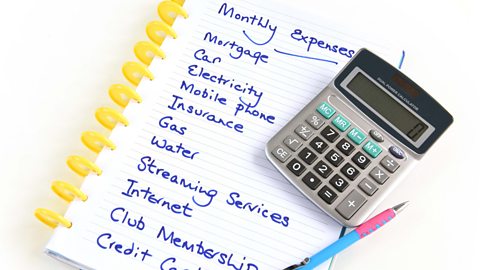
Drawing up a budget is central to having a healthy financial life.
Working out weekly or monthly income (money which is received) and outgoings (making a commitment to pay for services or items) will help to identify any overspending or areas where savings could be made.
Typical outgoings include household expenses like:
- rent or mortgage
- groceries
- electricity
- gas or oil
- phone and broadband
- TV licence
- fuel
Writing a budget helps a person to:
- prioritise spending - necessities should be paid for first
- plan any spending in advance
- save for things they want
- avoid getting into debt or worrying about finances
What are the consequences of budgeting and not budgeting?
Budgeting helps when making informed financial decisions.
| Consequences of budgeting | Consequences of not budgeting |
|---|---|
| Ability to pay for all necessities on time. | There might not be enough money to pay for necessities which could lead to borrowing money and ending up in debt. |
| Unlikely to overspend or get into debt which will be good for mental health. | Credit score will be negatively affected and they will pay high interest fees if they are accepted to borrow money. |
| Likely to have a good credit score and could borrow money with good interest rates in the future. | Could pay fees for late payments which would cause them to owe even more money. |
Watch: Sticking to a budget
Watch this video about making informed financial decisions
Narrator:
Money doesn't grown on trees. Money makes the world go round.
A fool and his money are easily parted.
Doe, dosh, spondulicks.
There are countless words and phrases to describe money.
That's because whether we like it or not, money is one of the most important aspects in everyday life, affecting everything from the clothes you wear, to the food you eat and the house you live in.
Learning to manage your money is one of the first steps in adulthood.
And while it may seem daunting at first , it will soon fall into place if you stick to a budget.
Unless you're as rich as say the Kardashians or a premiership footballer you should learn to live on a budget.
It's as simple as working out your income and your outgoings - to ensure that there isn't a shortfall n money and making sure your essential bills are covered - such as electricity, heating and food.
I love food.
A budget allows you to carefully plan your spending, avoid worrying about finances and save for the things you really want, like new shoes, for example, or, I don't know, an army of space monkeys. (Why do I not have an army of space monkeys).
There are several reasons why people find themselves short of money.
Poor budgeting, unexpected bills, increase in the size of family, poor health, meaning you can't work - addiction such as gambling, drugs or alcohol.
Any of these can lead to you falling into debt. Which can be really difficult to pay off, leaving distress and worry. This can be avoided by keeping a close eye on your outgoings and learning to save.
You should aim to save around 20% of your income, a financial safety net is really important in case of emergencies. For example, if your boiler breaks down or your car needs to be replaced.
So when the unexpected happens you've got it covered.
More on Making informed financial decisions
Find out more by working through a topic
- count2 of 4

- count3 of 4

- count4 of 4