Key points
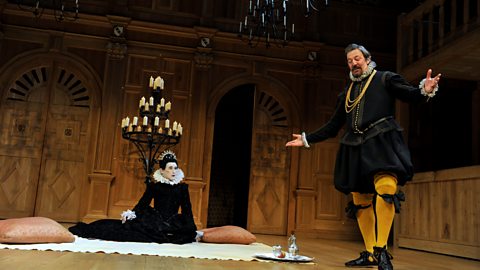
Twelfth Night is a fast-paced comedy by William Shakespeare that contains romance, mistaken identities and practical jokes.
Themes are the main ideas that appear repeatedly in a play. Some of the important themes in Twelfth Night are:
- Love - different types of love, including romantic love and family love.
- Ambition - the desire and determination to achieve something.
- Appearance and reality - nothing is quite how it appears, there is confusion and mistaken identity.
Did you know?
Shakespeare often combines romance and comedy in his plays. For example, in A Midsummer Night’s Dream a group of young people find their true loves with a little help from some fairies.
Love
Watch this video about love in Twelfth Night:
Narrator: Love. Love gets put through its paces in Twelfth Night. There’s Orsino, Duke of Ilyria, who’s madly in love with Countess Olivia. It doesn’t matter what Olivia says, he’s not going to stop fancying her.
There’s Olivia. She falls in love with Cesario, who doesn’t return her affections. And Cesario, who’s really Viola dressed up as a man, falls in love with Orsino. She can’t show her true feelings.
And Malvolio does show his true feelings, but they’re based on a lie. He’s definitely wasting his time. Oh crikey. Looks like love’s going to fight them all. But remember, love winning is a good thing.
It’s just winning can be messy. But Shakespeare always tidies up in the end, which is just as well. What are you cleaning up with? Truth. That’s what Shakespeare recommends for a Love Mess.
The play presents different types of love:
Selfish love
Malvolio and Sir Andrew both want to marry Olivia, however, neither man seems to have genuine feelings for her. For example, Malvolio only wants to marry Olivia because he wants to increase his status.
Family love
There are several examples of family bonds and love. For example, Olivia is mourning the death of her brother and the twins, Sebastian and Viola, are devastated when they each fear that the other has drowned.
Romantic love
Viola (Cesario) represents genuine and faithful romantic love. She is in love with Orsino and suffers when she cannot be honest with him about her feelings. They get engaged at the end of the play.
How are music and love connected in the play?
Love and music are often connected in Shakespeare’s plays. In the opening scene of Twelfth Night Orsino delivers the famous line “If music be the food of love, play on.” At the end of the play, when three happy couples have been united, the characters sing and dance.
Ambition
Watch this video about ambition in Twelfth Night:
Narrator: Ambition. There’s one very ambitious person in Twelfth Night. Somebody who wants marriage to get him where he wants to be in life. No, not the pirate! Malvolio, the Countess Olivia’s steward. You might think Malvolio is a minor character, but at one point in the 1600s, they called the whole play ‘Malvolio’.
Audiences would have known someone like him. A social climber, a snob, who fancied himself. It’s not just the Countess that he wants, but her status! Audiences loved to hate this pompous man! And thought Maria’s fake love letter from Olivia was hilarious.
Shakespeare knew that we all love to hate people who think they’re better than they are, and put other people down, just to raise themselves’ up. Some people need to be brought down a peg or two. Malvolio doesn’t die. He just gets humiliated, publicly. Now that’s humiliation.
Malvolio is an ambitious character. He secretly hopes that Olivia loves him, but only because he would have greater power over Sir Toby and the other members of the household as Olivia’s husband. Ultimately Malvolio’s self-importance and ambition lead to his downfall.
Appearance and reality
Watch this video about appearance and reality in Twelfth Night:
Narrator: Appearance and reality. Shakespeare knew that appearing to be something you’re really not, could lead to new adventures; exciting - yes, but sometimes confusing or dangerous. Give up. You’re too old to get in.
The central character in Twelfth Night is a girl, Viola, who can pass for a boy, Cesario. It’s a brilliant disguise. Just remember which door to go through…. Oh, look, it’s Cesario’s new boss, Orsino. Viola falls in love with him, but she can’t declare her love because she’s disguised as a boy.
And if it wasn’t complicated enough, Olivia falls in love with Cesario. Oh, good grief. Here comes Viola’s twin Sebastian. His appearance is even more confusing. Olivia proposes to him, thinking it’s Cesario. Shakespeare shows us how hard it can be to tell appearance from reality, but how also how much this confusion can teach us about ourselves.
After all, if it weren’t for Viola’s appearance as Cesario, these couples would never have met! But it’s only when the reality of who they are is known, can true love blossom! Hang on. They keep coming out of the gents. What’s going on in there? They’re sneaking in! Oh dear. It appears that Shakespeare’s missed a trick. I’ve never seen this before.
In Twelfth Night, nothing is quite what it seems:
Viola is a woman who appears to be a man called Cesario - this leads to lots of confusion and mistaken identity.
When Viola is disguised as Cesario she looks very similar to her twin brother Sebastian, which is why Olivia confuses their identities and marries Sebastian.
Sebastian’s friend Antonio confuses Cesario (Viola) with Sebastian, and cannot understand why Cesario says he does not know him.
Malvolio finds a letter that appears to be from Olivia, but in reality has been forged by her A woman who attends to a lady such as Lady Macbeth, similar to a lady-in-waiting. Maria. He is tricked into believing that Olivia loves him.
Feste, a A comedian employed to entertain. in the household of Olivia, disguises himself as a priest called Sir Topas in order to trick Malvolio. He pretends that the dark room in which Malvolio is locked is a light room full of windows.
Test your knowledge
Play Bitesize secondary games. game
Have fun playing science, maths, history, geography and language games.

More on Twelfth Night
Find out more by working through a topic
- count3 of 6
- count4 of 6
- count5 of 6
- count6 of 6