Key points
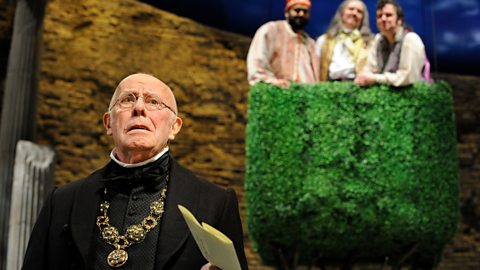
Viola is a character from Twelfth Night, a play written by William Shakespeare, an English playwright.
Twelfth Night is a fast-paced comedy that contains romantic plots, mistaken identities and practical jokes.
Viola disguises herself as a man named Cesario in order to work for the Duke of Illyria, Orsino.
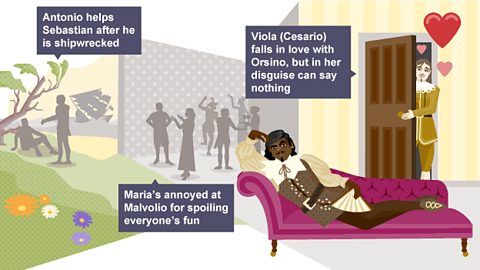
Things soon become complicated when she finds herself caught up in a love triangle - Orsino loves Olivia, Olivia loves Cesario (Viola) and Viola (Cesario) loves Orsino.
Did you know?
In Shakespeare’s time, female characters were played by young male actors because women were not allowed to act on stage. This means that Viola would have been played by a man, who was playing a woman, who was pretending to be a man.
Plot summary
Viola’s key moments
Click through the slideshow to see Viola’s key moments
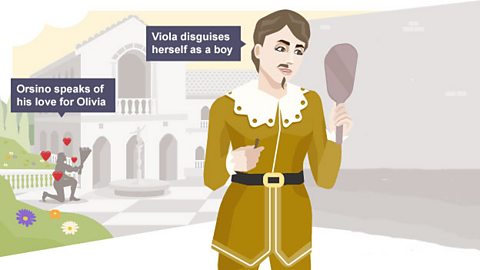
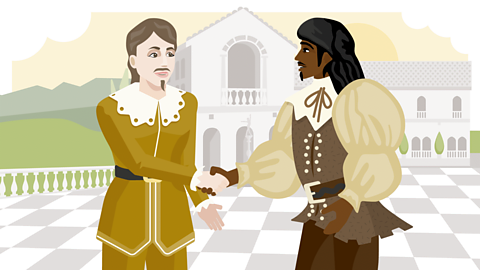
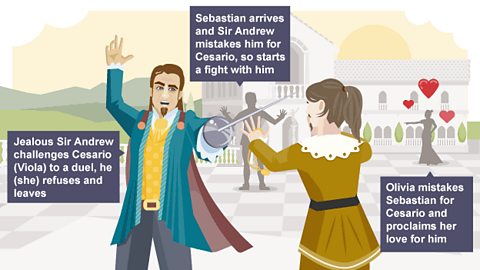
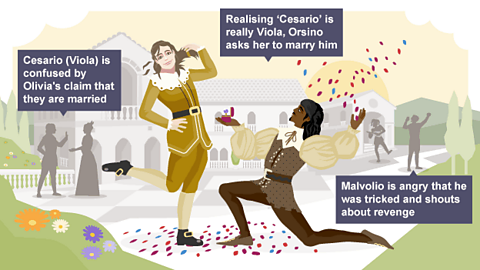
Image caption, Viola has been shipwrecked on the shores of Illyria and fears that her twin brother Sebastian has drowned. With the help of a captain, she disguises herself as a man named Cesario.
1 of 5
Character traits
Courageous
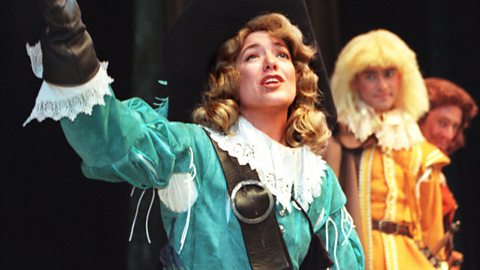
Viola is alone when she comes to Illyria, which would have been dangerous for a woman. She bravely disguises herself as a man to find work and protect herself.
Loyal
Viola (Cesario) is loyal to Orsino, and tries to encourage a relationship between him and Olivia even though she loves Orsino herself.
Passionate
She falls in love quickly and expresses her passionate love for Orsino in poetic language.
Genuine
She is genuine in her love for Orsino. Whereas Orsino and Olivia seem able to switch the focus of their love quickly, Viola remains true to her feelings throughout.
Why does Viola disguise herself as a man?
Viola disguises herself as a man to improve her chances of getting a job. In Shakespeare’s time, women were not treated the same as men and it could be harder for women to find employment.
It could also be dangerous for a woman to be on her own. Disguising herself as a man may have been a form of protection.
Relationships
Viola has a twin brother named Sebastian. When she thinks he has drowned she is devastated, but she is delighted to be reunited with him at the end of the play. When Viola is in disguise as a man called Cesario, she closely resembles Sebastian, and this causes lots of confusion and changes in relationships.
Did you know?
Shakespeare had twin children himself - daughter Judith and son Hamnet. One of his other plays, The Comedy of Errors, also features twins.
Viola (Cesario) works for Orsino and wins his trust quickly. He asks Viola (Cesario) to take his romantic messages to Olivia. This is difficult for Viola (Cesario) as she has fallen in love with Orsino.
The love triangle is complete when Olivia falls in love with Viola (Cesario). Viola feels pity for Olivia, because Olivia thinks Viola is a man and Viola cannot be honest with her.
At the end of the play, everyone’s true identities are revealed and Viola no longer has to disguise herself. She agrees to marry Orsino.
Video - Rehearsing Cesario’s (Viola’s) visit to Olivia
What is the role of a director in a play?
The director of a play is in charge of all aspects of the performance. They make key decisions on everything from lighting to costumes. While practising the play, the director will tell actors where to stand, how to say their lines and how they should move.
Watch the following video to learn how a director might stage the scene.
Presenter: Hello and welcome to The Big Scene. We’re at rehearsals for Twelfth Night and it’s the scene where Olivia falls for Cesario. Simple right? Far from it. You see Cesario is actually a girl called Viola in disguise. Why I hear you ask? Well partly because in Shakespeare’s day she would have been played by a fellow and Shakespeare loved messing around with gender roles and partly because cross dressing meant that Viola could get a job which is funnily enough how I ended up here-get that down!
But the real challenge is can an actress convincingly play a woman and a man in the same play? Luckily it’s not my problem. It’s this guy’s. Good luck mate. You’re going to need it.
Olivia: Are you a comedian?
Viola: No, my profound heart. And yet by the very fangs of malice I swear I am not that I play.
Presenter: We hear that sweetheart. She came in way too high with that voice and the director is surely saying to her you’ve got to go deep if you want to find your man.
Viola: What I am and what would, are as secret as maidenhead.
Presenter: Much better. She came in low and hard with that voice and really nailed it but in front of a big crowd, on a big stage she’s going to need more to her game than that.
Director: Great. The voice is really there but physicality not so much … think of Mike.
Presenter: That’s right. Watch and learn. This actor eats, drinks and sleeps being a man. Largely because he is a man but still, what a pro.
Mike: What?
Presenter: If you want a woman to play a girl playing a boy, then this lady’s your man.
Presenter: Woah hello. Looks like the director wants to try something different here. And it’s controversial. Sure, it’s how Shakespeare would have done it back in the day. but girls weren’t allowed to be actors then so you had to pick a chap to play a girl. This is a whole different ball game.
Mike: ’Tis beauty truly blent. That sort of thing yeah?
Presenter: Is there any place for it in the modern game? I’m not so sure. It’s effective at this point when Viola’s dressed as a fellow but what about when Viola’s meant to be a woman? It’s a big gamble.
Mike: Ready when you are.
Presenter: Oh that is a total disaster. He’s not convincing anyone with play-acting like that.
Mike: What?
Presenter: Oh deary me. The crowd do not want to see that. If that’s not a sending-off offence, I don’t know what is. Unbelievable!
Activity - Order it
What do these key quotations mean?
Whoe’er I woo, myself would be his wife.
Viola
Act 1, scene 4
This is the first line that shows Viola (who is in disguise as Cesario) has fallen in love with Orsino. She has been placed in a difficult position, as she must try and woo Olivia for Orsino, but she wants to marry Orsino herself. To woo someone means to gain their love - this can be done on behalf of someone else, as in this instance when Viola (as Cesario) is wooing Olivia for Orsino.
Poor lady, she were better love a dream.
Viola
Act 2, scene 3
Viola feels pity for Olivia. Her disguise is causing Olivia pain because Cesario (Viola) does not return her love.
I am not what I am.
Viola
Act 3, scene 1
Viola is disguised as a man called Cesario and this causes all sorts of confusion and mistaken identity.
Listen to a scene
In Act 2, scene 4, Orsino and Cesario (Viola) are talking about love. Listen to this audio clip and then answer the question below.
Orsino: What dost thou know?
Viola (Cesario): Too well what love women to men may owe.
In faith, they are as true of heart as we.
My father had a daughter loved a man
As it might be perhaps, were I a woman,
I should your lordship.
Orsino: And what’s her history?
Viola (Cesario): A blank, my lord. She never told her love,
But let concealment, like a worm i’th’bud,
Feed on her damask cheek. She pined in thought,
And with a green and yellow melancholy
She sat like Patience on a monument,
Smiling at grief. Was not this love indeed?
We men may say more, swear more, but indeed
Our shows are more than will: for still we prove
Much in our vows, but little in our love.
What is “She sat like Patience on a monument” an example of?
“She sat like Patience on a monument” is an example of a simile. Viola is here using powerful language while talking to Orsino about love to express her feelings for him. She pretends she has a sister and talks about her sister’s strong feelings of love. Her feelings of love are presented as genuine.
Test your knowledge
Play Bitesize secondary games. game
Have fun playing science, maths, history, geography and language games.

More on Twelfth Night
Find out more by working through a topic
- count4 of 6
- count5 of 6
- count6 of 6
- count1 of 6