Grams and kilograms
Grams (g) and kilograms (kg) are used to describe measurements of mass.
Grams are used for smaller or lighter items. 1,000 grams are equal to 1 kilogram. You can write it like this:
1,000 grams = 1 kilogram
1 gram is very light. A paperclip might have a mass of just one gram.
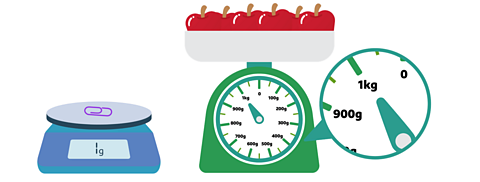
Kilograms are used for heavier items.
1 kilogram is much heavier than 1 gram. 1,000 times heavier!
Together 6 medium-sized apples might have a mass of 1 kilogram.
Quiz: Mass in grams and kilograms
Test out your knowledge of measuring mass with this quiz, then read on to complete the page.
When do you use grams and kilograms?
Measuring how heavy something is can be really useful.
For example, when you bake or cook, you use scales to weigh the ingredients and make sure you have the right amounts.
When measuring mass, you use grams and kilograms.
To read analogue scales, you need to look closely at the marks between the numbers.
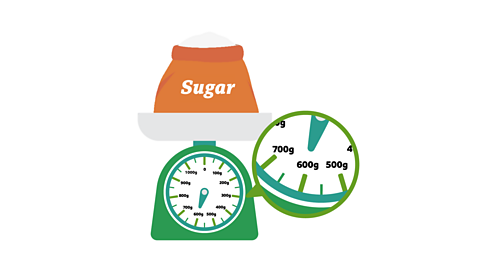
These marks show smaller amounts. Paying attention helps you work out exactly what each mark represents.
The scales also tell you whether you are reading grams or kilograms.
The bag of sugar on these scales measures 600g.
Writing measurements in kilogram and gram
Kilograms (kg) and grams (g) are both units of mass, so they are related.
1 kilogram is equal to 1,000 grams.
This means you can express the same mass in different ways, but it still represents the same amount. For example:
7 grams is equal to seven-thousandths of one kilogram.
This could be written as '7 grams', '7g', '0.007 kilograms' and '0.007kg'.
This shows that the same measurement can be written in grams, in kilograms and grams, or as a decimal in kilograms.
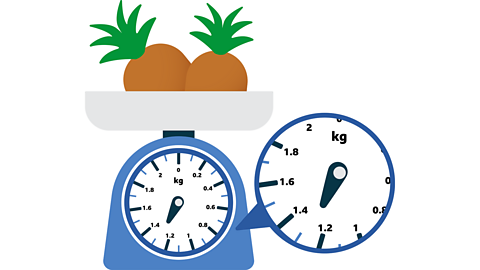
These pineapples have a mass of 1,255 grams.
This could be written using kilograms and grams like this, '1 kilogram 255 grams'.
Or, this could be written as a decimal using kilograms like this, '1.255kg'.
Understanding these different ways to write mass is important because they all represent the same amount, it is just expressed differently.
Converting between grams and kilograms
When converting between grams and kilograms, it is helpful to remember that:
1 kilogram (kg) = 1,000 grams (g)
Look at these scales.
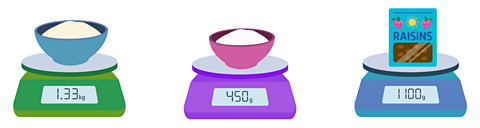
The flour has a mass of 1.33 kilograms. The bowl of sugar has a mass of 450 grams. The raisins have a mass of 1,100 grams.
To compare the mass of the three items you can convert the mass of the flour into grams.
To convert from kilograms to grams you multiply the measurement by 1,000.
1.33 × 1,000 = 1,330
So, the mass of the flour is 1,330 grams. You can then work out that the mass of flour is larger than the mass of the sugar and the raisins.
To convert from grams to kilograms you divide by 1,000.
So, the weight of the raisins in kilograms would be 1.1 kilograms or 1 kilogram 100 grams.
1,100 ÷ 1,000 = 1.1
Explore: Reading weighing scales
Investigate how to read different masses on weighing scales with this interactive activity.
Example 1
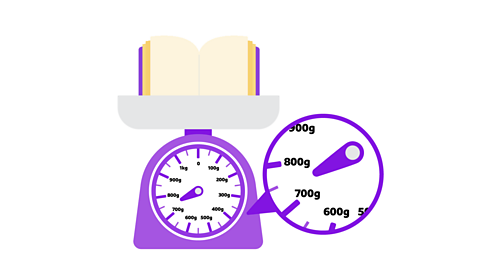
What mass is shown on the scales?
✓ The mass shown is 750g.
When reading scales, the first thing you need to do is look at the intervals and the labels.
Are the measurements in grams or kilograms? What are the intervals going up in? What mass is shown on the scales?
The larger intervals go up in hundreds. Each larger interval is 100 grams.
You can also see there is a smaller interval in between each hundred. This must be 50g since it is the halfway point between hundreds.
The arrow on the scale is pointing at the smaller division between 700g and 800g, so the mass of the fruit must be 750g.
Example 2
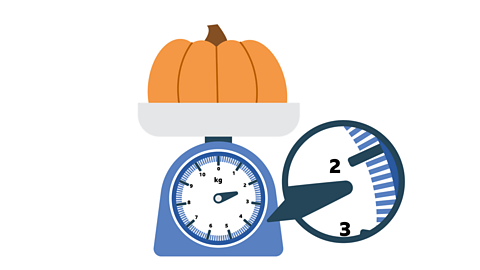
Look at the intervals and labels on these scales.
Is the mass of this pumpkin 2,300g or 2,800g?
✓ The mass shown is 2,300g.
The arrow is between 2kg and 3 kg, but what do the intervals represent?
The kilograms are split into 10 equal parts, so each one must represent 100g since 10 lots of 100g is 1kg.
The arrow is on the third division after 2kg, so the mass of the potatoes is 2kg 300g or 2.3kg
Now, let's work out what 2kg 300g is in grams.
2kg is the same as 2,000g.
2,000g + 300g = 2,300g
You also know that:
2.3 x 1000 = 2,300
So, you can say:
2.3kg = 2,300 grams
Example 3
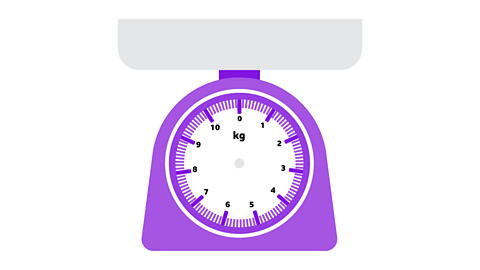
Where on these scales would you draw an arrow to represent the mass of 7kg and 800g?
✓ The mass of 7kg and 800g would be represented with an arrow pointing to the 8th division after the 7kg mark, as shown in this picture.
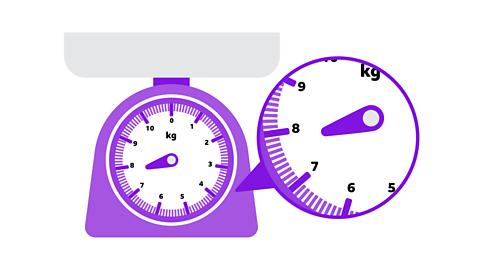
To find this answer, the first thing to do is work out what the smaller divisions represent in-between the whole kilograms.
The kilograms are split into 10 divisions, so each one must represent 100g.
Then find the 8th division after 7kg and draw an arrow to represent 7kg 800g or 7.8kg.
More on Weight and mass
Find out more by working through a topic
- count3 of 3
- count1 of 3