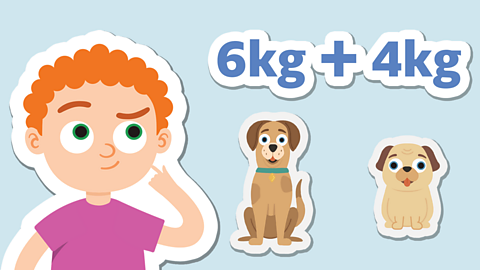
What is mass?

The mass of an object tells you how heavy something is.
You can measure mass in grams (g) and kilograms (kg).
Light items, like apples and bananas, are measured in grams.
Heavy objects, like a toy box or a person, are measured in kilograms
'Kilo' means 'times a thousand' or 'one thousand of'.
1 kilogram is equal to 1000 grams or 1kg = 1000g
Activity: Comparing mass
Complete this interactive activity to understand how to compare mass. Then put your knowledge to the test.
Reading scales
When measuring mass, you use weighing scales. These can be digital or analogue.
On analogue scales, measurements may be marked in grams, kilograms, or both.
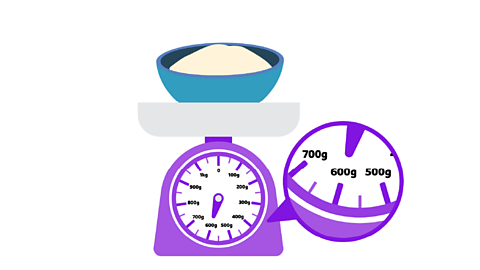
To measure the mass of an item, place it on the scale and read where the scale points.
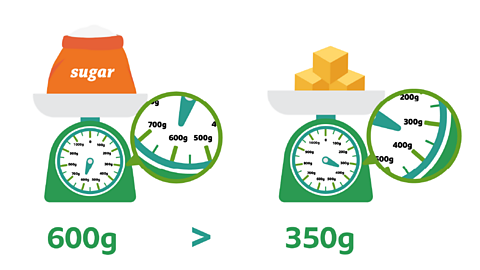
You can use the 'greater than' (>) , 'equal to' (=) or 'less than' (<) signs to help you compare the mass of two objects.
Example 1
On this set of scales you can see there is a small unlabelled mark halfway between each increment of 100g.
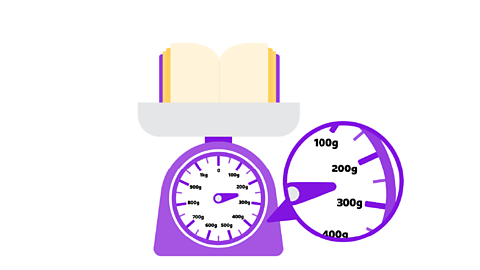
What mass is shown on the scale?
✓ The measurements on the scale go up in 50g. So the mass of the book is 250g.
Example 2
Here are two scales.
On the first scale, the measurements are marked in grams. The scale goes up to 2000 grams.
On the second scale, the measurements are marked in kilograms. The scale goes up to 2 kilograms.
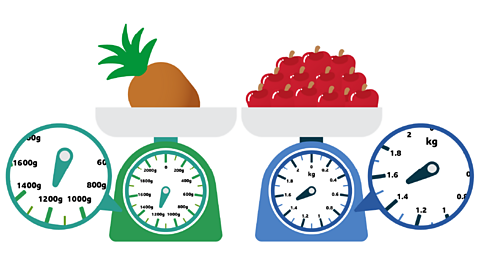
1. What mass is shown on the scale with the pineapple?
✓ 1200 grams.
2. What mass is shown on the scale with the apples?
✓ 1.5 kilograms.
3. Which scale shows the greater mass?
✓ You need to convert the measurements so they are using the same units. Let's convert to grams.
What is 1.5kg in grams?
1kg = 1000g
So 1.5kg is 1500g.
Now you can see that the mass of the apples (1500g) is bigger than the mass of the pineapple (1200g).
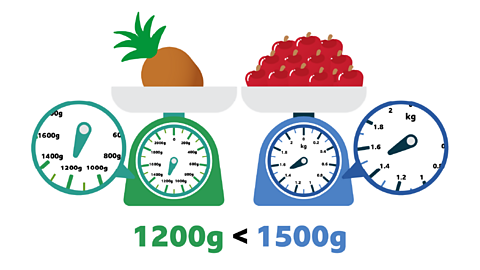
You can use a 'greater than' or 'less than' symbol to show this information.
The tip of the arrow always points to the smaller number.
1200g < 1500g
Example 3
Here is a scale where there are marks between each 100 grams.
The scale goes up to 1000 grams.
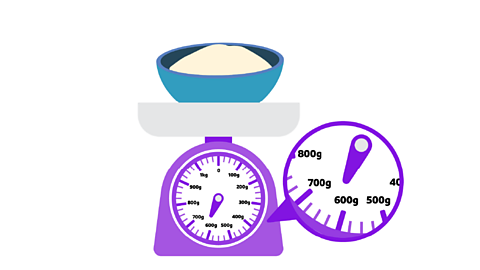
What mass is shown on the scale?
✓ Between each 100 grams there are four parts.
100 ÷ 4 = 25
So each part represents 25 grams.
Therefore the dial is pointing to 625 grams.
Play our fun maths game Guardians: Defenders of Mathematica. game
Use your times tables and more maths skills to defeat monsters and reclaim the Kingdom of Mathematica

More on Weight and mass
Find out more by working through a topic
- count2 of 3
- count3 of 3