Key points
- Pressure in gases is caused by particles When two or more things bump into each other. with the walls of the container.
- Gas pressure is increased when the temperature increases or the volume of the container decreases.
If air is pumped into a bike tyre, does it increase or reduce the air pressure inside the tyre?
The air pressure increases because more air particles are being added to the inside of the tyre.
What is gas pressure?
Video
Watch this video to find out about gas The force applied by a gas or liquid on a specific area., and how it can be increased.
Pressure is caused by gas or liquid particles colliding with the walls of a container.
Think of a bicycle tyre. Pressure increases when particles move faster.
To do that you can either add more particles into the same container, reduced the volume of the container, or increase the temperature.
All of these actions increase the overall force that particles push on the tyre wall per unit area.
What happens to the pressure of a gas if the temperature is increased?
The gas pressure increases. If a gas is heated, its particles move around more quickly. They hit the walls of their container harder and more often, which increases the pressure.
- As the A particle is a single piece of matter from an element or a compound, which is too small to be seen. Particles can be atoms, molecules or ions. of a gas When two or more things bump into each other. with the walls of their container, they exert a force on these walls.
- Gas pressure is the name given to the force exerted by gas particles colliding with the wall of their container.
- Pressure is force exerted over an area.
- Gas pressure is the force exerted by a gas on a specific area.
- A car tyre contains gas under pressure. This means that there are more air particles pushing on the inside of the tyre than on the outside of the tyre.
What would happen to the pressure inside a car tyre if more gas is added?
The pressure would increase because there are more gas particles pushing on the inside of the tyre.
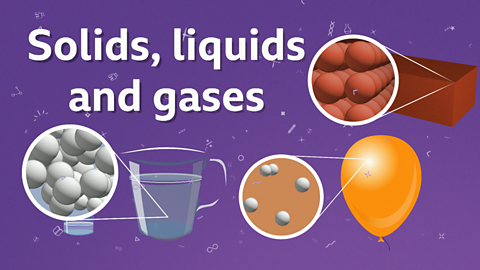
Gases – the particle model
Gas pressure is used in many areas of life such as inflating a balloon, a ball or a tyre.
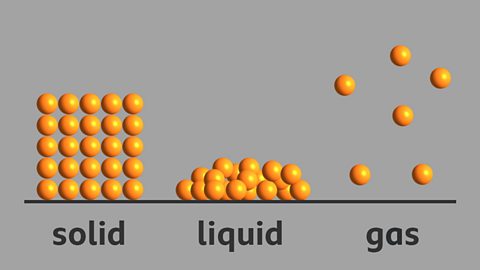
The particles in a gas:
- are spaced widely apart
- can be easily compressed because of the spaces between them
- move at random, quickly and travel in straight lines
- collide with each other and with the sides of their container
- move faster when the gas is hot as the pressure is greater
How do the particles of a gas move?
The particles travel in straight lines, bouncing off each other and the sides of the container so the movement is random.
How does temperature affect pressure?
Increasing the temperature of a gas increases the pressure and the energy of the gas particles.
These higher energy particles move faster, colliding harder and more often with each other and the walls of the container.
How does volume affect pressure?
What happens to the pressure inside a container filled with gas when you squash it?
Look at the picture below.

When the woman pushes down on the physio ball with her weight, the volume of the ball decreases.
Decreasing the volume of the ball causes the pressure inside the ball to increase.
The volume of the ball decreases until the pressure inside the ball balances the woman’s weight.
When you decrease the volume of a sealed container containing a gas, the particles collide with the walls more often, increasing the pressure.
Working scientifically
Making a hypothesis
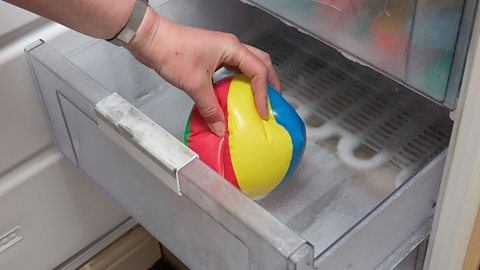
Do you think an inflated beach ball would look the same or different after 30 minutes in the freezer?
Write out what you think would happen to the appearance of the beach ball after 30 minutes in the freezer. Explain why using scientific ideas.
Use this template and fill in the gaps.
When an inflated beach ball is placed into the freezer for 30 minutes, it will appear …
This is because when the gas inside the ball has cooled, the pressure has …
This is because the particles of gas have … energy so there will be … collisions with the walls of the container.
When an inflated beach ball is placed into the freezer for 30 minutes, it will appear deflated.
This is because when the gas inside the ball has cooled, the pressure has decreased.
This is because the particles of gas have less energy so there will be fewer collisions with the walls of the container.
In science, a hypothesis is an educated guess that you can test by investigating.
This is an example of a hypothesis because you could find out if you are right by putting an inflated beach ball in the freezer for 30 minutes.
Find out more about using a hypothesis in science.
Activity
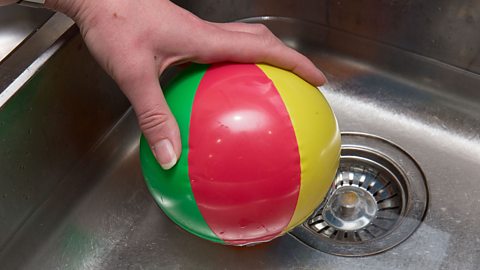
Try this at home to observe changes in gas pressure.
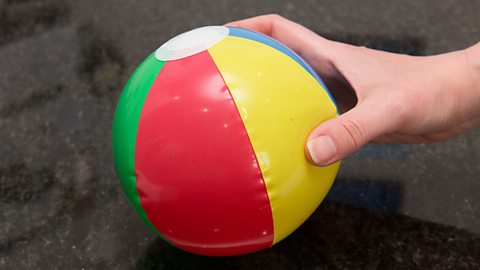
Image caption, 1. Use a small beach ball or a small, empty carbonated drink bottle.
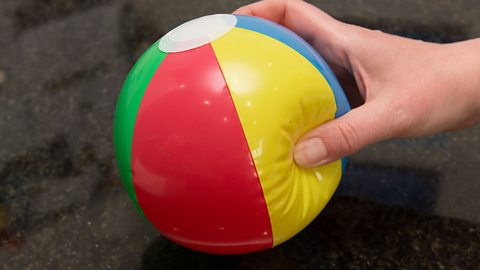
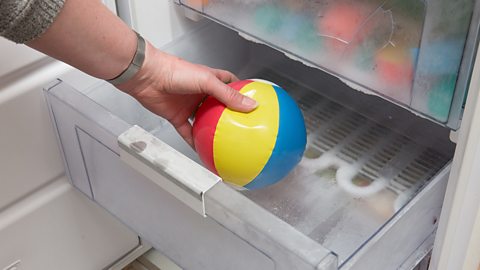
1 of 5
Test your knowledge
Solve the Story!
An exciting new series from the Other Side of the Story, designed to help young people strengthen their media literacy skills.

More on The particle model of matter
Find out more by working through a topic
- count4 of 4

- count1 of 4
- count2 of 4