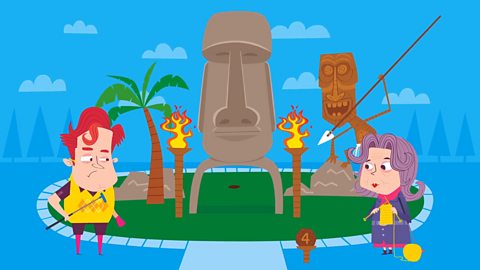
JEFF: How likely is it that Putter's going to make this shot, Janine?
JANINE: The probability? Well he needs to get his ball past that pineapple windmill.
JEFF: The windmill with six segments?
JANINE: That’s the one, Jeff. He’s got three segments covered that he needs to avoid, and three clear segments that he can get his ball through.
JEFF: But what’s the probability of him making the shot?
JANINE: I’m getting there, Jeff. We can do a probability sum.
We can take the number of ways Putter can make his shot, which is three. And divide it with the total number of outcomes, which is six.
So we get three over six.
JEFF: Ah! I get it, Janine. Three divided by six is half. So we can say he has a one in two chance.
JANINE: Oh he’s hit the windmill! Let’s take another look…
JEFF: Yes the Ghost Kid changed the probability, he covered up two more segments.
Meaning Putter only had a one in six chance.
PUTTER: Ahhhhhh!
JANINE: Putter is not happy.
Probability
Probability or chance is how likely something is to happen. If something has a low probability, it is unlikely to happen. If something has a high probability, it is likely to happen.
Probabilities are most commonly shown as fractions. The probability of getting 'tails' when you toss a coin is a 1 in 2 chance, or 1/2.
Probabilities can also be shown as decimals or percentages. A probability of 1/2 can also be shown as 0.5 or 50%
A bag contains three bananas and nothing else.
Probabilities can be shown on a scale between 0 (impossible) and 1 (certain).
The probability of reaching into the bag and pulling out a banana is 1 (certain), as there is nothing else in the bag.
The probability of reaching into the bag and pulling out an apple is 0 (impossible), as there are no apples in the bag.
More on Information and data
Find out more by working through a topic
- count5 of 6

- count6 of 6
- count1 of 6
- count2 of 6