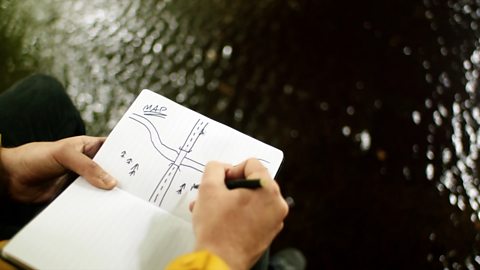
Case study - The Glenarm river
Glenarm river is the perfect place to test the hypothesis that the width of a river should decrease as you move upstream. Get your wellies on!
The geography of the Glenarm river
One of the most exciting things about geography is fieldwork and it can be done anywhere in the world, not just in a field. You can do fieldwork in a range of places, from a busy town centre to a quiet rural meadow. It isn’t about learning dates or remembering equations - it is about exploring.
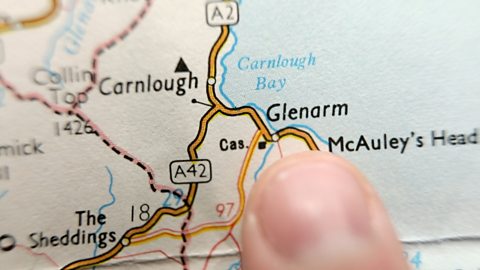
Before conducting any fieldwork, it is important to find out as much information about the place you are going to. Let’s use Glenarm river as an example. The Glenarm River is approximately 5 miles long and is located in the Glens of Antrim, County Antrim in Northern Ireland. The river starts at different places in the Antrim Hills and the water makes its way down hill and eventually flows into the sea at the village of Glenarm. The river is joined by a number of tributaries such as the Linford Water at the top of the glen. A tributary is a river or stream that flows into a larger river or lake.
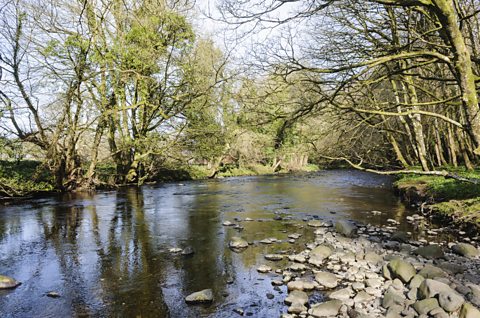
The Glenarm river is a much wider river compared to rivers nearby like the Glencloy and Glenariff rivers. The Glenarm river can be as wide as 17 metres in some parts (mostly close to the mouth in Glenarm).
It can be very difficult to work out exactly where a river starts, at the source, because there are usually a number of different places where small streams and tributaries will begin their journey towards the mouth. The mouth is where a river enters a lake, larger river or the ocean.
The Glenarm river starts across a range small streams in the hills including the Loughdull Burn, Clady Burn, Ballytober Water, Mullaghsandall Burn, Skeagh Water, Capanagh Water, Wolf Water, Shillnovogy Water and Owencloghy Water.
The river has plenty of different types of fish, and you can usually find brown trout, sea trout, salmon and eels. You can also sometimes see otters, but they are hard to spot. There are plenty of opportunities along the river to catch a glimpse of different types of birds such as mallard, heron, dipper or kingfisher.
Establishing a hypothesis before carrying out field work
When doing field work you need to first work out what it is that you are wanting to test or examine along the river. Fieldwork needs to start with a good hypothesis. A hypothesis is a statement that can be either proved or disproved by what you measure in the fieldwork. If you don’t know what you are testing or looking for, your fieldwork won’t have a focus.
Let’s take all we have learnt about the Glenarm River and develop a new hypothesis - different from the one that was explored in the video above.
Hypothesis - as you move downstream in the Glenarm river, its width will increase.
Before testing a hypothesis, it is important to predict what we expect to see (using our knowledge of rivers). In this case – we are expecting to see that up near the source of the river – the river will be narrow (as it is only starting its journey) and that they river will continue to get wider as it gets closer to the mouth.
Primary sources vs secondary sources
When conducting fieldwork, you are gathering information from your own enquiries - we call this a primary source, because it is the first evidence of something happening.
A primary source uses original results as building blocks that can be used to find patterns and trends. Fieldwork is always a primary source, because it is made at the time of an event, or very soon after something has happened. For example, the measurements of the width of the river.
Secondary sources can also be used to help you plan your fieldwork. Secondary sources are created after primary sources and they often help to explain primary sources or data. In doing so, secondary sources can give additional opinions on what the data means or predict what may happen in the future.
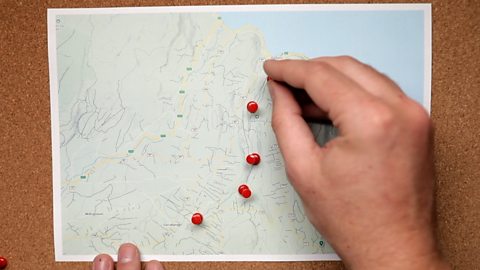
For example - Geography textbooks, maps, biographies, published stories, documentaries of natural environments, art and music recordings are all examples of secondary sources.
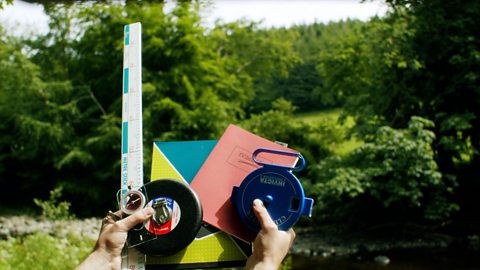
If you want to conduct original fieldwork, you will need to get your own primary data to prove or disprove your hypothesis. Think about what kind of data needs to be collected and the equipment you will need to collect accurate data.
Collecting the data
Hypothesis - as you move downstream in the Glenarm river, its width will increase
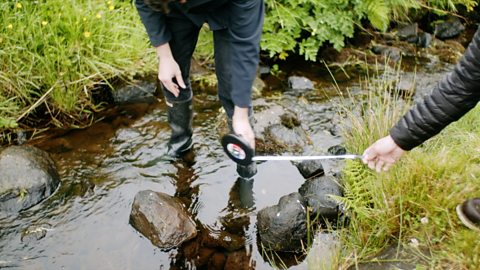
In order to collect the information for this hypothesis – students would have to visit a range of different sites along the course of the river where they will measure the width of the river at each site.
Safety gear – students should wear waders and should have access to a safety rope and ranging poles to help them across the river. Helmets might also be required.
Equipment – long tape measure
Procedure – at each site the students should do the following :
- Stretch the safety rope across the river about 2m above the water level (tie round trees etc)
- Use the tape measure and stretch it from one river bank to the other – across the river. It should be held tight, above the water.
- The measurement is usually taken in metres.
Test yourself
More on Field Work
Find out more by working through a topic
- count2 of 3
- count3 of 3