What are skills and qualities?
There’s a job out there for everyone, no matter what skills they possess.
Filmmaker, matchmaker, flower-arranger, piano-tuner, hedge-pruner, company director, barista. Career possibilities are endless.
Think about the skills, qualities, achievements and attitudes which are needed for the world of work.
| Definition | Example | |
|---|---|---|
| Skills | Something an individual can develop | • Problem Solving • Communication |
| Qualities | Something which a person possesses | • Ambition • Honesty |
| Attitudes | How a person thinks or feels about something | • A positive attitude 'sport is brilliant for improving mental health' |
Skills
There are certain skills which every business will look for, regardless of the role.
Below are the most common ones.
- Literacy: most jobs require the individual to be able to read and write.
- Numeracy: most jobs require the individual to manage basic maths.
- ICT ability: most employers look for people who can use a computer.
Qualities
There are certain qualities that employers need their staff to have to ensure the smooth running of their business.
Commitment: seeing all tasks through to the end. Loyalty: keeping employer's interests at heart. Flexibility: adapting to different tasks or surroundings. Reliability: showing up on time each day, attending meetings on time and refraining from theft. Trustworthiness: building up trust and demonstrating reliability. Honesty: telling the truth, not stealing or misleading people. Teamwork: getting along with others.
The last one is important. Every business has clients or customers.
Every employer is looking for professional people who can get along with each other and customers.
Attitudes
Your attitudes are all about your emotions and how you deal with them. This is difficult to assess for ourselves as our emotions can be hard to describe.
A good way to do this is to ask how your friends might describe you to someone else. They might say that you’re confident, considerate, calm under pressure, organised or good with people.
They could say negative things too. Do you lose your temper easily? Are you shy around new people? This exercise will help you imagine how other people see you, which is important when you’re going for an interview.
Remember that employers want someone who will be a welcome addition to the workforce and this will require a positive attitude.
Achievements
Not every job requires perfect grades, but all employers will look at academic achievements.
Why?
Achievements say a lot about a person’s basic qualities. Success in school means that commitment, loyalty, flexibility, honesty and teamwork have already been demonstrated.
Achievements are also something to consider when thinking about future careers.
Think about preferred subjects - which careers will provide the opportunity for an individual to continue to explore these areas? Don’t forget about extra-curricular activities either - a passion for sports or drama could lead to a career in these fields.
Looking for a job
After assessing all skills, qualities, achievements and attitudes, it’s time to start looking for work.
Where to start?
What to consider when applying for a job?
Application form
Each company or organisation has a different process for recruiting staff. Some might require an application form to be submitted.
An application form will require the individual to provide:
- qualifications
- work experience
- qualities
- skills
- extra-curricular activities and hobbies
CV
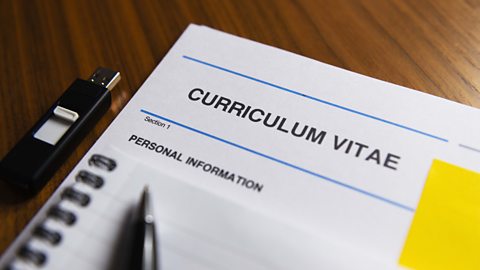
Others will want a Curriculum Vitae (CV).
A CV should include:
- personal details
- qualifications and training
- work experience
- interests
- details of suitable references, these might be from a teacher or a previous employer
Cover letter
A cover letter should accompany the application form or CV. It should be short, introduce the individual and explain why they are applying. There are good examples of cover letters online.
The prospective employer will likely form an opinion or first impression of a candidate based on the quality and content of the application form or CV.
If the application is untidy with spelling and grammatical mistakes, the employer might assume that the individual’s communication and literacy skills are somewhat lacking.
How can a candidate make a good impression?

Remember that any form of written application is the first opportunity an individual has to make a good impression on a potential employer.
They should ensure that spelling, grammar and punctuation are accurate as this will demonstrate that their literacy and communication skills are excellent.
As well as this, they should make sure that they do not exceed any recommended word limit or add something unnecessary to the document as doing so could suggest that they are not able to follow simple instructions.
If they are unsure about a completed application, they should ask someone they trust to proof read it to confirm that it is ready to go!
More on Preparing for employment
Find out more by working through a topic
- count2 of 4

- count3 of 4