What's the next stage in recruitment?
| Interviews | This is the most common form of assessment. A prospective employer will ask the individual to come and meet them for a face-to-face discussion of the role and determine the candidate’s suitability. |
| Telephone conversation | The employer may phone for a chat. They will want to know how well the individual can communicate and to get an outline of their skills and experience. |
| Aptitude testing | Some companies may ask the individual to complete a test of their literacy, numeracy and problem-solving skills. |
| Presentation | Some companies may ask the candidate to give a presentation. It could be based on their own experience, or they may ask them to prepare a talk on a particular topic related to the role. |
| Set a group task | The employer may ask the candidate to perform a task in cooperation with other candidates to judge how well they work with others |
How does an employer assess a candidate's suitability for the job?
How can candidates prepare for a job interview?
The key to doing well in an interview is preparation. There are a lot of things an individual can do before an interview to make sure they perform at their best.
Research the job and the employer
Read the company website and find out what they do, who their clients are and who's in charge. This will give the individual a chance to decide if this is a company that they truly want to work for. They could also research whether this company has opportunity for career progression.
Prepare responses to potential questions and ask someone to play the interviewer.
Typical questions include:
- Why do you want this job?
- What are your strengths?
- What are your weaknesses?
- What do you do when something goes wrong?
As well as helping to prepare responses, a mock interview will also give the individual the opportunity to practice the pitch and pace of responses as well as focusing on eye contact.
Draw on personal experience
Has the individual done anything in the past that relates to the role they’re interviewing for?
Even if previous jobs are very different from the job they are applying for, there will still be opportunities to demonstrate the skills, qualities and attitudes that the employer will be looking for.
For example; a previous role as a retail assistant might not be obviously similar to a potential new role as a Personal Trainer but they do share many skills, qualities and attitudes such as excellent communication skills, customer service, an enthusiastic attitude and numeracy skills!
Practise using the STAR technique
Break answers into four parts to keep them focused:
- Situation — what happened?
- Task — what did you need to do?
- Action — what did you actually do?
- Result — what was the outcome?
How could the STAR technique be used in an interview?
For example:
Interviewer ‘Tell us about an occasion where you have dealt with a disgruntled member of the public’
Response:
SITUATION: ‘In my previous role in retail, I dealt with various disgruntled members of the public. On one particular occasion, the store did not have the size of clothing that the elderly customer required in stock. They were irate as they needed this for a special occasion and had travelled all the way to the store to find this.’
TASK: ‘I wanted to help the customer and reassured them that I would try to locate the garment in the correct size via our online store or from another branch.’
ACTION ‘The first thing I did was check whether this was available online before ringing different branches as I did not want the customer to have to wait for any longer than necessary. I found that the item was available to order online and could be delivered free of charge to either the store of choice or the customers home address.
RESULT ‘The customer was delighted that I had managed to find the item for them. They chose to have it delivered to their home as this was the method of least hassle. They thanked me profusely for helping them and even apologised for their negative attitude.
What are some key points to consider at the interview stage?
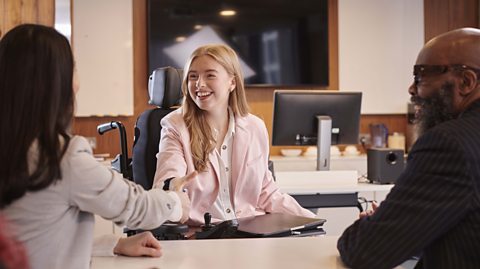
- Interviewers will look at how an individual holds themselves. Don't fidget, play with hair, or chew gum — watch body language.
- An individual should ensure that they are appropriately dressed. They will be representing the company or business and their appearance should reflect this.
- Get as much practice in as possible as this will help with nerves.
- Review any social media presence. Employers will undoubtedly look at a prospective candidate’s social media feeds to see what they are like. The individual should carefully consider what they want them to see and adjust their privacy settings accordingly.
- Think about the journey to the interview. The individual should make sure that they have thought about the time it will take to get there at a particular time of the day. They should show up to the interview early; this shows the potential employer that they have good time management skills.
Why is self-evaluation and reflection important after an interview?
It’s always a good idea to self-evaluate after an interview, to identify what improvements could be made.
The individual should list the questions that they answered well, and those which they didn’t. It is advised to take some time to improve specific answers.
They could also run through their performance with a careers teacher, Learning for Life and Work teacher, or a form teacher.
Watch: What are some of the key ways to ace a job interview?
Getting a job
Narrator:
Job interviews can be nerve wracking. You might be anxious beforehand as you're keen to make a good impression. But the key to success is preparation.
Here's how to get geared up for success.
The first step should always be to research the company, read their website to find out what they do, who their clients are, who's in charge and what kind of skills or qualities they look for.
Go through your CV and consider the types of skills you displayed in your previous work experience or through extracurricular activities. It might be teamwork, leadership, or organisation.
Draw up a list of possible questions and ask someone to pretend to be the interviewer, so you can practise your answers, bringing in the skills you've identified from your CV.
The Star Technique is a great way to break down answers into 4 focused sections.
Practise giving your responses in this format.
Situation. What happened?
Task - what did you need to do?
Activity - what did you do?
Result - what was the outcome?
Interviews are not the time to fidget, play with your hair or chew gum.
Also, make sure you have the appropriate outfit for the interview - best leave the flip flops at home.
Lots of employers today research candidates online to see what kinds of work they've carried out.
Check your social media feeds - to make sure there are no posts or photographs which you might regret.
Find out the location of the interview well in advance and plan your route beforehand. You don't want to end up running late or even worse, getting lost.
Aim to arrive 10 minutes before the interview time.
During the interview, be positive and enthusiastic, answer confidently, making eye contact with your interviewer and smile occasionally.
Most importantly, be yourself.
Oh, and don't forget to switch off your mobile phone.
More on Preparing for employment
Find out more by working through a topic
- count3 of 4
- count1 of 4