International organisations in sub-Saharan Africa
Quick version
The United Nation faces significant issues when it comes to providing aid, including:
- non-payment of contributions by member states
- reduced aid available due to global crises like COVID
- political instability in regions that need support.
Organisations within the United Nations contribute to aid:
- World Food Programme (WFP) supported 152 million people in 2023
- World Health Organisation (WHO)promotes health and has helped extend life expectancy and improved the health of millions of people across sub-Saharan Africa.
Non-governmental organisations (NGOs) play key roles providing assistance, eg:
- Save the Children helped 47.4 million children in 2023
- Oxfam has provided emergency aid in areas including Zambia, Zimbabwe, Malawi and Mozambique.
Learn in more depth
Keep going to learn more on:
United Nations organisations
- World Food Programme (WFP)
- World Health Organisation (WHO)
- Why UN organisations struggle to secure development
Non-Governmental Organisations (NGOSs)
- Save the Children
- Oxfam.
- Why Non-Governmental Organisations (NGOSs) struggle to secure development
Then test how much you have learned.
How well does the UN support development in sub-Saharan Africa?
The United Nations supports development through a number of its own organisations. These provide a range of assistance and aid.
There is evidence that international organisations have both succeeded and failed in securing development in sub-Saharan Africa.
How does the World Food Programme support sub-Saharan Africa?
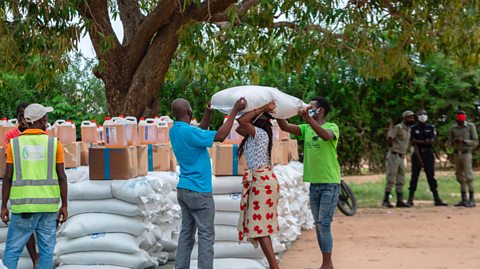 Image source, ALFREDO ZUNIGA / Getty Images
The World Food Programme (WFP) is an agency within the United Nations which aims to prevent and fight hunger. It is entirely funded by donations. Most of this comes from governments, with some coming from corporations and individuals.
WFP was awarded the Nobel Peace Prize in 2020 for its long-standing efforts to deliver food assistance across the world, especially in those areas affected by war and conflict.
In 2024, the World Food Programme supported 124.4 million people in over 120 countries.
Each day the World Food Programme has 5,000 trucks, 132 aircraft and 20 ships on the move delivering food and other assistance, much of it focused on sub-Saharan Africa.
Image source, ALFREDO ZUNIGA / Getty ImagesThe World Food Programme has a range of projects which look to reduce hunger and malnutrition.
50% of WFP’s projected funding needs in 2025 have been targeted towards sub-Saharan Africa. It is estimated $8.4 billion is needed to support its operations where there is conflict, displacement, food insecurity and extreme climate events such as droughts and floods.
In 2025, the WFP are responding to a range of different emergency projects in sub-Saharan Africa, including:
- in Somalia, where recurring drought, floods and conflict have resulted in 4.6 million people facing crisis levels of hunger.
- providing emergency cash and suitably nutritious food to over four million people each month, facing starvation in Sudan due to war, climate extremes and economic disasters.
- as violence by militia groups in the Democratic Republic of Congo has increased, the WFP in 2025 stated it needs $399 million to feed 6.4 million people.
Despite the best efforts of the World Food Programme (and others), there remains a world hunger crisis. Countries in sub-Saharan African are severely affected:
- More than 1 billion people in Africa struggle to afford a healthy diet.
- 30% of African children suffer from stunted growth due to malnutrition.
- An estimated 20% of the population is undernourished in Africa.
- An estimated 868 million people experienced moderate to severe food insecurity in Africa in 2022, with over one-third of those facing severe food insecurity.
(Sources: World Food Programme, Unicef, World Health Organization)
How does the World Health Organization support sub-Saharan Africa?

Established in 1948, the World Health Organization (WHO) aims to promote health and well-being to give everyone, everywhere an equal chance to a safe and healthy life.
In partnership with other agencies, it directs and responds to the world’s health emergencies as well as promoting healthier lives from pregnancy to old age.
In 2024, the WHO adopted its Fourteenth General Programme of Work (GPW 14). This plan sets out the WHO’s global health strategy for the years 2025-2028.
One of its main aims is to ensure the Sustainable Development Goals (SDGs) as they relate to health get back on track after the disruption of COVID.
(Source: World Health Organization)
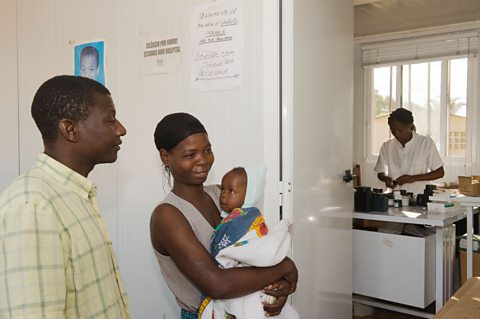
Within sub-Saharan Africa in 2024, the WHO is working to improve health and healthcare on an ongoing basis. Some of its health programmes include :
Lesotho – increasing the number of ICU beds available for very ill patients.
Comoros – working to end the transmission of mother-to-child HIV infection.
Guinea – assisting progress towards eliminating cervical cancer as a public health problem through vaccination, screening and treatment.
Liberia – Halting the spread of Ebola through sexual transmission.
Nigeria – Protecting children from polio virus.
Evidence of success of global health initiatives including the WHO can be found across sub-Saharan Africa. The Atlas of African Health Statistics for 2022 shows that most African countries have seen improving health data over the past decade.
For example, in Angola the adult mortality rate for men and women, and the under-five, infant and neonatal mortality rates have been falling steadily. Also, life expectancy and healthy life expectancy has been rising in recent years although health improvements have been affected by the impact of COVID-19.
Although the World Health Organisation and the agencies with which it partners have helped extend the life expectancy and improved the health of millions of people across sub-Saharan Africa, there remains significant challenges.
For example:
Life expectancy in sub-Saharan Africa was 63 years in 2023 compared to 81.4 years in Europe.
Infant mortality rate in sub-Saharan Africa was 40.6 per 1,000 live births in 2023 compared to Europe at 3.4 deaths per 1,000 live births.
Millions of people continue to die early from poor neonatal conditions, respiratory infections and diarrhoeal diseases, as well as diseases such as HIV/AIDS and malaria.
Why has the UN struggled to secure development in sub-Saharan Africa?
There are many complex reasons why the United Nations has not been more successful in securing development in sub-Saharan Africa:
Non-payment of United Nations assessed contributions
Many countries which are members of the United Nations do not pay their assessed contributions in full.
For example, in 2024, only 152 of the United Nation’s 193 members paid their assessed contribution in full.
Additionally, in recent years, several developed countries, including the UK, Norway, Sweden and Italy, have also cut their overseas aid budget.
Recent major global crises including the COVID-19 pandemic
The increasing impact of climate change and the war in Ukraine have slowed global economic growth and seen reductions in overseas development aid.
These crises has significantly weakened support for sub-Saharan Africa countries. For example, pre-COVID (2019) 19.5% of the sub-Saharan population were undernourished. By 2022, this figure had risen to 22.5%.
Political crises and conflict
Unstable governments and conflict within sub-Saharan countries themselves have also significantly impacted on the United Nation’s ability to secure greater development.
In 2024, there were at least 35 non-international armed conflicts in Africa, including in the Central African Republic, South Sudan and Sudan.
Non-Governmental Organisations (NGOs)
How has Save the Children supported development in sub-Saharan Africa?
Save the Children is one of the world’s largest and best known Non-Governmental Organisations (NGOs) or international charity groups.
Established over 100 years ago, its 24,000 staff work in over 115 countries including the UK and sub-Saharan Africa countries. Funded mainly from institutional and individual voluntary contributions, Save the Children spent £309 million in 2024 on a range of health, education and nutrition projects, as well as emergency relief where crises arose.
Today, Save the Children can point to numerous ongoing development projects which are improving the lives of many of the poorest people in sub-Saharan Africa.
Save the Children programs in 2024 included:
- supporting over 82,000 children through education programmes in Sudan.
- providing lifesaving assistance to over 245,000 people in Burkina Faso, including more than 145,000 children.
- creating 75 A safe, protected area set up during emergencies where children can play, learn, and recover, helping them regain a sense of normalcy after crises. assigned 40 mobile child protection teams to help children at the risk of exploitation or violence, and provided child safeguarding support to over 60,000 children in Somalia.
How has Oxfam supported development in sub-Saharan Africa?
As with Save the Children and many other Non-Governmental Organisations (NGOs), Oxfam provides a range of emergency and development support.
Founded in 1942 and operating within 86 countries, Oxfam aims to reduce poverty across the world as well as respond to emergencies situations as they arise. For example, in 2023/24, Oxfam and its partner agencies:
supported 10.99 million people globally through its humanitarian work - of these 54% were women and girls
provided over 800,000 people in East Africa with emergency humanitarian assistance, including emergency food support
completed fresh water and sanitation projects which supported thousands of people in South Sudan
assisted nearly 30,000 people in Ethiopia with locally produced and distributed food
provided direct cash support to over 5,000 people affected by drought in Kenya
provided solar lights to over 1,100 households in Somalia, which allow people to move around and work safely after dark
(Source: Oxfam)
Why Non-Governmental Organisations (NGOs) have not been successful
Despite the huge support given by hundreds of NGOs globally, the consequences associated with a lack of development in sub-Saharan African countries continues to impact on people’s lives.
For example in sub-Saharan Africa in 2024:
124 million children/young people have not started school or dropped out. Over 250 billion children are out of school.
45% of child deaths are linked to malnutrition. Millions more children suffer from stunted growth development.
16,000 under-fives die each day, many from preventable diseases. Each year, nearly three million babies die in their first month of life.
In 2024, 24 million mothers gave birth without a doctor, midwife or nurse and 28 million women gave birth outside of a health facility.
Every two minutes a mother dies due to pregnancy or childbirth.
(Source: Save the Children, World Health Organization)
Why have NGOs struggled to secure development?
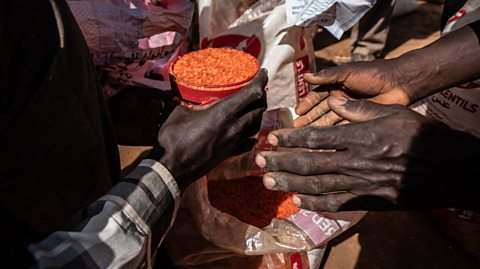 Image source, Giles Clarke / Getty Images
There many complicated reasons why NGOs have not been as successful as they would aim to be in securing development in sub-Saharan Africa.
These reasons include:
Despite raising hundreds of millions of pounds every year to support development, NGOs lack sufficient resources to achieve their targets. Even working in conjunction with the United Nations and other multilateral organisations and/or developed governments, the scale of the development challenge in sub-Saharan Africa (and globally) is immense. NGOs lack the capacity to fully tackle the lack of development in sub-Saharan Africa.
NGOs often find themselves having to work in some of the most difficult of circumstances where conflict and poor governance does not allow them to operate freely or safely.
Those working for NGOs are themselves at risk due to conflict and criminal activity.For example:
- From 2012 to 2023, 142 humanitarian workers in South Sudan lost their lives while carrying out their duties.
(Source: United Nations Office for the Coordination of Humanitarian Affairs)
- In 2023, 34 aid workers were killed in targeted revenge attacks in violent regions in South Sudan and in Sudan, 25 aid workers have died as a result of fighting between the Sudanese Armed Forces and Rapid Support Forces.
(Source: Institute for Security Studies)
Image source, Giles Clarke / Getty ImagesQuiz
Recap what you have learned
International organisations have seen mixed success in promoting development in sub-Saharan Africa.
United Nations organisations include:
- The World Food Programme (WFP) which delivers food assistance across the world.
- The World Health Organisation (WHO) which aims to promote health to give everyone, everywhere an equal chance to a safe and healthy life.
- In 2023, the WFP supported 152 million people across 120 countries, much of it focused on sub-Saharan Africa.
- The WHO programmes in sub-Saharan Africa focus on improving healthcare infrastructure, HIV transmission prevention, cervical cancer, Ebola, and polio.
Challenges for the UN include:
- members not paying their assessed contributions in full
- a reduction in overseas aid due to global crises (e.g., COVID, climate change, war in Ukraine)
- internal conflicts and political instability within sub-Saharan countries
Non-governmental organisations (NGOs) include organisations such as Save the Children and Oxfam.
- In 2023, Save the Children supported 47.4 million children globally through education, health, and nutrition programmes.
- Oxfam provided emergency aid, food assistance, and sanitation projects to millions across Africa in 2023/24.
Challenges for NGOs include:
- lacking the capacity to fully tackle the lack of development in sub-Saharan Africa
- operating in conflict zones (e.g. South Sudan) with high risks to aid workers
- criticism over resource management and accountability
More on Underdevelopment in Africa
Find out more by working through a topic
- count9 of 9
- count1 of 9