Development in sub-Saharan Africa
Quick version
Development is the process where a country makes progress resulting in an improvement in the living standards of its people.
Features of developed countries include: a high income, good education, high life expectancy, low child mortality, and good healthcare systems.
Features of less developed countries include: a low income, lack of education, low life expectancy, high child mortality, and poor healthcare systems.
The United Nations compare countries' development using the Human Development Index (HDI) which is based on life expectancy, education, and Gross National Income (GNI) per person.
The HDI categorises countries into four levels which are very high, high, medium and low human development.
Video - Development in Africa
Watch this video to learn how Africa is growing rapidly in some areas due to a young population and rich resources but also faces challenges including poor healthcare, large debts, unstable governments, and climate change.
Watch this video to find out about development in Africa.
The continent of Africa is made up of 54 countries.
Those that lie south of the Sahara Desert are referred to as Sub-Saharan Africa.
This area contains some of the fastest growing economies in the world.
It's home to over a billion people, and that's increasing fast.
A large workforce, a rich supply of natural resources and increased foreign investment are all contributing to economic growth.
But African countries face many social, economic and political challengesto their development.
A lack of health infrastructure and trained doctors and illnesses,including malaria and HIV/AIDS makes many African countries vulnerable.
These illnesses have high mortality rates and can leave people unableto stay in work or education, resulting in low rates of production and economic growth.
In many African countries, women and girls are overlooked from aspects of education and health care.
If more girls were taught to the same level as boys and women had better health education and care, a huge potential workforce could be able to improve their own incomes while contributing to the economy.
Many countries in Africa have borrowed large amounts of money from other countries and corporations to develop their economy.
But often, when borrowed money is used to pay off more urgent debts,these countries are left with huge loans to pay and are unable to invest in industry, education, infrastructure and health care.
The unstable political conditions of some African countries can create further problems.
Conflict can put strains on medical services and cause a loss of life.
If people of working age are fighting wars, they're unable to work or study.
Land is damaged, infrastructure destroyed and money is invested in weapons rather than development projects.
In these situations, people flee their homes or become expelled from their communities.
Agricultural production stops, economic progress is thrown into chaos and poverty increases.
Ethiopia, South Sudan and the Central African Republic are all countries that have recently faced armed conflicts and civil wars.
Many development issues are being made worse by climate change.
Devastating floods, intense heat waves and periods of drought can cause crop failures, which lead to food crisis and famine.
Climate change can also lead to population displacement and damage to vital infrastructure and services.
This increases pressure on the economies of African countries, which must try to balance the need for development with addressing these additional challenges.
Learn in more depth
Keep going to learn:
- What is meant by development?
- What are features of developed countries?
- What are features of less developed countries?
- What is the United Nations Development Index?
Then test how much you have learned.
What is meant by development?
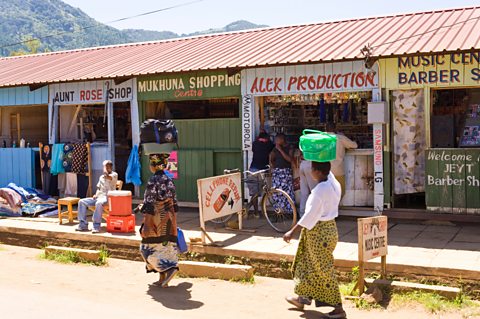 Image source, Stephen Dorey ABIPP/Alamy
 Development is the process whereby a country makes progress which results in an improvement in the living standards of its people.
This may be evidenced, for example, by rising life expectancy (the age to which people are expected to live to), rising rates of literacy (ability to read and write) or rising income levels.
Development is the term used to describe improvements in living standards.
What are levels of development?
Those countries with high standards of living are sometimes described as developed whereas those countries with a low standard of living can be described as less developed or developing.
Features of developed countries
Countries described as developed have the following features in common:
High income
High levels of education
Long life expectancy
Low levels of child mortality (deaths)
Good healthcare systems
Features of less developed countries
Countries described as less developed have the following features in common:
Low income
Low levels of education
Low life expectancy
Higher levels of child mortality (deaths)
Poor healthcare systems
Human Development Index
Since 1990, the United Nations (UN) has measured development across the countries of the world. The UN uses the Human Development Index (HDI) to compare the extent to which the people of a country achieve their full capabilities – longevity (long life) and educational experience - as well as the Gross National Income (GNI) per person.
The United Nations Development Index assesses 193 nations and has four levels of development:
Very high human development. 74 countries in the world are ranked at this level of development.
High human development. 50 countries are ranked at this level of development.
Medium human development. 43 countries are ranked as this level.
Low human development. 26 countries are ranked at this level.
(HDI 2025)
Comparing levels of development in different countries 2022
The UN Human Development Index ranks countries from 1 for the country with the highest HDI, to 193 for the country with the lowest HDI.
Look at the tables below to see how level of HDI reflects income, life expectancy and mean (average) years of schooling.
Very High Human Development Countries
| UN Human Development Index rank (lowest is best) | Income per person per year $ | Life expectancy years | Mean years of schooling | |
|---|---|---|---|---|
| Switzerland (first) | 1 | 69,433 | 84.3 | 13.9 |
| United Kingdom | 15 | 46,624 | 82.2 | 13.4 |
| United States | 20 | 65,565 | 78.2 | 13.6 |
High Human Development Countries
| UN Human Development Index rank (lowest is best) | Income per person per year $ | Life expectancy years | Mean years of schooling | |
|---|---|---|---|---|
| China | 75 | 18,025 | 78.6 | 8.1 |
| South Africa | 110 | 413,186 | 61.5 | 11.6 |
Medium Human Development Countries
| UN Human Development Index rank (lowest is best) | Income per person per year $ | Life expectancy years | Mean years of schooling | |
|---|---|---|---|---|
| Bangladesh | 129 | 6,511 | 73.7 | 7.4 |
| Kenya | 146 | 4,808 | 62.1 | 7.7 |
Low Human Development Countries
| UN Human Development Index rank (lowest is best) | Income per person per year $ | Life expectancy years | Mean years of schooling | |
|---|---|---|---|---|
| Nigeria | 161 | 4,755 | 53.6 | 7.6 |
| Ethiopia | 176 | 2,369 | 65.6 | 2.4 |
| Somalia (last) | 193 | 1,072 | 56.1 | 1.9 |
Source: UN Development Reports (2022-23)
Sub-Saharan Africa
The map below shows the least developed countries in the world, according to UN Trade and Development data from August 2024.
The map shows that many of the least developed/poorest countries of the world lie in sub-Saharan Africa. Sub-Saharan Africa refers to all the countries in Africa that lie to the south of the Sahara Desert. This includes Sudan, Malawi, Cameroon, Burundi and many more.
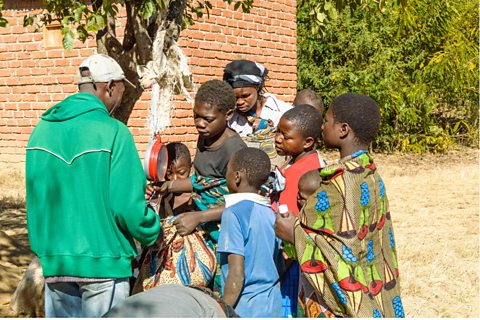 Image source, Julian Lott / Alamy
 As in all countries of the world, there are differences in wealth, life expectancy, infant mortality, etc across the population of sub-Saharan Africa. For example, in Kenya, just like in the UK, some people are wealthy millionaires. In 2024, it was estimated that there were 7,200 people who were dollar millionaires in Kenya and 7.8% of the Kenyan population were also living in extreme poverty.
Differences in living standards can also be found between urban and rural areas, between those with higher levels of education and between men and women. In Kenya, the gender pay gap between men and women was 17.7% in 2023.
A country’s development statistics can hide big differences between different groups of people within the same country.
Image source, Julian Lott / Alamy Quiz
Recap what you have learned
Development aims to improve the standard of living in countries.
Features of developed countries include:
- a high income
- good education
- high life expectancy
- low child mortality
- good healthcare systems.
Features of less developed countries include:
- low income
- lack of education
- low life expectancy
- high child mortality
- poor healthcare systems.
The Human Development Index (HDI) compares countries development, based on life expectancy, education, and Gross National Income (GNI) per person.
Many of the poorest countries of the world lie in Sub-Saharan Africa.
Differences in living standards can also be found within individual countries between:
- urban and rural areas
- those with different levels of education
- men and women
More on Underdevelopment in Africa
Find out more by working through a topic
- count5 of 9