What is electricity?
Electricity is all around us. We can even find it in nature - in the lightning that comes from the sky during a storm.
It is most commonly known as the energy that we use in our everyday lives to make things work.
Our lives would be very different without it.
Electricity is created by generators which can be powered by gas, coal, oil, wind or solar.
Electrcity can be extremely dangerous, so be careful when using electrical appliances.
Watch: What is electricity?
Fran: Electricity!
It is all around us - powering our devices, kitchen appliances and even some cars!
But what is it?
Generally, electricity comes from two sources: either mains electricity, like with this hairdryer or from batteries, like with this toy.
It's the electricity that makes them heat up, move, spin and even dance!
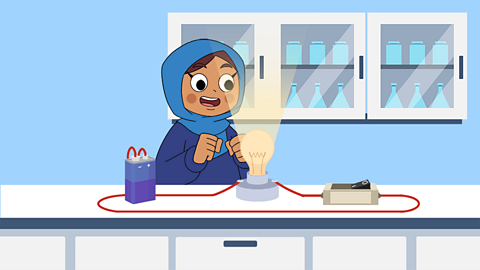
We want to light this bulb.
And to do that we need to make a circuit.
In our circuit, there will be a battery which connects to this light bulb using these wires.
And a circuit is a path around which electricity can flow.
So, we can connect this wire up to the battery and the lightbulb, and then another wire in here to complete the circuit, and voila!
The bulb comes on.
If we break the connection, then the electricity stops flowing and the bulb goes out.
I've sent one of my researchers to find out more about the electricity around us.
Child: How many electrical appliances do you think you'd find in your house?
Let's count and see.
That was a lot!
Phew.
We're constantly using things powered by electricity.
Every time these two metals touch the circuit completes.
The electricity flows through the circuit and makes the light flash and the buzzer sound.
I think I need more practise!
Fran: So, remember, the next time you are using a device, that it's electricity that is making it all possible!
Watch: Electricity and its uses
Discover where electricity comes from and how it is used.
Woah, electricity, man, it might look cool, but it’s really dangerous!
It’s all around us – powering stuff, in those plug sockets and stored in those batteries.
Created by far away generators – powered by gas, oil, wind and solar energy.
Let's get this experiment going!
Electricity can produce light, sound, movement and heat.
You’ve created toast – sweet!
Fascinating facts
The person who discovered that natural electricity creates energy which could be used as a source of power was an American scientist called Benjamin Franklin in 1752.
When we have a storm, lightning is formed by natural static electricity.
Electricity can travel close to the speed of light at almost 186,000 miles per second.
Thomas Edison invented the light bulb in 1879.
Diamonds need a small zap of electricity to form.
Lightning strikes around eight million times a day across the world.
Scientists have discovered that when bees swarm they create a small electrical field.
Slideshow: Where does electricity come from?
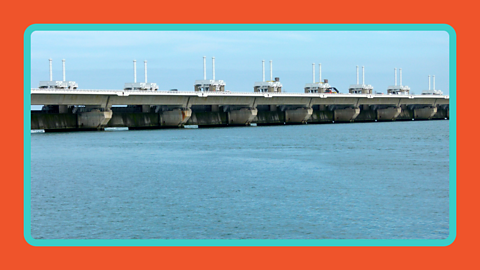
To be able to use electricity in our home, shops, schools and other places, it first has to be made.
Electricity can be made in lots of different ways, and some are better for the environment that others.
Electricity can be made by:
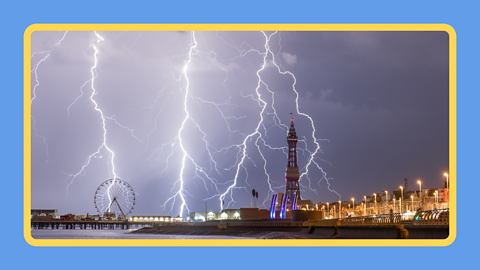
Image caption, Lightning
Lightning is a naturally generated electrical charge that flows from a cloud down to the ground in a zig-zag path during storms.
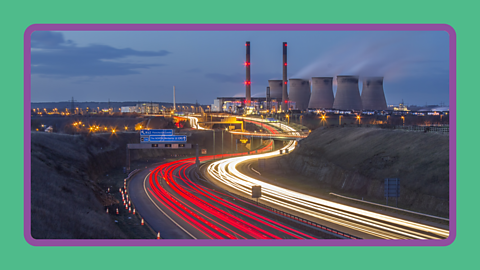
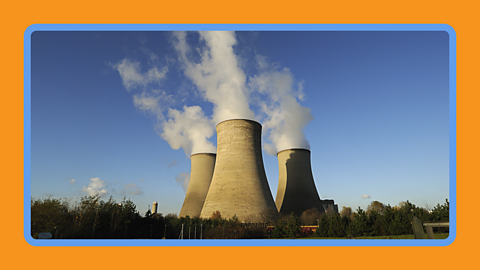
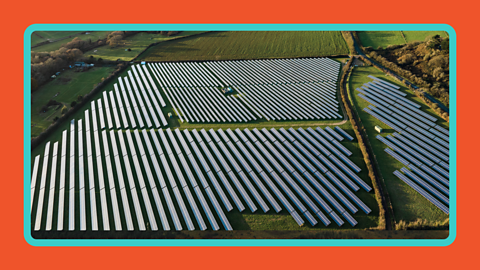
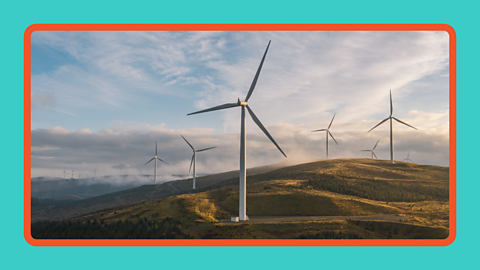
1 of 6
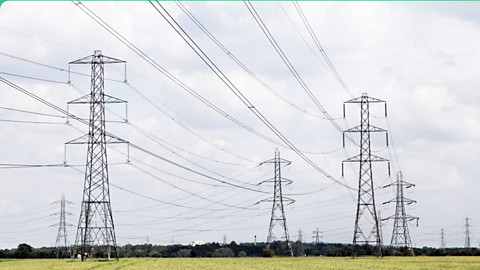
Once electricity is created it needs to travel from the power station to where it is needed, such as our houses, shops and schools.
It does this by travelling through wires and cables above the ground or below the ground.
You may have seen cables running overhead from pylon to pylon, like in this picture.
How do we use electricity?
Once electricity is created, it travels through large wires and cables, often carried by large pylons, to places where it is needed.
The electricity that runs to our houses is called mains electricity.
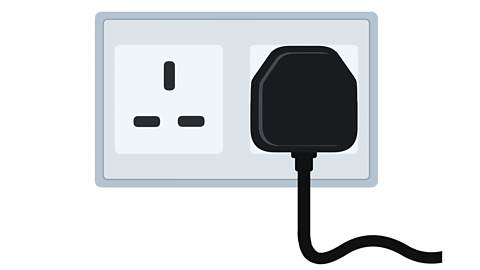
The mains electricity travels through smaller wires that are inside the walls of our houses and take the electricity to the plug sockets that are on the walls.
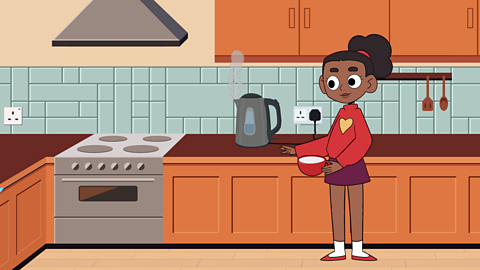
When you plug an electrical appliance into a plug socket and turn it on, the electricity flows into the appliance and makes it work.
We can also use electricity in other ways in our homes.
Batteries turn chemical energy into small amounts of electrical energy. We use batteries to power small electrical appliances, such as toys, and things that we need to move around, such as electric cars.
What does electricity do?
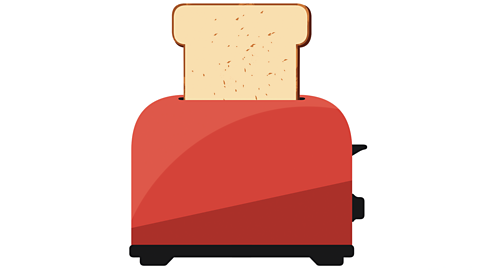
Electricity makes things work in different ways.
It can generate:
Movement
Heat
Light
Sound
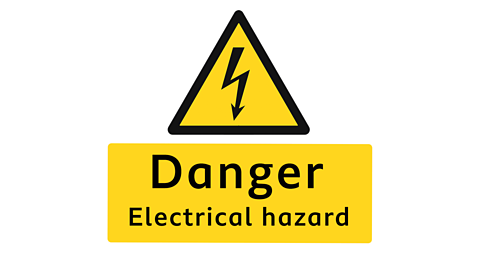
WARNING
Electricity can be dangerous.
Make sure you ask a parent or guardian to help you when using electrical equipment.
Plug sockets and wires always have a plastic cover or coating on them which helps to protect us from electric shocks.
Never put anything other than a plug into a plug socket.
Important words
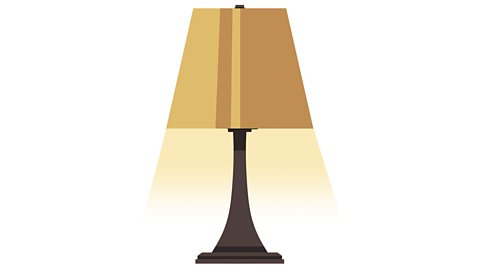
Appliances – A device or piece of equipment designed to perform a specific task, such as light bulbs, a fridge or a toaster.
Electricity – The flow of tiny particles called electrons and protons. Electricity is created by generators which can be powered by gas, coal, oil, wind or solar.
Electrical field – A field in the air that surrounds electrically charged particles.
Energy – When something has energy it is able to do work or move. Humans get their energy from food so that they can walk, run and climb.
Environment – The environment is everything that surrounds us, including a; living and non-living things.
Hydro power – Energy that is made by using water. Water spins a turbine and creates movement that can be converted into electrical energy.
Generator – A device that converts mechanical energy into electrical energy.
Nuclear – A chain reaction that creates energy through heat as elements break down.
Plug socket – Plugs provide safe electricity for appliances in our homes and other buildings.
Activities
Activity 1 – What is electricity?
Activity 2 – Sorting appliances
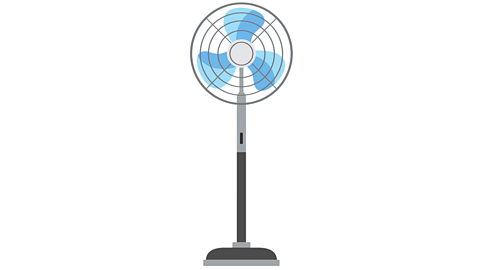
Lots of different appliances use electricity.
- Have a look around the room that you're in and make a list of all the appliances you can see which use electricity.
- Fold a piece of paper paper into four sections. In each section, draw one of the appliances that you can see.
- Underneath each drawing, write what types of energy that appliance produces e.g. light and heat energy.
Which is the most common type of energy produced by all of the appliances?
Activity 3 – Graphite circuits
Use a pencil to create your own graphite circuit with this activity from the Science Museum Group.
Download the activity sheet. document
Create your own graphite circuits in partnership with the Science Museum Group.
Activity 4 – Sort the order of electricity transfer
New game! Horrible Science: Stinky Space. game
Join Pipette on her epic mission and learn some revolting facts about space along the way.

More on Electricity
Find out more by working through a topic
- count2 of 4
- count3 of 4
- count4 of 4