Key points
- Throughout the 1950s and 1960s, many African countries gained their independence from Britain.
- One of the first African colonies to gain independence was the Gold Coast, which became the independent country of Ghana in 1957.
- Ghana’s independence paved the way for other African countries to gain independence soon afterwards.
Video about the fight for Ghanaian independence
Narrator: In the 1950s and 60s, many colonised countries that were part of the British Empire gained their independence. Ghana was one of the first African countries to do this. It had been part of the British Empire since 1874. Europeans referred to the region as the Gold Coast due to the amount of gold found there. After World War Two, the people of the Gold Coast began to push for more control of their economy and their government.
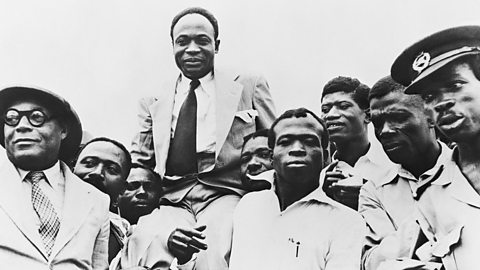
Kwame Nkrumah returned home in 1947 after 12 years studying in America and England. He helped grow the United Gold Coast Convention, a political party that campaigned for independence. But Nkrumah thought the UGCC was working too slowly, so in 1949, he established the Convention People’s Party. The CPP campaigned for independence now with strike action and non-violent protest against the British rule.
When some protests turned violent in 1950, Nkrumah was arrested. The protests and strikes continued. Britain and its allies were also engaged in the Cold War and they were concerned that if they didn’t establish democracy Nkrumah might turn to the Soviet Union for help. Aware of the pressure for democracy but not wanting to grant independence, the British held elections. The CPP launched a nationwide campaign.
They won 34 out of the 38 seats and Nkrumah was elected despite still being imprisoned. He was released and became the first prime minister in 1952. In 1956 Nkrumah asked again for independence. The British called another election to let the people decide. A large majority voted for the CPP and their plan for independence. And on the 6th of March 1957, the Gold Coast became the independent country of Ghana.
The new flag was designed by Theodosia Okoh with the Pan African colours of red, gold and green. The five-pointed star represents the freedom of Africa and unity against colonialism.
The Gold Coast after World War Two
At the end of World War Two in 1945, 65,000 troops from the A group of soldiers from the Gold Coast colony, which is now modern-day Ghana, who fought for Britain during World War Two. returned to the Gold Coast, now known as Ghana, after fighting for Britain.
The Gold Coast Regiment had fought for Britain in East Africa, Burma and the Gambia. Many believed that the service of people from the Gold Coast during the war would encourage the British government to grant the colony independence after Britain had taken control in the 1800s. This seemed even more likely because countries that had been When one country is committed to protect another if they are invaded, or if war is declared against them.of Britain during World War Two, such as the USA and the The Soviet Union existed from 1922 to 1991. It was a state made up of modern-day Russia and several republics that are now independent countries in Eastern Europe and Central Asia, which were under the control of the Soviet government., supported giving British A country, state or territory ruled over by another country, state or territory. their independence.
However, the Gold Coast did not get its independence. Instead, soldiers returned to the Gold Coast to high levels of unemployment and increased taxes. The people of the Gold Coast became more and more frustrated by British rule.
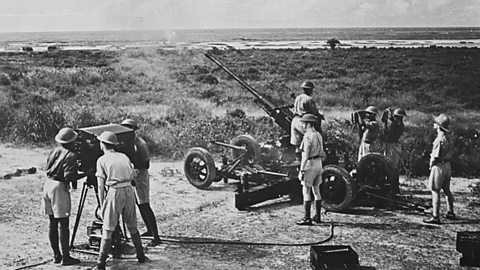
Which African colonies contributed to the British war effort during World War Two?
The Gold Coast Regiment, which sent 65,000 troops to fight for Britain in World War Two, was one of many African colonies that sent soldiers to fight for Britain.
There were also 45,000 Nigerian soldiers who fought for Britain, for example. Altogether, more than 600,000 Black Africans fought for Britain in World War Two. At least 15,000 lost their lives in battle.
As well as contributing soldiers, African countries also supported the war effort by supplying natural resources and materials.
The United Gold Coast Convention Party
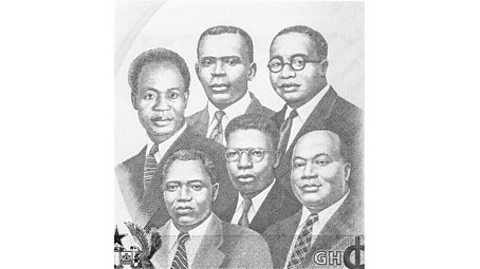
The United Gold Coast Convention party (UGCC) was set up in 1947 by a group known as the Big Six. It aimed to achieve independence from Britain.
Kwame Nkrumah, a political organiser who had studied in Britain and the USA, returned to Ghana to accept the position of The person in charge of the organisation of a group or company. of the UGCC. This was the first political party formed by the local people within the colony, and it was a significant step towards When the government of a country is run by its own people..
The British were under pressure from international allies such as the USA, so they were forced to allow this political party to form peacefully.
The Accra Riots
By 1948, people in the Gold Coast Colony were becoming very frustrated. Of the 65,000 troops in the Gold Coast Regiment, 63,000 were still unemployed.
On 28 February 1948, a group of unarmed former soldiers came together to peacefully protest. They asked the The head of an organisation, group or colony. of the Gold Coast for the payment they had been promised for their contribution to the war.
The British officials stopped the protesters and fired openly into the crowd. Three An ex-member of the armed forces. were killed instantly:
- Sergeant Adjetey
- Corporal Attipoe
- Private Odartey Lamptey
A violent outburst from a crowd. broke out immediately and the UGCC demanded that the British set up a new government led by Africans if they wanted to stop the riots.
The riots carried on for another five days. Shops and stores were To steal someone else's property, usually during a war or riot., and there were more deaths.
The riots ended with the arrest of the UGCC leaders and the British introducing the new Riot Act.
Nkrumah and the Convention People’s Party
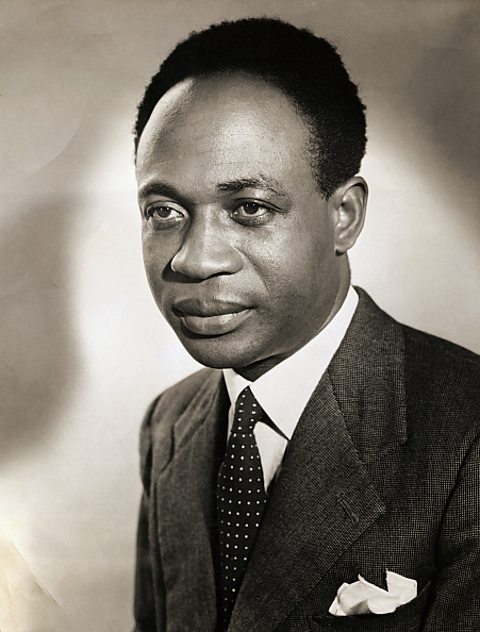
By 1949, Nkrumah made it clear that he thought the UGCC was not doing enough to push for independence. He set up the Convention People’s Party (CPP). He planned to use non-violent protests under the slogan ‘Self Government Now!’ to achieve independence in the Gold Coast’s immediate future.
Nkrumah was supported by people like Mabel Dove Danquah, who would become the first woman elected to the Legislative Assembly of the Gold Coast in 1954.
The British responded to this growing support by inviting the Big Six to draw up a new constitution for the Gold Coast in 1950, but they did not invite Nkrumah. Nkrumah was worried that the other members of the Big Six would agree to something less than full self-government through the new constitution, so he called a When many people across a country, who work in lots of different industries, refuse to work in protest against something they think is unjust. through the CPP.
Despite calling for peaceful protest, Nkrumah was blamed when the protests turned violent and he was arrested and sentenced to three years in prison.
How did Mabel Dove Danquah contribute to the Ghanaian independence movement?
Mabel Dove Danquah used her experience as a journalist and newspaper editor - she was the second woman to edit a newspaper in the Gold Coast - to share her views on independence.
She wrote regularly in The Times of West Africa, which was one of the Gold Coast’s first newspapers. It was first published in 1932.
Danquah went on to become a major supporter of the CPP, and recruited many women to their cause.
Gold Coast elections and independence
As Britain was involved in the Cold War, the British government was worried that if they did not respond to the ongoing protests and allow a democratic election in the Gold Coast, the leaders might form an alliance with the communist The Soviet Union existed from 1922 to 1991. It was a state made up of modern-day Russia and several republics that are now independent countries in Eastern Europe and Central Asia, which were under the control of the Soviet government. in order to get the election they desired. This would be a huge loss for Britain as they would lose an ally in Africa.
In 1951 the British government agreed to hold national elections in the Gold Coast. The CPP won 34 out of 38 seats and Nkrumah was made leader of the Gold Coast Colony. With this new position he demanded independence again in 1956. After the CPP won another national vote, this time on independence, the Gold Coast Colony became the independent nation of Ghana on 6 March 1957. Ghanaian Independence Day has been celebrated on 6 March every year since.
A stateswoman, teacher and artist named Theodosia Okoh designed the flag for the new nation. All the colours and symbols represent something different about Ghana.
Most historians would not say that Ghana became independent because of one person, or one group. Many historians argue that Ghana won its independence because lots of different people worked together and took advantage of the circumstances to achieve their goal. For example:
- The UGCC took the first step, which helped other organisations, like the CPP, to grow
- Nkrumah used the frustration after the war and the growing Pan-African movement to build up support for the CPP
- Women helped support and spread the message of independence
- The British government could not afford to keep supressing protests, after the huge cost of World War Two
- The Cold War meant that Britain had to compromise to avoid the Gold Coast becoming a communist ally
What is Pan-Africanism and how did Nkrumah support it?
Pan-Africanism is the idea that African people and people of African descent who live elsewhere have common interests, and that solidarity should be promoted among them. Some Pan-Africanists also believe that all people of African descent should live in unity in one African state. It has become a worldwide movement to help create unity between all people of African descent.
Between 1900 and 2014, eight Pan-African Congresses were held to address the problems faced in Africa that were the result of European colonisation and slavery. Nkrumah, while studying in London, helped organise the fifth Pan-African Congress. It was held in Manchester in 1945, and was attended by people from Britain, the USA, Nigeria, Kenya and Jamaica. Here, Nkrumah shared his support for greater unity between African people and people of African descent.
British Empire overview activity
Learn more about some of the key events in the history of the British Empire with this activity.
Activity - Put the events in order
Independence in other African countries
After Ghana won its independence in 1957, there was a The effect of one event causing a whole chain of further events, like a row of dominoes falling down and knocking each other over. on the rest of the British colonies in Africa.
Several African colonies declared their independence from Britain in the 1960s:
| Year of independence | Name of country after independence |
|---|---|
| 1960 | Somalia, Nigeria |
| 1961 | Sierra Leone, Cameroon, Tanzania |
| 1962 | Uganda |
| 1963 | Kenya |
| 1964 | Zambia |
| 1965 | The Gambia |
| 1966 | Botswana, Lesotho |
| 1968 | Eswatini |
Independence in Kenya
One of the countries that became independent after Ghana was Kenya.
Between 1952 and 1960, a conflict known as the Mau Mau Uprising took place in Kenya. It was fought between several Kenyan tribes, who were angry and frustrated by colonial rule, and the British authorities.
The Mau Mau Uprising did not win independence for Kenya. However, in 1957, Kenyans were allowed to be elected to positions in government.
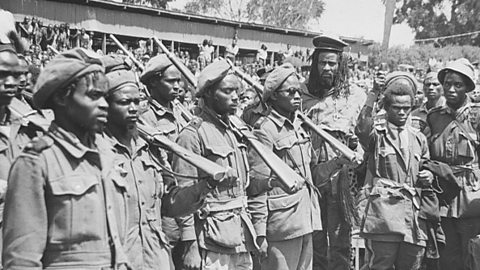
By the 1960s, once the Mau Mau rebellion had ended, the British government agreed to meet with representatives from Kenya to negotiate independence. They agreed on a government that had 33 seats reserved for Black Kenyans and 20 seats for other ethnic groups.
On 1 June 1963, Jomo Kenyatta was made Kenya’s prime minister, to prepare for independence. On 12 December 1963, Kenya was declared independent and officially no longer under British rule after nearly 70 years.
What happened during the Mau Mau Uprising?
In the early 1900s, people from Britain and other European countries migrated to Kenya to settle in areas that were good for farming. This caused problems because they pushed out the Kikuyu tribe, who had lived and worked on that land for hundreds of years. From 1920, the British government introduced laws that protected the British settlers.
By the 1950s a secret group, known as the Mau Mau, started to brutally attack and kill anyone who was loyal to the British government. They targeted Kenyans of white European descent and white settlers, but also other Black African Kenyans if they were suspected of supporting the British government. In 1952, the British government declared a state of emergency. During this period, extreme force and violence was used against thousands of Kenyans, many of whom had no involvement with the Mau Mau.
Many Kenyans were arrested, sent to detention camps and tortured on false charges. Some died while being tortured, others were killed and those who survived were often refused a fair trial to decide whether they were actually part of the Mau Mau. One of the men imprisoned on false charges was Jomo Kenyatta, who became the first Prime Minister of Kenya in 1963.
The Kenyan Human Rights Commission says that 32 white settlers were killed in the state of emergency, and it is estimated that as many as 2,000 Black Africans were killed by the Mau Mau during this period. An estimated 11,000 Kenyans were killed by the British, and many more were tortured. Some historians estimate that 160,000 Kenyans were arrested and held in awful conditions, some of whom were imprisoned for up to seven years. The number of people killed and imprisoned is still being debated by historians today.
Test your knowledge
Play the History Detectives game! game
Analyse and evaluate evidence to uncover some of history’s burning questions in this game.
More on The end of Empire
Find out more by working through a topic
- count3 of 3

- count1 of 3