Introduction to clouds
We can see clouds every day, and there are lots of kinds of clouds.
In this article you can learn:
- What a cloud is
- The process of condensation
- Different types of clouds and the weather they bring
- How to measure cloud cover
This resource is suitable for weather topics for primary school learners.
Video - What is a cloud?
Watch this video to find out how a cloud is formed and about the different types of cloud.
Look up into the sky, and you will more than likely see some clouds. Even on nice warm days, you may see clouds floating by.
But what are clouds?
It might not look like it, but clouds are made from water.
They are formed when water in the air cools down and changes from a gas called water vapour into droplets of liquid water - or even tiny ice crystals. This process is called condensation.
These water droplets are big enough to catch the light so we can see them - but so small and light that they don’t just fall down to the ground. Instead they gather together and make clouds.
There are three main types of clouds to look out for:-
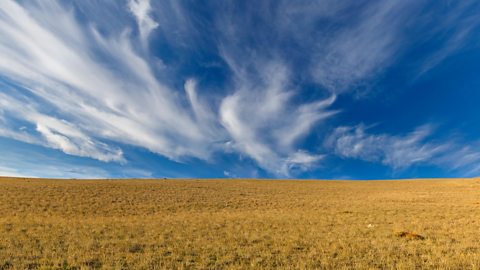
Cirrus. These clouds look like thin wispy feathers. They float high up in the sky around 6000 metres - and are made up of tiny pieces of ice.
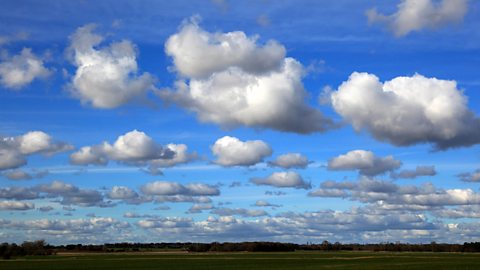
Cumulus. These are puffy clouds that look like cotton wool or candy floss. They usually float between 300 and 2000 meters in the sky and are the type of clouds that might make shapes!
If you spot cumulus clouds, that often means dry weather, so good for a run around or a bike ride in the park. But watch out. Sometimes cumulus clouds grow very big. When they do that means heavy rain showers – and even thunderstorms!
Stratus. These clouds are often flat and don’t move. On overcast days they stretch across the whole sky like a blanket and they can bring steady drizzle.
Stratus clouds float low down in the sky. In fact, sometimes they are so low down they appear near the ground in the form of fog. If you have ever been outside in fog and felt the damp, then you’ve felt what the inside of a cloud feels like.
We add ‘nimbus’ to the names of clouds to describe them when there is rain or snow falling from them. For example, a cumulonimbus is a dark puffy thunder cloud with rain falling out of it. And a nimbostratus is a dark blanket of cloud with rain.
Next time you’re outside, try and work out which type of clouds you can see…and whether you’ll need an umbrella.
How is a cloud formed?
From a distance, clouds might look like cotton wool but they are actually made from water.
Clouds form when the air cools down. This changes Water when it is an invisible gas. into drops of liquid water, or even tiny ice crystals in a process called condensation.
The water droplets are big enough to catch the light and allow us to see them, but so small and light that they hang in the sky and don't fall to the ground.
The water droplets all gather together and make clouds.
Clouds are part of the water cycle.
Different kinds of clouds
Click through this slideshow to learn about the types of clouds you might see in the sky and what kind of weather they bring.
- cirrus
- cumulus
- stratus
- cumulonimbus
- nimbostratus
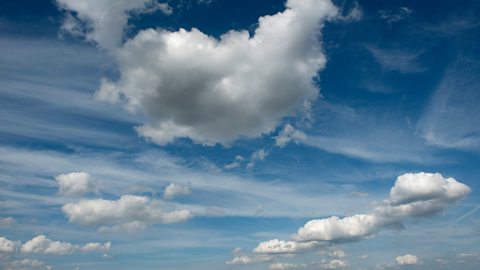
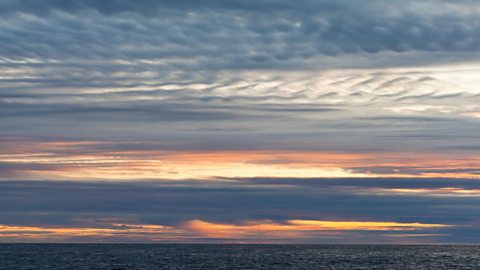
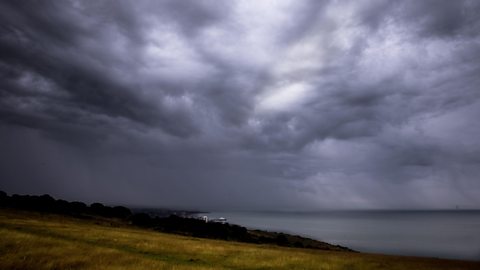
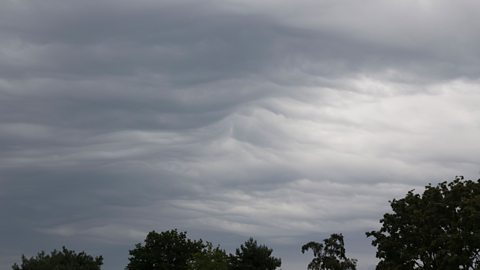
Image caption, Clouds come in all shapes and sizes - let's have a look at some of the most common kinds of clouds.
Did you know that there are lots of different kinds of clouds?
1 of 6
How to measure cloud cover
Video - Measuring cloud cover
Clouds play an important role in what the weather will be like.
With help from BBC Weather's Kawser Quamer, learn:
- Why it is important to measure cloud cover
- How we measure cloud cover with a lux meter
- What lux means
- What the okta scale is
KAWSER: It's a very overcast day today and you can see that on the map by the white clouds across the country. We get a lot of dull weather in Scotland and clouds play a very important role in what the weather will be like.
Let's take a look at how we measure cloud cover and how it can affect our day to day lives.
Different types of cloud can bring different weather conditions. For example, lots of low, heavy clouds can often bring rain. Clear skies with few or no clouds can bring sunshine and warm weather in summertime and cold, frosty conditions in the winter. Some cloud patterns can even tell us when a change of weather is coming.
Pilots and air traffic controllers need to know how much cloud there is and what height it's at. Very low clouds make it difficult to see so planes might change their route to avoid them. So it is very important to have an accurate cloud cover reading.
Solar panels work best when there's no cloud and it's bright and sunny, but they can still make a little electricity when there's some cloud.
Cloud cover can be measured using various apps on your phone.
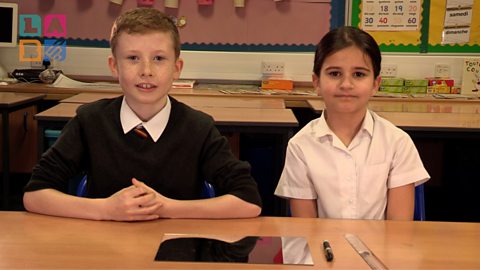
PUPIL: It's really dull.
PUPIL: The app said the lux is 290.
PUPIL: What does that mean?
KAWSER: Lux is the unit for measuring brightness just like we measure length in centimetres. Using a lux meter will tell us how bright the sky is. A dark cloudy sky will give you a low lux reading and a brighter cloudless sky will show a higher number of lux appearing on the meter.
Another way to measure cloud cover is by using estimation. Meteorologists, people who study the weather, use a system called the okta scale.
PUPIL: The sky is completely cloudy today.
PUPIL: That would be eight oktas.
KAWSER: Okta means eight, just like an octagon has eight sides or an octopus has eight legs.
By looking at the sky, you can estimate how many eighths of it are covered with clouds. On the okta scale, zero oktas means no clouds. Four oktas means that half the sky is cloudy and if the sky is completely covered in clouds, it would be eight oktas.
Just remember that when you are measuring cloud cover, don't look at the sky for longer than a few seconds at a time and never, ever look directly at the sun. This could really damage your eyes.
Another way of measuring oktas by yourself is to draw a grid of eight equal sections on a mirror tile like this one. Put it on the ground and count the number of sections in the reflection that are full of clouds. This will let you work out how many oktas of cloud cover there are.
There you have it. Anyone can measure cloud cover by looking up at the sky. So how cloudy is it where you are today?

Key words about clouds
- cirrus - Thin, wispy clouds that look like feathers and which float around 6000m up in the sky.
- cumulus - Puffy clouds that look like cotton wool or candy floss. They usually float between 300 and 2000 meters in the sky.
- stratus - Clouds which often flat and don’t move. On overcast days they stretch across the whole sky like a blanket.
- nimbus - We add the word ‘nimbus’ to the names of clouds to describe them when there is rain or snow falling from them. For example, a cumulonimbus is a dark puffy thundercloud with rain falling out of it.
Test your knowledge
Quiz
Challenge
Measure cloud cover in the sky today.
There are a number of ways you could do this:
- Using a A unit of measurement used to measure light. meter app on a smartphone or tablet.
- Using A guess or opinion. Not based on facts. and the A way of measuring cloud cover. The okta scale divides parts of the sky into 8 equal parts. You can then note how many of the 8 parts were covered in cloud..
- Creating a grid using a mirror tile.
Watch the video above to get more help with measuring cloud cover.
Remember
- Don't look at the sky for longer than a few seconds.
- Never look directly at the sun.
More on Weather
Find out more by working through a topic
- count7 of 22

- count8 of 22
- count9 of 22

- count10 of 22