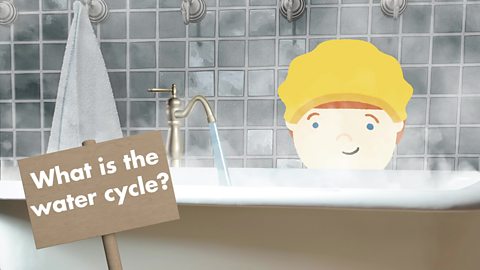
What is fog?
We see fog mainly in autumn and winter. Fog is cold and damp and makes it difficult to see. Where does it come from?
In this article you can learn:
- How fog is formed
- Different types of fog and how we measure it
- The difference between fog and mist
- How different places around the world use fog
This resource is suitable for weather topics for primary school learners.
Video - What is fog?
Watch this video to learn about fog and mist.
You’ve probably seen your breath on a cold day, your own little cloud hanging in the air as you breathe out. These clouds form when water vapour in your breath turns into drops of liquid water.
Just like drops of water forming clouds up in the sky.
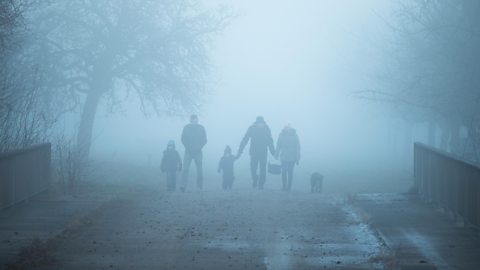
But what if the clouds were not high in the sky? What if they were near the ground? What do you think they would look like? Well, this happens and we call it fog.
Fog is a cloud that has formed near the ground. This usually happens after it's rained and there is lots of water vapour in the air.
When the ground cools down, so does the air near it. When air cools down it can't hold as much water vapour, so the vapour condenses into cloud droplets, which we see as fog.
Weather forecasters describe fog in different ways depending on how thick it is. If you can’t see more than 50m, we call this dense fog. And we describe it as thick fog when you can’t see further than 180m. If the fog is thin enough so that you can see 1km away it’s called mist.
On a clear day you can see much further. Fog will often disappear as the air warms up and the droplets of water evaporate into the air.
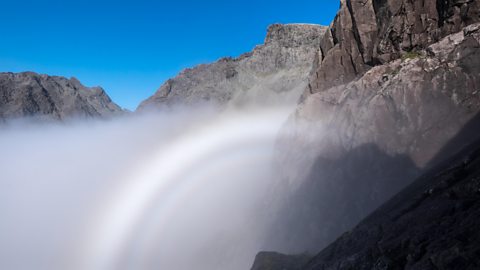
If you are out on a foggy day and the sun comes out, you might catch sight of a fogbow. They are hazier than rainbows and less colourful because the water droplets in fog are tiny, much smaller than raindrops.
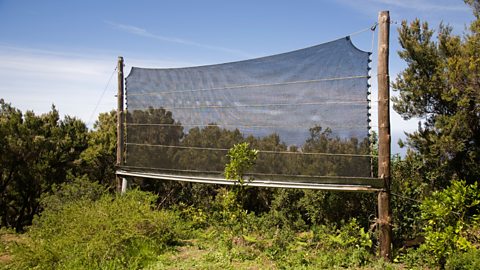
Around the world, in very dry places, fog is an important source of water. The Atacama Desert in Chile is the driest place on Earth. There isn't any rain to collect, so people hang nets that catch the fog, trapping water droplets from the air.
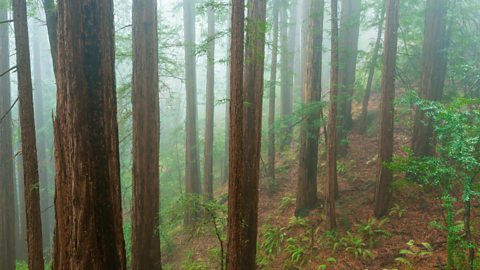
In California, trees called redwoods trap fog coming in from the ocean. When the water droplets reach the redwood, some are stopped by the trees leaves, and drop down to make the surrounding areas wet.
So the next time you’re in foggy weather, remember, this is what walking through a cloud feels like.
How does fog form?
Fog usually appears after rain, when there is a lot of Water when it is an invisible gas. in the air.
When the ground cools down, so does the air near it.
When the air cools down it can't hold so much water vapour.
So the water vapour condenses into cloud droplets - which we see as fog.
Foggy days and fogbows
Click through this slideshow to discover more about fog around the world.
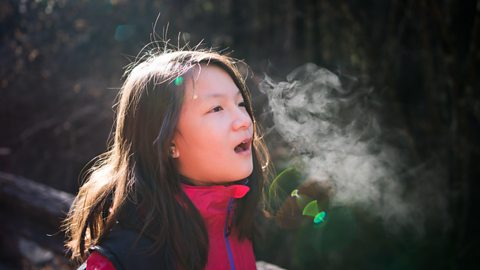
Image caption, Foggy breath
When you breath out on a cold day and see your breath, you're making your own cloud of fog!
1 of 6
What is the difference between fog and mist?
Weather forecasters describe fog in different ways depending on how thick it is.
- dense fog - if you can’t see more than 50 metres ahead of you.
- thick fog - when you can’t see further than 180 metres.
- mist - if the fog is thin enough so that you can see one kilometre away.
Fog of all kinds can affect our lives and the world around us. Learn more here: How does fog affect our daily lives?

Key words about fog
- fog– A cloud that has formed near the ground.
- dense fog – When you can’t see further than 50 metres.
- thick fog – When you can’t see further than 180 metres.
- mist– When the fog is thin enough that you can see one kilometre away.
- fog bow – A fog bow looks like a rainbow, but is pale and hazy instead of colourful.
Test your knowledge
Quiz
Challenge

Create and give a presentation about fog.
This article is full of information about fog and how it can be used in different ways across the world. Can you explain what you have learned in a presentation?
Before you give your presentation, you might want to think about some of these tips:
- Remember to prepare any points, slides and props you might have.
- Think about who your audience is.
- You can use graphs, charts or quotes to support your ideas.
- Make eye contact with the audience and speak clearly.
If you need more help on giving a presentation, here is a video to help: How to give a presentation.
More on Weather
Find out more by working through a topic
- count8 of 22
- count9 of 22

- count10 of 22
- count11 of 22