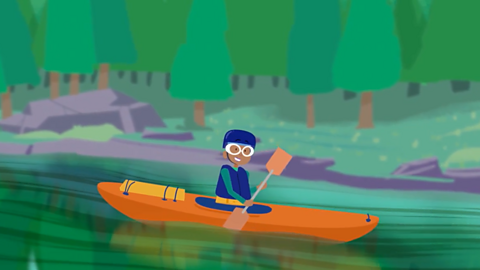
Watch: Mountains
Learn about mountains with Sue Venir.
I’m heading to the top of Mount Elbert, the tallest of all the Rocky Mountains.
The Rocky Mountains, or Rockies for short, is a mountain range that stretches all the way from the USA into Canada.
A mountain range is a group of mountains found on land or under the sea, and they include the Andes in South America, the Himalayas in Asia, the Alps in Europe, or even the Mid-Atlantic Ridge deep in the ocean.
Some mountain ranges are formed when two sections of the Earth’s outer surface, called tectonic plates, push against each other and the pressure forces the ground up.
Not all mountains are formed this way.
Some of the biggest mountains in Britain like Ben Nevis in Scotland and Snowdon in Wales used to be volcanoes.
But they became extinct long ago, and haven’t been active for millions of years.
Here in the Rockies, I’ve been following the rivers that have carved a valley through the mountains.
It’s a sunny day today, but I’m going to have to put on another layer!
That’s because the higher I climb, the colder the temperature is.
If I was to climb a really tall mountain, like Mount Everest, the tallest mountain in the world, I might also need an oxygen mask.
That’s because the higher you go the thinner the air becomes.
Which means there’s less oxygen around to breathe.
I’ve reached the top! And now I need to use my most important piece of equipment. My selfie stick!
What are mountains?
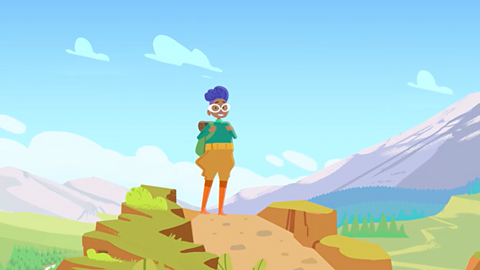
Mountains are areas of land that are much higher than the land surrounding them.
They are higher and usually steeper than a hill and are generally over 600 metres high. They are often found together in a group called a mountain range.
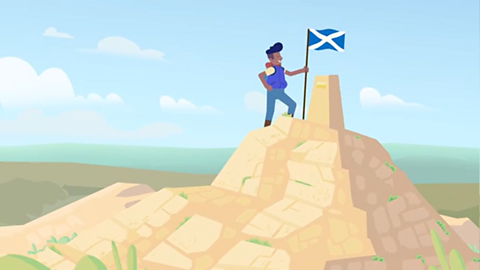
Some well-known mountain ranges in the four countries that make up the UK include:
- the Cairngorms in Scotland
- the Pennines in England
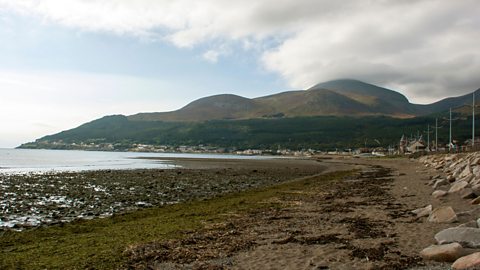
- the Mourne Mountains in Northern Ireland
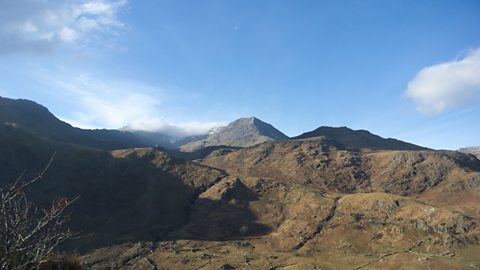
- Snowdonia in Wales
How are mountains formed?
The highest mountain ranges are created by tectonic plates pushing together and forcing the ground up where they meet. This is how the mountains of the Himalayas in Asia were formed.
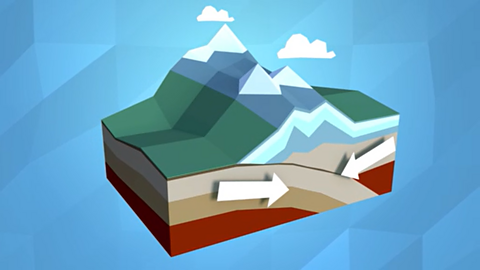
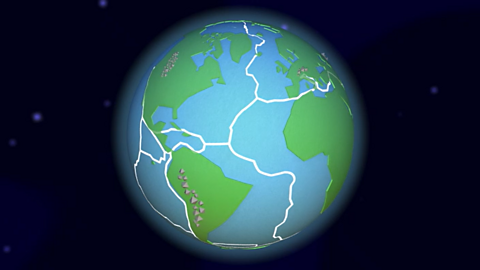
Tectonic plates are also at work under the Atlantic Ocean.
Instead of forcing the ground up, the two plates in the middle of the Atlantic Ocean are actually moving apart in opposite directions.
This causes lava to erupt out of the gap that is left.
As it cools down, the lava creates a long line of mountains under the ocean called the Mid-ocean Ridge - the longest mountain range on Earth.
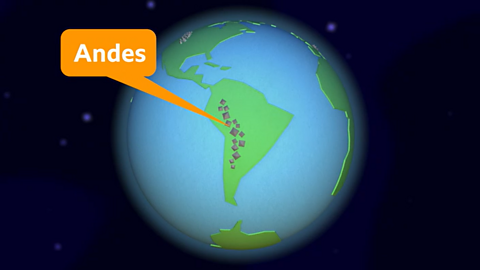
The longest mountain range on land is the Andes in South America. The Andes run for over 7,000km.
Other mountains (usually those that stand on their own) are created by ancient volcanoes.
Ben Nevis in Scotland was once a very large active volcano. It last erupted millions of years ago and the eruption was so violent that it caved in on itself.
Watch: Mount Snowdon
Learn more about Mount Snowdon, the tallest mountain in Wales, in this video from BBC Bitesize for Teachers.
De-Graft:
I’m in Wales, finding out about the country’s tallest mountain - Snowdon. It takes a good few hours to walk up and down it. But thankfully there’s a train you can catch too.
Mountains are high areas, rising more than 600 metres from the surrounding land. And often they’re found in groups called mountain ranges. This is Snowdon. The summit, or top of the mountain, is over 1000m high and it’s part of a mountain range called Snowdonia. Later locals Iola and Oliver are going to be helping me think about climbing mountains and how you can prepare.
But first, let’s zoom out. Snowdon is here in North Wales. The highest mountain in the UK is actually in Scotland and it’s called Ben Nevis. Slieve Donard is the highest in Northern Ireland. And Scafell Pike is the highest mountain in England.
Mount Everest is perhaps the most well-known mountain in the world. It has the highest peak above sea level at 8,848 metres. Mount Everest is part of the Himalayan mountain range in Asia where many of the world’s tallest mountains are found. Earth’s surface is made up of different sections called tectonic plates. Most mountains are fold mountains, which means they’re created when two tectonic plates collide, and they force the ground up where they meet. Like this…
Other mountains are created by ancient volcanoes. These are often individual peaks. Ben Nevis in Scotland and Snowdon here in Wales were once very large active volcanoes. They last erupted millions of years ago. Another cool thing about mountains is that they can affect the weather as clouds carrying water droplets are pushed up and over the physical barrier of the peak, they move into colder air, lose their energy and then drop their load as precipitation: rain, hail, snow or sleet.
I’m meeting Oliver and Iola at the bottom, or base, of Snowdon. We’re packing backpacks to prepare for a hike.
What kind of things do you have in your backpack?
Oliver:
I have an emergency survival kit. First off, we have a whistle, to make sure that people know where you are and if someone is in danger.
Iola:
If you go up the mountain and you get really thirsty, you’re going to need a drink. If you don’t drink, sometimes you can get a bit tired, so it’s good to always stay hydrated.
De-Graft:
Nice. So, we’ve got a map here. Do you guys know what the numbers and lines mean?
Oliver:
The numbers means how high up the mountain is.
Iola:
The more where there's loads of orange lines together, it means that it would be steeper to climb up.
De-Graft:
Yeah, you guys are pretty much there. We call that contours. The closer the lines are to each other, the steeper the hill or the mountain is. The further away they are, the more gentle the slope is. Now we can use contours to help us prepare for a route when we’re hiking, to decide whether we want to hike on a steeper route or a more gentle slope.
What do you think the weather is like at the top of a mountain?
Iola:
I think it would be quite windy and snowy.
De-Graft:
Yeah, you’re right. Did you know that on tall mountains, like Mount Everest, it’s so high up that people need oxygen masks to help them breathe, because the higher up you go the thinner the air gets.
OK, time to compare… Snowdon is the same height as around 240 double decker buses stacked on top of each other! Mont Blanc, one of the tallest mountains in the Alps in Europe, is 4807 metres, over a thousand double deckers tall.
So, is there a hill or mountain near you that you could explore? Why not try and find it on a map? Zoom in and have a look for yourself.
Right, off you go then guys. But, just double checking, there is a train we can get, right? No?
What are the highest mountains in the UK?
The highest mountains in the UK are:
- Ben Nevis in Scotland (also the highest in the UK)
- Scafell Pike in England
- Slieve Donard in Northern Ireland
- Snowdon in Wales
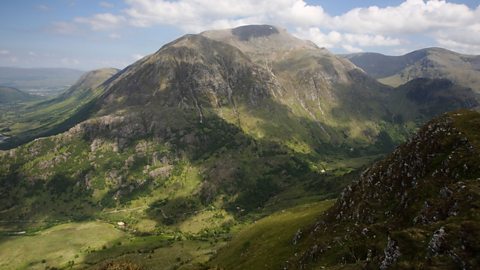
Image caption, Ben Nevis is the highest mountain in Scotland and the UK.
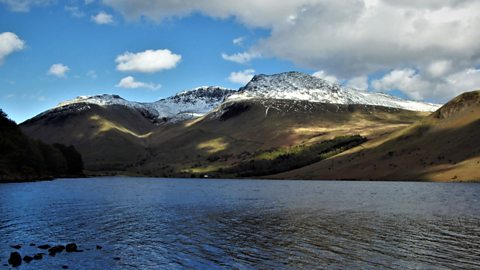
1 of 4
Activity: Quiz – Mountains
Race Across the Continents game - new update! game
Help this team of adventurers race their way to victory. Explore the globe in this exciting game update to discover new audio voiced by Ade Adepitan and fun animations. Challenge yourself with brand-new achievements and become a high-flyer!

More on The natural world
Find out more by working through a topic
- count12 of 16
- count13 of 16

- count14 of 16
- count15 of 16