Quick version
Coastal landscapes are formed by a combination of Erosion is the process of moving the small pieces of rock formed by weathering. Erosion occurs from the action of water or wind. , When sediment (small fragments of rocks and soil) is moved by waves. and When water, that is carrying sediment (small fragments of rocks and soil), loses its energy it drops the material it is carrying. This often builds up to form a beach. processes.
The four processes involved in erosion are:
- A process of erosion involving the force of the waves against the coastline. Air becomes compressed within cracks and crevices, which weakens the rock.
- When rocks and pebbles carried by the waves smash into each other, wearing each other away and gradually becoming smaller, rounder and smoother.
- The process of rocks and pebbles carried by the waves wearing away rocks as they are thrown against cliffs.
- When chemicals in the seawater dissolve minerals in the rocks, causing them to break up.
These contribute to the formation of cliffs, caves, arches and stacks
Differential erosion is when different rock types along the coastline, such as sandstone and clay, erode at different rates.
Differential erosion leads to the formation of headlands and bays.
Coastal landscapes
The map below shows the location of some of the prominent coastal landscapes in the British Isles.
Can you notice anything the highlighted areas have in common?
Although the whole perimeter of the British Isles are coastal landscapes, the areas highlighted in the above map are more exposed parts of land that will as a result attract more extreme weather and in turn, more erosion features.
What causes coastal erosion?
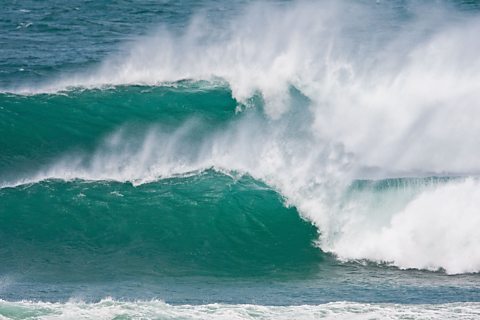
The force of the sea changes the coastal landscape. Waves get their energy from the wind and waves erode, transport and deposit material along the coastline.
The size of the wave is determined by:
- the speed of the wind
- the length of time the wind has been blowing
- the distance of sea it has travelled over (the fetch)
What four processes cause erosion?
Hydraulic action
Hydraulic action is the sheer force of waves crashing against the shore and cliffs. The power of the waves forces air into cracks, compresses it and blows the rock apart as the pressure is released.
Attrition
Attrition happens when rocks and pebbles carried by the waves smash into each other, wearing each other away and gradually becoming smaller, rounder and smoother.
Abrasion
Abrasion (also called corrasion) is the process of rocks and pebbles carried by the waves wearing away rocks as they are thrown against cliffs.
Solution
Solution (also called corrosion) is when chemicals in the seawater dissolve minerals in the rocks, causing them to break up.
Features of coastal erosion
In this video, you can learn about the erosion processes that form cliffs, headlands and bays in coastal landscapes.
Erosion processes that form cliffs, headlands and bays
Here are the areas of coastal erosion found in the UK, such as the north west and north east of Scotland.
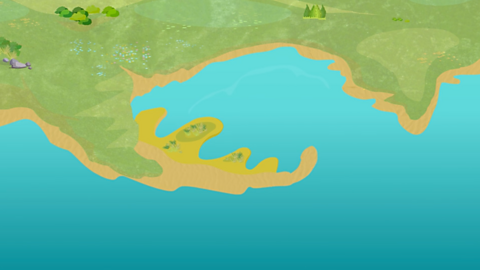
The force of the sea constantly changes the shape of our coastal landscape, like with this headland and bay, created by differential erosion, where rocks are eroded at different rates.
This coastline has areas of clay and sandstone. As clay is a softer rock than the sandstone, it erodes more quickly, moving backwards faster to form sheltered bays.
The harder sandstone is more resistant to erosion and forms exposed headlands.
Cliffs, as well as headlands, formed when there is more resistant rock such as limestone or chalk. Erosion will therefore form at the base where the waves are strongest, creating a wave cut notch beneath.
Eventually, the cliff will collapse and over time retreat backwards.
Headlands, bays and cliffs witness the power of the sea, creating distinctive features on our coastlines and maps.
How is a cliff formed?
usually form where there is harder more Hard rocks which are less easily eroded by the sea. such as A type of sedimentary rock. It is made of calcium carbonate. and A type of sedimentary rock..
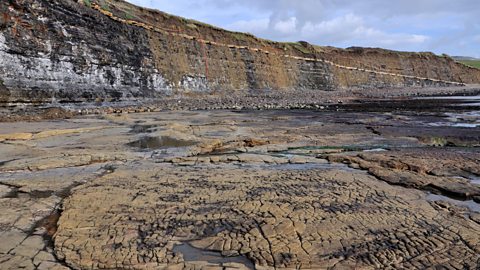
This graphic shows the process of erosion that forms a cliff and wave-cut platform.
Wave erosion is strongest where large waves break against the base of the cliff.
- Cliff is undercut by wave erosion at its base
- A wave-cut notch forms and grows
- Eventually, the cliff becomes unsupported and collapses into the sea
- The cliff retreats and leaves behind a wave-cut platform, which is visible at low tide
How do headlands and bays form?
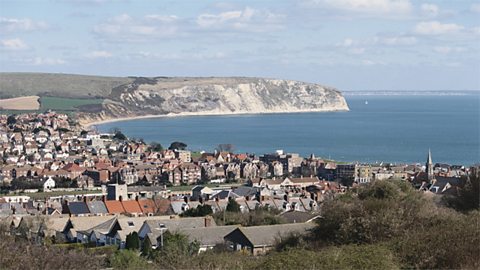
A narrow piece of land that projects from a coastline into the sea. and A section on the coast, where the land curves inwards. are created by When different types of rocks are eroded at different rates..
Rocks along the coastline are formed in Rocks which are laid down in different sections. of different rock types, eg A type of sedimentary rock. and A type of sedimentary rock., which meet the coast at right angles.
This graphic shows the process of erosion that forms headlands and bays.
Rock type
- Clay is a softer rock than the sandstone so is eroded more quickly.
- Softer rocks erode backwards faster to form sheltered A section on the coast, where the land curves inwards. (which may have beaches).
- The harder sandstone areas are more resistant to erosion and jut out into the sea to form exposed headlands.
Features of headland erosion
In this video, you can learn about erosion processes that form sea caves, arches and stacks.
Erosion processes that form sea caves, arches and stacks
The shape of our coastal landscape is constantly changing.
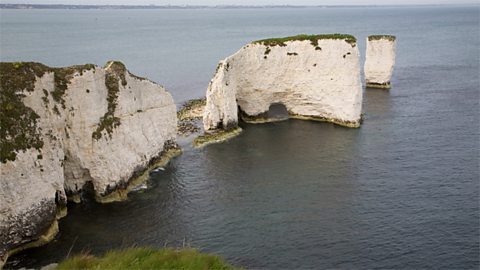
The force of the sea can erode even the hardest headland rock, like with this section of eroded headland with a sea cave, arch and stack. These features are created by the sea. Its waves erode any lines of weakness which increase in size and develop into small sea caves. Eventually, these caves can deepen and widen until the sea cuts all the way through the headland creating an arch.
The rock at the top of the arch becomes unsupported, over time, collapses into the sea, leaving a stack.
Sea caves, arches and stacks. Waves constantly creating these distinctive features on our coastlines.
How are caves, arches and stacks formed?
How did the original A narrow piece of land that projects from a coastline into the sea. become eroded to the present coastal landscape?
A number of stages are involved in the formation of sea caves, arches and stacks:
- All rocks have lines of weakness. The sea and its waves use A process of erosion involving the force of the waves against the coastline. Air becomes compressed within cracks and crevices, which weakens the rock., The process of rocks and pebbles carried by the waves wearing away rocks as they are thrown against cliffs. and When chemicals in the seawater dissolve minerals in the rocks, causing them to break up. to erode along any lines of weakness.
- These lines of weakness get enlarged and develop into small sea caves.
- The Recess in a cliff where waves have enlarged a crack in the rock face. are deepened and widened on both sides of the headland until eventually the sea cuts through the headland, forming an A natural rock formation often created by two sea caves eroading backwards towards each other until the back walls disappears..
- The rock at the top of the arch becomes unsupported as the arch is enlarged, eventually collapsing to form a stack.
- The A pillar of rock left standing in the sea when the top of an arch has collapsed. gets eroded until only a stump remains.
- Over time the stump will disappear.
- As the headland retreats under this erosion, the gently sloping land at the foot of the When the headland moves backwards as it is eroded by the sea. is called a wave-cut platform.
Examples of different headland erosion features
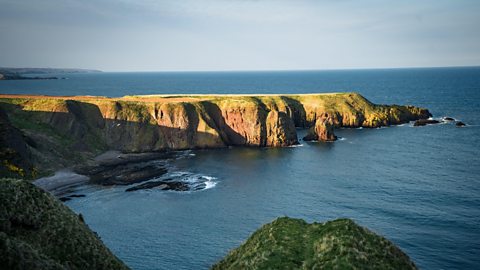
Image caption, Headland
Headlands and bays are created by differential erosion, where rocks along the coastline are formed in alternating bands of different rock types, which meet the coast at right angles, like this rocky headland on the north east coast of Scotland. (Pavel Kasak / Alamy Stock Photo)
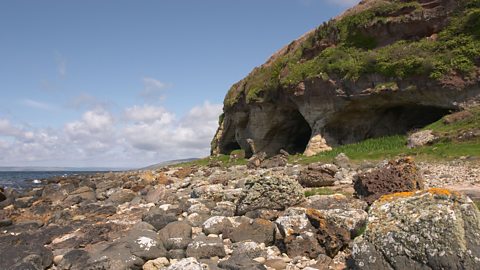
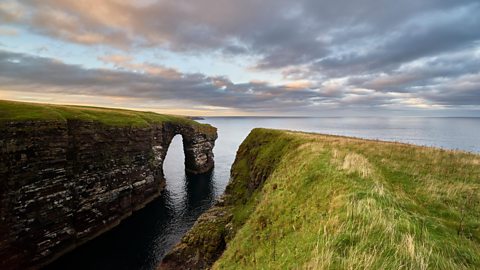
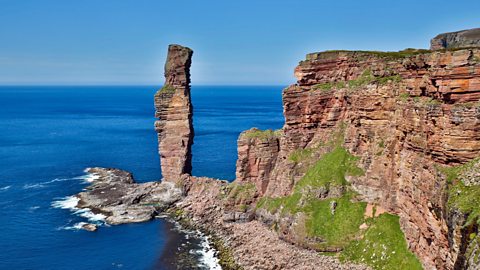
1 of 5
Quiz
Recap
Coastal landscapes are formed by a combination of Erosion is the process of moving the small pieces of rock formed by weathering. Erosion occurs from the action of water or wind. , When sediment (small fragments of rocks and soil) is moved by waves. and When water, that is carrying sediment (small fragments of rocks and soil), loses its energy it drops the material it is carrying. This often builds up to form a beach. processes.
The four processes involved in erosion are:
- A process of erosion involving the force of the waves against the coastline. Air becomes compressed within cracks and crevices, which weakens the rock.
- When rocks and pebbles carried by the waves smash into each other, wearing each other away and gradually becoming smaller, rounder and smoother.
- The process of rocks and pebbles carried by the waves wearing away rocks as they are thrown against cliffs.
- When chemicals in the seawater dissolve minerals in the rocks, causing them to break up.
These contribute to the formation of cliffs, caves, arches and stacks
Differential erosion is when different rock types along the coastline, such as sandstone and clay, erode at different rates.
Differential erosion leads to the formation of headlands and bays.
More on Coastal landscapes
Find out more by working through a topic
- count2 of 2