Quick version
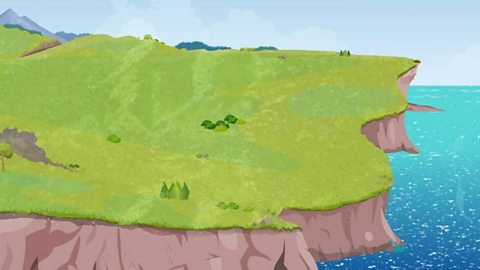
Deposition is the laying down of material in a new location. It occurs when waves lose energy to transport rocks, pebbles and sand.
Longshore drift is the process where particles moves along the shoreline over and over again, due to the strength and angle of waves.
Deposition features include:
- spits
- sandbars
Spits are formed when the coastline changes direction and material is deposited over time due to longshore drift.
A sandbar occurs when deposited material eventually joins up with the other side of the bay - the area behind the newly formed bar is known as a lagoon.
How is material transported along the coastline?
Transportation is the movement of material along the coast from areas of erosion to areas of deposition. The main process that transports material along the coastline is longshore drift.
Transportation of particles along a coastline is influenced by:
- the strength of waves
- the angle at which the waves strike the Where the land meets the sea.
This is determined by the direction from which the Wind that blows from a single direction over a specific area. blows.
What is longshore drift?
- A pebble or sand particle moves from point A to B, carried by the The water flowing towards a beach when a wave breaks. up the beach, the angle determined by the wave and wind direction.
- It is then pulled down the beach from B to C, carried by gravity and the wave's The movement of water down the beach..
- This process is repeated over and over again and the particle moves along the shoreline. This process is called longshore drift.
Features of coastal deposition
There are different depositional features produced by longshore drift. This video explains how deposition forms spits, sandbars and lagoons.
Powerful waves constantly erode our coastline.
At the same time, weaker waves shape it through a process called deposition. This can be seen with the formation of a spit created when sand and other material is transported along the coast through longshore drift.
When the coastline changes direction, the drift can follow the original direction moving material along the beach and into the sea.Over time the deposited sand will build up until it is above sea level forming a spit.
Spits usually have a distinctive curved or hooked end. This happens when the wind causes wave direction to change the direction of drift. Sometimes these spits extend into the sea and across the bay. This is called a sandbar.
Spits and sandbars: key depositional features of our coastlines.
How are spits formed?
Spits form where the coastline changes direction and longshore drift continues to move material along the beach.
- Longshort drift moves material along a beach in the direction of the prevailing wind.
- When the coastline changes direction, longshore drift continues to deposit material in the sea, extending the line of the beach.
- Over time the level of the sand deposited will build up until it is above sea level.
- The beach appears to extend out into the sea and is known as a spit or sandspit.
- Secondary wind and wave direction causes waves to strike the spit from a different direction.
- This changes the line of the spit, giving it a curved or hooked end.
- The spit creates an area of sheltered calmer water.
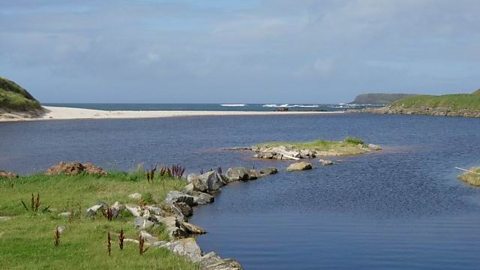
- The flow of river water into the sea can prevent a spit developing right across an The open mouth of the river where it meets the sea..
- The mixing of salt water fresh water and sediment carried into an estuary can form a An area of the coast that is flooded by the sea..
- Sediment can build up to form dry land.
How are sandbars formed?
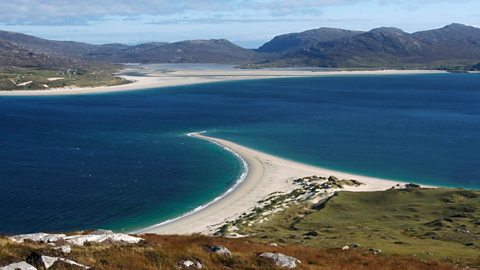
A sandbar is formed when a spit extends across a bay from one headland to another.
- Longshore drift moves sand out across the bay, forming a spit.
- Where there is no river estuary or slow flow of water, the sand can be deposited faster than it is removed.
- The deposited material eventually joins up with the other side of the bay and a strip of deposited sand blocks off the water in the bay from the sea.
- This feature is called a sandbar and the area behind the newly formed bar is known as a lagoon.
Quiz
Recap
Deposition is the laying down of material in a new location. It occurs when waves lose energy to transport rocks, pebbles and sand.
Longshore drift is the process where particles moves along the shoreline over and over again, due to the strength and angle of waves.
Deposition features include:
- Spits
- Sandbars
Spits are formed when the coastline changes direction and material is deposited over time due to longshore drift.
A sandbar occurs when deposited material eventually joins up with the other side of the bay - the area behind the newly formed bar is known as a lagoon.
More on Coastal landscapes
Find out more by working through a topic
- count1 of 2