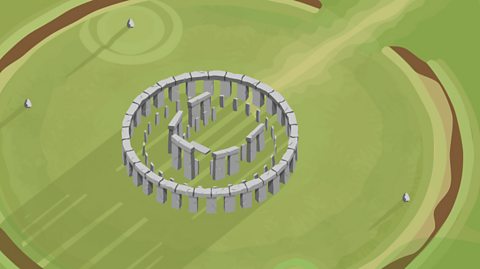
What was the Bronze Age?

Bronze Age Britain began around 2500BC.
It was a time when Britons learnt how to use metals to make many different objects.
People travelled using long wooden boats and by riding horses that had been tamed, this meant they had been taken from the wild and trained to be useful. This helped Bronze Age Britons travel and trade goods with people in Europe.
Many of these items have been found by *archaeologists who study objects and places from the past.
These items have helped them understand what life was like for people in Bronze Age Britain.
Important words
Important words on what we know about Prehistoric Britain.
| Keyword | Definition |
|---|---|
| Archaeologist | Someone who studies objects and places from the past. |
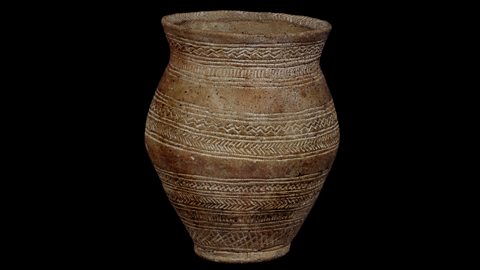
| Beaker people | Groups of people named by archaeologists after the bell-shaped pottery they made and used. |
| Bronze | A metal made by mixing copper and tin. |
| Copper | A metal that is easy to shape and can be mixed with other metals. |
| Hoard | A large collection of valuable items, such as weapons, tools and jewellery. |
| Metalworker | A craftsperson who works with metal to create objects. |
| Stone circle | A large ancient monument. These structures might have been used by people for religious ceremonies. |
| Tame | To train a wild animal so it can live with humans. |
Watch: How did bronze change people's ways of life?
Find out how bronze tools changed the lives of Bronze Age people.
Hello. Greetings! I’m back in the workshop.
Look at this new pattern I'm carving. I'm pretty pleased with it.
Children today often work with their families. My sons keep the furnace hot, and my partner pours the molten bronze… and me? I do the really detailed stuff. I love it.
Bronze tools are much stronger and sharper than the stone tools that came before.
See? This one cuts through trees like they’re twigs. Makes building round houses, fences, and boats so much easier.
And look at this: a plough.
Because bronze can be melted and poured into moulds, we can make strong blades like this. With them, farmers can prepare their fields faster and plant more crops.
That means not everyone has to farm anymore. So I can spend all day making bronze tools.
Then I trade those tools for grain, salt, even animal skins. Other people get better tools. And I don't have to step in pig poop!
Word has spread about these beauties. People travel for days, sometimes weeks, to trade for them.
(WHISPERS) It feels good to be known for your craft, you know?
Of course, some things haven't changed. We still herd animals, weave cloth, and gather around the fire at night. But bronze? Bronze is speeding everything up.
These are the paths traders walk. Imagine carrying goods for weeks across hills, rivers, even the sea, just to swap for bronze tools.
That's how powerful this stuff is. It connects us.
Stone was good… but bronze? Bronze is a complete game-changer!
How did the Bronze Age start?

Around 2500BC, settlers from mainland Europe brought new skills to Britain.
They were metalworkers who knew how to work with copper.
They were later called the Beaker people after the bell-shaped pottery they made and used.
By 2100BC, Britons were mining metals by digging them out from underground.
Trading ships travelled to mainland Europe carrying copper, tin and precious objects made by metalworkers.
Watch: How to make a Bronze Age sword
Watch the video to learn more about how swords were made in the Bronze Age.
Find out how Bronze Age metalworkers made swords.
NEIL BURRIDGE (ANCIENT METALWORKER): If you control the bellow speed, it'll hold the perfect temperature for casting.
NEIL OLIVER VO: With just the right mixture of copper and tin, metalworkers could create an alloy that was hard enough to make useful tools, and weapons. An impact that crumples copper, is no match for bronze, the hardest metal of the ancient world.
NEIL BURRIDGE: No matter how often I do this I still find it quite challenging.
NEIL OLIVER VO: Molds were made of stone or clay.
NEIL BURRIDGE: Fingers crossed gentlemen.
NEIL OLIVER: Fingers, everything crossed.
NEIL OLIVER VO: In this case, to cast something that was unknown before bronze came along, a sword.
NEIL BURRIDGE: That's fantastic.
NEIL OLIVER: Loving this! Right…
NEIL BURRIDGE: Can you lift that off Rob? Ok, this is it.
NEIL OLIVER: Right.
NEIL BURRIDGE: That's it. Oh! Ok, up.
NEIL OLIVER: It's like a beating heart, look at it.
NEIL BURRIDGE: Ok, in you go. Bit lower.
NEIL OLIVER: A fine one.
NEIL BURRIDGE: See that. That's it. Well done gentlemen!
NEIL OLIVER: Aw, look! Amazing! It's a bit like blook, better than blood.
NEIL BURRIDGE: Ok, that's good. Lift it up a little bit. That's it, we're there.
NEIL OLIVER: Wow! It's so visceral isn't it?
NEIL BURRIDGE: Oh definitely.
NEIL OLIVER VO: The moment of truth!
NEIL BURRIDGE: Oh there we go.
NEIL OLIVER: Look at that, behold. That is amazing. Look at the colour of it.
NEIL BURRIDGE: Are you impressed?
NEIL OLIVER: I'm very… I'm deeply, deeply impressed. Look at that. Yeah, it even makes a ring.
NEIL BURRIDGE: It's a very hard piece of bronze.
NEIL OLIVER: Just amazing. From liquid fire to metal sword in a couple of minutes.
Slideshow: Bronze Age artefacts
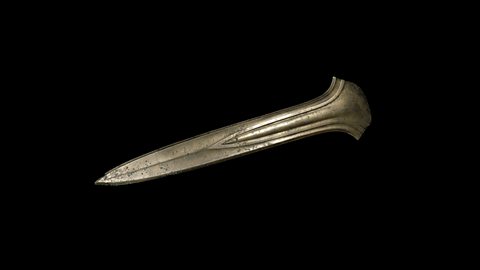
Click through the slideshow to see the kinds of things people made in the Bronze Age.
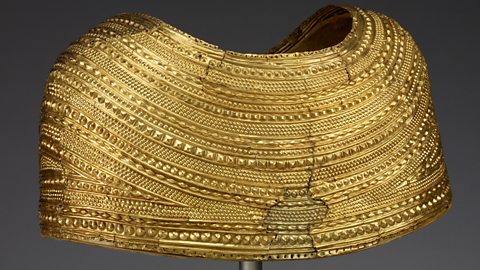
Image caption, This golden cape was found in a grave at Mold in North Wales. It is decorated with an intricate pattern. The cape is the work of a very skilled goldsmith and must have been worn by a very important person – probably a woman.
1 of 3
Watch: How far did people trade in prehistory?
Discover how far people traded in the Bronze age.
Greetings everyone.
Dara here chatting to you from our bronze workshop.
Take a look at this axe.
I traded it for a necklace I made the other day.
It's made of volcanic stone from far to the north.
Pretty cool huh? Volcano axe!
See all this?
We've settled in one place now, and we don't have amber also in our new village.
And we can't just wander off to find them.
That's why we trade.
Trading is buying and selling things.
I sell my bronze axe and they pay for it with salt or grain.
Fair deal, right?
Why salt and grain?
It’s all about food.
Keeping food fresh is really difficult, so we use salt.
Completely covering food in salt makes it last longer.
And grain can be kept to eat in the winter when it's more difficult to get food.
And people love our bronze.
Stronger than stone. Sharper too!
We've traded axes like this for tools, animal skins, and these amber beads from across the sea.
These beads have been on a journey.
Maybe traded for a cart, then for sheep, then for salt, then for one of my axes.
Days, even weeks, just people walking, carrying, trading, across land and over water.
Like one big chain.
Without trade, we all just grow our own food and not have time to do much else.
But with trade, we get specialised tools.
Salt, grain, amber and I can make beautiful things like this.
Trade changes everything.
How did Bronze Age people come to Britain?
During the Bronze Age, many people crossed the sea from mainland Europe to Britain.
They travelled in long wooden boats rowed by oarsmen.
The boats carried people, animals and trading goods.
 Image source, © Canterbury Archaeological Trust Ltd
Boats were very useful for carrying heavy materials like stone.
They could also be loaded with metal from mines, precious swords, pots and jewellery.
These boats could be very large. The Dover Bronze Age boat found by archaeologists in 1992, needed 18 people to paddle it!

Learning to tame wild animals

By the Bronze Age, people in Britain had learned to tame horses.
In around 1000BC, they learned to make carts with wheels.
Some farmers travelled on horseback or used wooden carts pulled by horses or oxen.
The first war chariots appeared towards the end Bronze Age. Warriors rode into battle standing on these chariots, which were pulled by horses.
Who was the Amesbury Archer?
 Image source, © Wessex Archaeology
In 2002, archaeologists in Amesbury, in Wiltshire, discovered the grave of a Bronze Age man.
He was:
- discovered just a few miles from Stonehenge
- buried with around 100 objects
- nicknamed ‘the Amesbury Archer’ because he was buried with arrowheads used by archers
Image source, © Wessex ArchaeologyHow do we know what Bronze Age Britain was like?

Bronze Age people made many objects from hard metals.
This meant these objects could last for thousands of years in the ground.
Archaeologists discovered artefacts in Esher, Surrey, in 2013 and 2014, including a Bronze Age hoard.
A hoard is a large collection of valuable items, such as weapons, tools and jewellery.
The remains of Bronze Age homes have also been found in Britain, such as those at Must Farm.
Archaeologists can use clues from all of these finds to learn more about Bronze Age Britain, what it may have been like and how its people may have lived.
Think like a historian

Have a look at the thinking points below and think about your answer to each question. You could even write them down on a piece of paper or discuss them with somebody else if you want to.
A Bronze Age golden cape was found in a grave in North Wales. What do you think archaeologists can learn from this about the people who made it and the person it was buried with?
Archaeologists found the remains of homes at Must Farm. Why do you think this discovery is important for understanding the Bronze Age?
Did you think that the design and construction of a beautiful, detailed object such as a gold cape might show how clever and skilled the Bronze Age metalworkers were. Maybe you thought it shows that the person it was buried with was very important.
Perhaps you thought that studying the remains homes helps archaeologists understand how a group of Bronze Age people may have lived together? Objects found inside the houses also give clues about daily life, such as cooking, working and farming.
Activities
Activity 1: The Amesbury Archer
What can you learn about the Amesbury Archer from his grave?
Main image © The Salisbury Museum. Additional images © Wessex Archaeology
Activity 2: Bronze Age quiz
Let's find out what you know about life in the Bronze Age in this quiz.
Grown-ups corner
Are you a parent, carer or teacher?
Take a look at some of the links below on KS2 History which are packed full of knowledge, videos, quizzes and activities.
KS2 History: Bronze Age Britain
BBC Bitesize for Teachers

KS2 History / PSHE and Social Studies: Discovering wool in Bronze Age Britain
BBC Bitesize for Teachers

KS2 History / PSHE and Social Studies: Discovering metalwork in Bronze Age Britain
BBC Bitesize for Teachers

Horrible Histories: Raid and Trade game! game
Play Horrible Histories: Raid and Trade KS2 History
More on Prehistoric
Find out more by working through a topic
- count17 of 21
- count18 of 21
- count19 of 21
- count20 of 21