Fertilisation
Human fertilisation
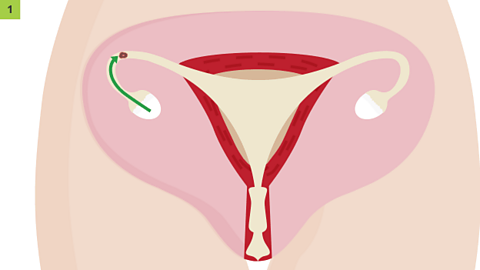
Image caption, The human female reproductive system working during reproduction and fertilisation. The egg is released from the ovary and moves toward the oviduct.
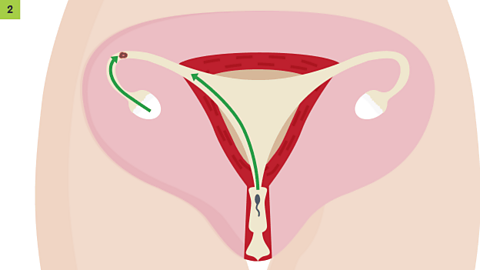
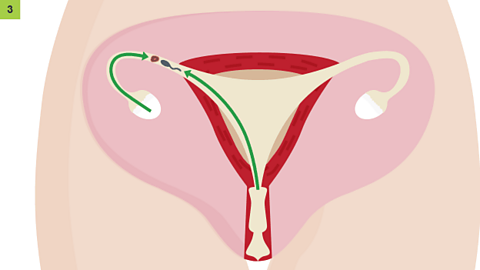
1 of 3
Fetal development and birth
Fertilisation happens when an egg cell meets with a sperm cell and joins with it.
The fertilised egg divides to form a ball of cells called an embryo.
The embryo attaches to the lining of the uterus. It begins to develop into a fetus and finally into a baby.
Development of the fetus
The foetus relies upon its mother as it develops. These are some of the things it needs:
- protection against knocks and bumps, and temperature changes
- oxygen for respiration
- nutrients (food and water)
The developing foetus also needs its waste substances removing.
The foetus is protected by the uterus and the amniotic fluid, a liquid contained in a bag called the amnion.
The placenta
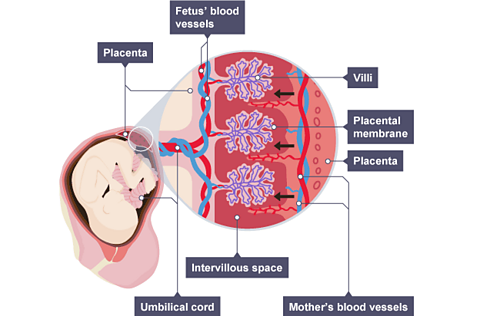
The placenta is an organ responsible for providing oxygen and nutrients, and removing waste substances. It grows into the wall of the uterus and is joined to the foetus by the umbilical cord.
The mother's blood does not mix with the blood of the foetus, but the placenta lets substances pass between the two blood supplies:
- oxygen and nutrients diffuse across the placenta from the mother to the foetus
- carbon dioxide and other waste substances diffuse across the placenta from the foetus to the mother
Smoking and alcohol during pregnancy
Smoking and drinking alcohol and caffeinated drinks during pregnancy could risk the health of the unborn baby.
Smoking
- Woman increases her risk of miscarriage and stillbirth
- Babies have a greater risk of low birth weight
- Greater risk of premature birth
- Greater risk of sudden unexpected death in infants
Alcohol
Babies may have:
- facial abnormalities
- heart problems
- restricted growth
- mental disorders
- incorrect development of nervous system
Caffeine
Heavy use may be associated with increased risk of low birth weight
Drugs
Increased risk of:
- low birth weight
- birth defects
- premature birth
- growth retardation
- sleep problems
- behavioural problems
- miscarriage
- stillbirth
Birth
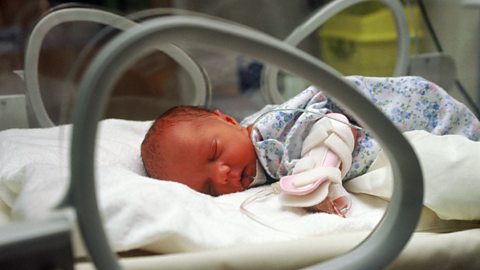
It takes about 40 weeks for a baby to develop in the uterus. This time is called gestation. After this, the baby is ready to be born. The cervix relaxes and muscles in the wall of the uterus contract. Waves of muscle contraction push the baby out of the mother's body through the vagina. A new baby is born!
Puberty
The reproductive system of a child is not mature. It needs to change as a boy or girl develops into an adult, so that the system is fully working. The time when the changes happen is called puberty.
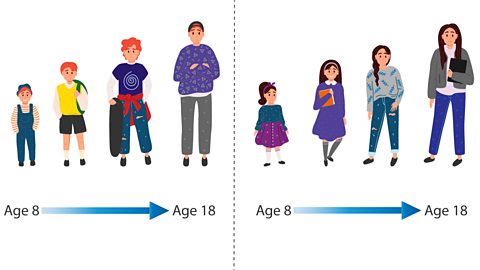
Girls develop breasts and start their periods. Boys develop a deeper voice and facial hair will start to appear.
The average age for girls to begin puberty is 11, while for boys the average age is 12.
But it's different for everyone, so don't worry if you reach puberty before or after your friends and classmates.
It's completely normal for puberty to begin at any point from the ages of 8 to 14 and the process can take up to four years for girls and six years for boys.
The changes happen because of sex hormones produced by the testes in boys and by the ovaries in girls. Some changes happen in both boys and girls, while others just happen in boys or girls.
Here are some changes that happen to both boys and girls:
- underarm hair grows
- pubic hair grows
- sweat more
- emotional changes occur
- growth rate increases
- acne can develop
Boys are generally taller than girls, except for the ages 12 and 13 when girls are taller than boys.
The time between puberty and adulthood is called adolescence.
Boys
Here are some changes that happen only to boys:
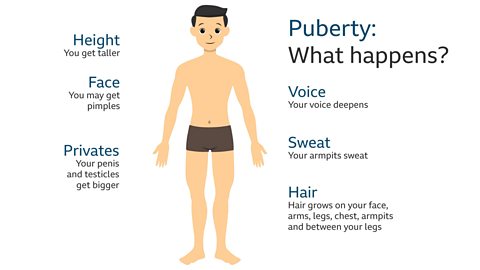
- voice breaks (gets deeper)
- testes and penis get bigger
- testes start to produce sperm cells
- shoulders get wider
- hair grows on face and chest
- may have "wet dreams" (involuntary ejaculations of semen during sleep)
Girls
Here are some changes that happen only to girls:
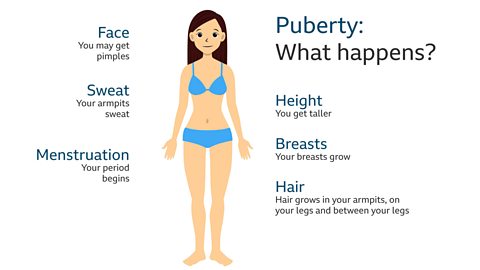
- breasts develop
- ovaries start to release egg cells (the menstrual cycle starts)
- a white vaginal discharge that keeps the vagina clean and moist, and protects it from infection, is produced
- hips get wider
DR ROBERT WINSTON:
We often have the illusion that we're in control of our bodies, but the reality is that it's usually our biology which controls us.
And that's particularly obvious during the great roller coaster ride of puberty. We don't precisely know when it's going to start.
We don't even know how long it's going to take. And although we may think we know what's going to happen, nothing can quite prepare us for exactly how we're going to feel.
It feels exciting and dangerous, and you don't know where the next shock's coming from.
And the worst thing is, just as you think you've mastered it, suddenly something else happens and your body changes again!
If living through puberty feels like a horror story, the villains of the piece are hormones. These tiny chemical messengers are beyond our control. Suddenly, hordes of them start racing through our bloodstream, ordering our body to change.
They tell us to switch on to sex, getting us ready to make babies.
They tell our muscles and bones to get bigger and stronger.
They make hair sprout in unusual places.
Sometimes, they really let us down.
Contraception
Contraception is the deliberate use of artificial methods or techniques to stop pregnancy. It can be used to plan when people have children and how many children they have.There are four contraceptive methods used to prevent a pregnancy:
- mechanical
- chemical
- surgical
- natural
Mechanical
| Example | Method | Advantage | Disadvantage |
|---|---|---|---|
| Male condom | A barrier that prevents sperm entering the vagina. | Easily obtained. Protects against Sexually Transmitted Infections STIs (e.g. HIV). | Unreliable if not used properly. |
| Female condom | A barrier that prevents sperm reaching an egg. | Easily obtained. Protects against STIs (e.g. HIV). | Unreliable if not used properly. |
Chemical
| Example | Method | Advantage | Disadvantage |
|---|---|---|---|
| Contraceptive pill | Taken regularly by the female. Stops eggs being released | Very reliable | Female needs to remember to take the pill. Side effects include weight gain, mood swings or an increased risk of blood clots. Does not protect against STIs. |
| Contraceptive implant | A small tube placed under the skin of the upper arm. Releases hormones slowly over a long period of time. Stops eggs being released | Very reliable. Can work for up to 3 years. | Does not protect against STIs. Can prevent menstruation. |
Surgical
| Example | Method | Advantage | Disadvantage |
|---|---|---|---|
| Vasectomy | Sperm tubes are cut preventing sperm entering the penis. | Virtually 100% reliable. | Difficult or impossible to reverse. Does not protect against STIs |
| Female sterilisation | Oviducts are cut preventing fertilisation occurring. | Virtually 100% reliable. | Difficult or impossible to reverse. Does not protect against STIs |
Natural
| Example | Method | Advantage | Disadvantage |
|---|---|---|---|
| Rhythm method | Sexual intercourse is avoided around the time the egg is released. | No unnatural product is used | Very unreliable especially if the menstrual cycle is irregular. Does not protect against STIs |
The natural method is chosen by some groups opposed to contraception for religious or ethical reasons.
More on Biology
Find out more by working through a topic
- count7 of 14

- count8 of 14
- count9 of 14

- count10 of 14