Plant reproduction
Flower structure
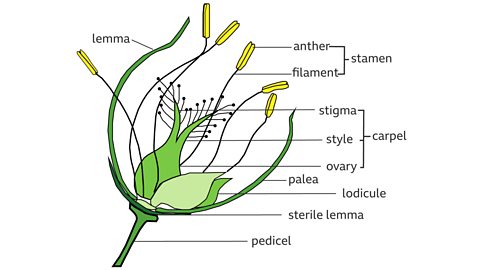
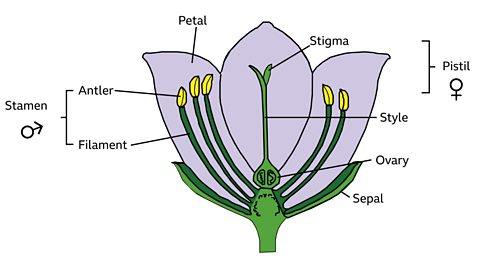
A flower is the reproductive part of flowering plants. Flowers have colourful petals. The petals surround the male and female parts of the flower.
The male parts are called stamens,The female parts are called carpels.
Stamens produce fine grains, called pollenCarpels produce ovules.
The table describes the main parts of a flower and their functions:
| Structure | Function |
|---|---|
| Sepals | Protect the unopened flower |
| Petals | May be brightly coloured to attract insects |
| Stamens | The male parts of the flower. Each consists of an anther held up on a filament |
| Anthers | Produce pollen grains, the male sex cells |
| Carpel | The female part of the flower (consists of an ovary, a stigma, and usually a style.) |
| Stigma | The top of the female part of the flower which collects pollen grains. |
| Style | The pollen tubes grow through this |
| Ovary | Produces and contains the female sex cells, the ovules |
| Ovule | Contains the female sex cell. Once fertilised an ovule becomes a seed |
| Nectary | Produce a sugary solution called nectar, which attracts insects |
What is pollination?
During plant reproduction, pollen grains need to move to the stigma of a flower. This is called pollination.
Insects can pollinate flowers, and so can the wind. Insect-pollinated flowers are different in structure from wind-pollinated flowers. This table describes some differences:
There are two types of pollination:
self pollination - pollen from an anther of the same flower or same plant arrives at the stigma of the flower. Examples of self-pollinating plants include wheat, barley, rice, tomatoes and potatoes.
cross pollination - the transfer of pollen from an anther of a flower of one plant to the stigma of the flower of another plant, but of the same species. Most plants use cross pollination.
Insects can pollinate flowers, and so can the wind. Insect-pollinated flowers are different in structure from wind-pollinated flowers. This table describes some differences:
Examples of plants that use insects for cross-pollination include apples, plums, pears, daffodils, heather, lavender, and most flowering plants.
Examples of plants that use wind for cross pollination include grasses, dandelions and maple trees.
Many plants that are capable of self-pollinating can also be cross pollinated.
We depend upon pollination by insects, including the honeybee, for many of our crops.
Seeds and fruit
A pollen grain starts to grow if it lands on the stigma of a flower of the correct species.
A pollen tube grows through the style of the flower until it reaches an ovule inside the ovary.
The nucleus of the pollen grain (the male gamete) then passes along the pollen tube and joins with the nucleus of the ovule (the female gamete).
This process is called fertilisation.
The slideshow explains what happens:
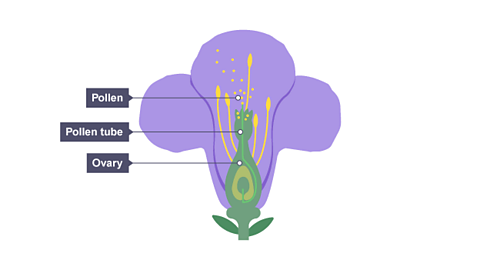
Image caption, A pollen grain is transferred from one flower to another. A pollen tube grows from the stigma to the ovary.
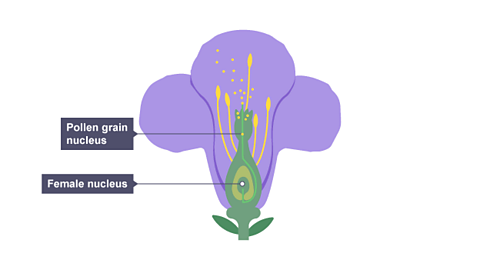
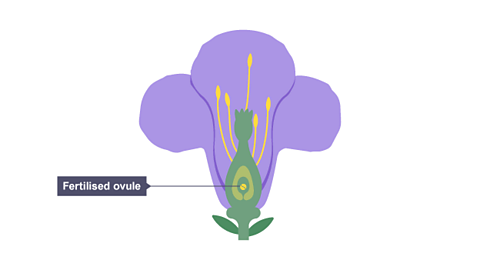
1 of 3
After fertilisation, the female parts of the flower develop into a fruit:
- the ovules become seeds
- the ovary wall becomes the fleshy part of the fruit that we eat
Seeds
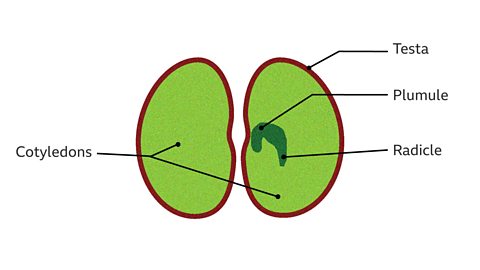
A seed has three main parts:
- embryo – the young root and shoot that will become the adult plant
- food store – starch for the young plant to use until it can carry out photosynthesis
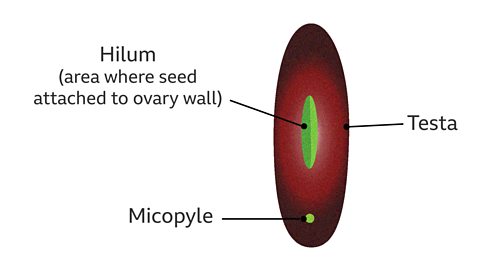
- seed coat – a tough protective outer covering
| Structure | Function |
|---|---|
| Testa | This is the seed coat. It surrounds the seed and is tough and waterproof |
| Radicle | The young root that will become the adult plant below ground |
| Plumule | The young shoot or stem that will become the adult plant above ground. The plumule grows after the radicle. |
| Cotyledon | A food store – starch for the young plant to use until it is able to carry out photosynthesis. Cotyledons are the first leaves to emerge from the soil when a seed germinates. |
| Micropyle | A small opening in the seed coat (Testa) that lets water move into the seed. The seed can then swell and split the seed coat for the young plant to emerge |
Germination
Germination occurs when a new plant grows out from a seed embryo. All seeds require three conditions for successful germination:
- Water
- Oxygen
- Warmth
Investigating germination
Apparatus
Five small tubes with labels and stoppers or lidsCress seedsLabelsCotton woolDark boxFridgeConical flask and stopperNitrogen gas
Method
- Label the five tubes A, B, C, D and E
- Put a small ball of cotton wool into each tube
- Add a few drops of water to soak the cotton wool
- Add the damp cotton wool to tubes A, B, C and D
- Add dry cotton wool to tube E
- Add 20 cress seeds to each tube
- Place A in the dark box at room temperature: wet, warm, oxygen and dark
- Place B in the fridge: wet, cold, oxygen and dark
- Place C in light at room temperature: wet, warm, oxygen and light
- Place D in a conical flask flushed with nitrogen gas to remove oxygen gas and stoppered: wet, warm, light, no oxygen
- Place E in the dark box at room temperature; dry, warm, oxygen and dark
- Leave for about three days and record your results in a suitable table.
Conclusion
The three conditions needed for germination to occur are water, oxygen and warmth
| Conditions (WOW!) | Reason |
|---|---|
| Water | Allows the seed to swell and split. Also lets the chemical reactions involved in the growth of the new plant to take place |
| Oxygen | Needed for respiration, the process which provides the energy needed to carry out cell division and growth |
| Warmth | Needed for respiration and cell division |
A way to remember the three conditions is:
WOW! = Water Oxygen Warmth
As the new plant grows, it produces roots which take in water and minerals from the soil and produces leaves on its shoots which carry out photosynthesis to make food for the plant.
Speaker 1: Germination is the process by which a plant begins to grow from a seed. Seeds need certain conditions to germinate successfully. Dr Laura Bowden is a seed specialist, and I've asked her to try and germinate crop seeds for us in different conditions.
Speaker 2: Well, these are barley seeds, and these ones I grew in our controlled temperature room, which is at 20 degrees, so they've been nice and warm. These ones have been in the fridge at four degrees, so they haven't germinated at all, there's quite a difference, showing that temperature really is very important to seed germination.
Speaker 1: So we've seen that warmth is essential for germination, but there are two other crucial factors.
Speaker 2: Water is probably the most important factor for germination.
Speaker 1: Without water, most seeds can't germinate. In hotter parts of the world, the lack of water is a serious problem. Droughts can result in crops dying, causing terrible starvation.
Speaker 2: This experiment here, these are rye grass seeds. These ones have had a good amount of water — enough for them to grow well. These ones here haven't had quite as much water, so they're looking unhealthier. These poor ones have had no water at all. If you give them too much water, that would also be a stress and they wouldn't be able to cope and it would kill them.
Speaker 1: We've seen that warmth and water are essential for germination, but there is one other crucial factor.
Speaker 2: Oxygen is very important. They need oxygen because they have to respire.
Speaker 1: Seeds contain a food store. Respiration requires oxygen and releases energy from the food store. This is why seeds need oxygen during germination. Once the young plant has leaves, it no longer needs its food store because it makes glucose in its leaves by photosynthesis. Respiration then releases the energy needed from this glucose. So these are the basic factors that seeds need to germinate…But to have any chance at solving the world's food shortages, scientists are helping farmers work out the best ways of getting their crops to grow quickly.
Speaker 2: Quite often, farmers will apply fertilisers to their fields, which will speed up germination and plant growth. So these are grass seeds again, and these ones have had nitrate added to the solution that they're given to grow with, and these ones haven't, they've just had water. And you can see there is a huge difference in the growth. These ones, they have started to germinate, you can see the shoots, but they're so much smaller, and that's because of the effect of nitrates, which is the major component of fertiliser — so farmers use exactly this principle.
Speaker 1: Wow, that really is impressive. The research that Dr Bowden and her colleagues are doing is crucial to understanding how to improve our farming techniques. In 2011, the world population hit 7 billion, and by 2050, that number will be 9 billion — 9 billion people need an awful lot of food. Science is helping us understand more and more about how plants grow and germinate. And it's helping us to understand how we can feed our ever-expanding population.
Dispersal
Plants compete with each other for factors such as:
- light
- water
- space
- minerals in the soil
Seed dispersal is the spreading of seeds away and apart from each other and from the parent plant. It is done to reduce competition between the parent plant and the new plants, and between the new plants.
The table describes the most common methods of seed dispersal:
| Method | Detail | Examples |
|---|---|---|
| Wind | Seeds have lightweight parts, wings or parachutes | Dandelion, sycamore |
| Animals (inside) | Brightly coloured and tasty fruits contain seeds with indigestible coats, so that the seeds pass through the animal’s digestive system undamaged | Tomato, plum, raspberry, grape |
| Animals (outside) | Fruits have hooks that attach them to the fur of passing animals | Goose grass, burdock |
| Self-propelled | Have a pod that bursts open when ripe, throwing the seeds away from the plant | Pea pod |
Investigating dispersal
Seeds dispersed by the wind are easier to investigate than seeds dispersed by other methods. For example, you could release sycamore seeds and measure the distance they travel. Factors that could affect the distance travelled by a sycamore seed include:
- the height from which it is released
- the surface area of the wings
- the mass of the seed
- the wind speed
More on Biology
Find out more by working through a topic
- count8 of 14
- count9 of 14

- count10 of 14
- count11 of 14