Did you know?
The symbol for a paragraph ¶ is called a pilcrow. You might see this symbol when you use a computer to type.
Introduction to paragraphs
Paragraphs give structure to the text. Without paragraphs, readers could get muddled or bored.
What are paragraphs?
Find out how paragraphs can be used to improve speeches
Jeff: Jeff and Janine here, coming to you live from the opening ceremony!
Derek: Blah blah blah blah blah blah blah blah…
Jeff: Oooh and yip, I think the crowd have lost interest Janine.
Janine: Classic mistake here Jeff. He’s not used paragraphs.
Jeff: Why don’t you break it down for the viewers at home Janine.
Janine: Well Jeff, it’s often easier to read something if the writing is split up.
Jeff: Ah yes, sentences grouped together are paragraphs.
Janine: That’s right Jeff, and each paragraph starts on a new line and is usually about one idea or theme.
Derek: Blah blah blah blah blah blah blah blah!
Jeff: Wow! Now for any of you at home, that’s how you make an opening speech.
Janine: Textbook Jeff. Text. Book.
How to use paragraphs
Almost every piece of writing that uses more than a few sentences is organised into paragraphs.
Paragraphs are groups of linked sentences about a single main topic.
They divide texts into sections to make it easier to read and understand what is being said.
Paragraphs can also be used to make writing more memorable.
A paragraph is usually created for a new topic or idea.
A paragraph is also used when a new person is speaking.
Paragraph structure
To make an idea or information clear, a paragraph might contain:
A topic sentence – this tells the reader what the paragraph is going to be about.
The middle section – new sentences are often added here to expand on the main idea introduced by the topic sentence.
The final or ‘hook’ sentence – this sentence can be used to link to the topic sentence of the next paragraph or it may summarise what has already been said.
However, writers can also decide to structure paragraphs for pace or flow. For example, a long, flowing description of a setting or a series of punchy short paragraphs to make an argument hit home.
Split this recipe into paragraphs
When to start a new paragraph
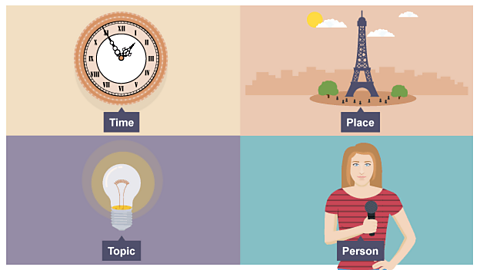
There are two main reasons to start a new paragraph:
To show a change of topic
To show when a new speaker begins talking
You can use TiPToP (Time, Place, Topic, Person) to help remind you when to use paragraphs.
Split the dialogue into paragraphs
Analysing paragraph structure
It is worth looking closely at how paragraphs are organised to understand a writer’s purpose. It is useful to consider these questions:
- What is each paragraph about?
- How long is the paragraph?
- What are the lengths and types of sentences being used?
- What is the impact of how the paragraph opens or closes?
- Overall, what is the effect of these choices?
Using paragraphs for effect
Paragraphs are powerful tools for writers. They can add drama in a story or make a complicated argument easier to understand in a persuasive text.
If you just looked at the shape of paragraphs, you might even be able to guess what type of text you were about to read. For example, an information leaflet usually has short, similar size paragraphs; a formal letter also has a very recognisable shape.
One-line paragraphs
Rather like the use of ultra-short sentences, writers can use a one-line paragraph to stand out as a contrast to their longer paragraphs.
That night, everything changed...
Contrasts of all kinds are often worth discussing as they create impact. One line paragraphs can create impact by impact by any of the following reasons:
- slowing the pace
- creating a shock
- making something stand out
- changing the flow of the writing
- repeating something
But, overusing one-line paragraphs reduces the impact they have so try to use them sparingly.
Test your knowledge
Play Bitesize secondary games. game
Have fun playing science, maths, history, geography and language games.

More on Grammar
Find out more by working through a topic
- count1 of 12
- count2 of 12
- count3 of 12
- count4 of 12