Did you know?
The word 'tense' comes from 'tempus', the Latin word for time.
Some languages like Mandarin Chinese don’t have verb tenses but express time in different ways.
Introduction to tenses
When writing, it’s important to use the correct form of a verb and to use it consistently. Better writers think carefully about what tense to use and when they use it.
The A verb is a word that shows an action (physical or mental) or state of being. is the part of a sentence that shows the tense - it shows when something is happening.
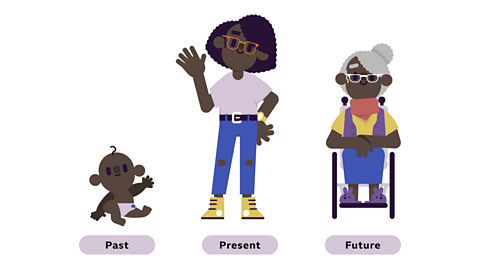
Verbs come in three main tenses - A verb tense expressing an action that has happened, or a previous state., A verb tense expressing an action that is currently happening , or a state that currently exists. and A verb tense expressing an action that has not yet happened, or a state that does not yet exist..
How to use tenses
Find out how to use tenses
Presenter 1: When writing, it’s important to use the correct form of a verb. A verb is the active word in the sentence, the doing word, and the tense of the verb lets the reader know whether something has already happened, is happening now, or is going to happen.
Presenter 2: So, let’s search for the past, present, and future tenses and look at some common mistakes these little guys can cause in your writing.
Both: Welcome to Planet Verb.
Presenter 2: First, let’s look at the past tense. There’s one! Write in the past tense when describing something that has already happened. In a fictional piece, it means the narrator is retelling the events of the story to the reader. For example, you could write: “Last week, I searched for tenses.” It makes a written story seem more natural, probably because it’s how we typically tell stories in everyday conversation.
Presenter 2: Past tense does cause some common mistakes. Make sure you use the right word for the past tense of the verb to be. Generally, use was when you’re writing about a single person: I was, he was, she was, but use were for more than one person and for direct address: We were, they were, you were.
Presenter 1: Look over there! The present tense is used when you’re writing about something happening at that moment. For example: “I watch as the little guy scurries by.” It’s common in essays where writers are describing an idea or making an argument, rather than recounting a story, but it can be used in fiction too to make it feel as if the narrator is reporting on events as they happen. This helps the reader feel closer to the action.
Presenter 2: The other main tense is the future. Look up there! The future tense is used to write about something that hasn’t happened yet. For example: “I will look for more tenses tomorrow.” You might use the future tense when writing an introduction to your essay, to let readers know what you will be discussing.
Presenter 1: When you’re writing an essay, story, or exam answer, you’ll want to be mindful of the verb tense.
Presenter 2: Carelessly switching from one tense to another can confuse the reader.
Presenter 1: However, it can be very interesting when done deliberately, like in a flashback.
Presenter 2: So, read your writing aloud to check that all the tenses are working together…
Presenter 1: …And keep your eyes on those little guys. Using tenses consistently and correctly will help make your writing clear and engaging, and will help your readers follow along.
Past tense
Most novels are written in the past tense. Readers are more familiar with this tense because they are used to being told a story that has already taken place.
For most verbs you add an 'ed' at the end of the word to change it to the past tense - for example, 'she talks' becomes 'she talked'.
However, there are some irregular verbs where the whole word changes in the past tense. For example:
- I choose - I chose
- They build - they built
- She swims - she swam
It’s also important to make sure you use the right word for the past tense of the verb 'to be'.
- Use 'was' when you’re writing about a single person - 'I was, he was, she was'.
- Use 'were' for more than one person and for direct address - 'We were, they were, you were'.
Present tense
The present tense is used when writing about something that is happening at that moment. Sometimes a fiction writer may use the present tense to make their writing more immediate, as in this example from The Hunger Games by Suzanne Collins:
Sixty seconds. That’s how long we’re required to stand on our metal circles before the sound of a gong releases us. Step off before the minute is up, and land mines blow your legs off. Sixty seconds to take in the ring of tributes all equidistant from the Cornucopia, a giant golden horn shaped like a cone with a curved tail, the mouth of which is at least twenty feet high, spilling over with the things that will give us life here in the arena.
Using the present tense can give the writing an almost cinematic, vivid quality, as in this example from Raybearer by Jordan Ifueko:
A hot wind rushes into the clearing, swirling up dirt and clay into a tall, lean man. His wings smoulder cobalt blue, like a young fire, but his voice is frost cold. “Stop.”
It is also common for essays to be written in the present tense. For example, if you were to write an essay about the poem Blessing by Imtiaz Dharker, you could say: The broken water pipe is a miraculous event for the people in the slums without access to clean water.
Future tense
The future tense is often used in speech, for example when planning a future event:
We will meet at 5 pm at the museum.
In writing, it could also be used to talk about something that hasn’t happened yet. You might also use the future tense when writing an introduction to a scientific report or essay, to let readers know what you will be discussing. For example:
In this report, I will be covering the details of the experiment and my findings.
The future tense might also be used to create impact in a piece of non-fiction writing. For example, in a persuasive speech:
Should we let them control our lives? No! We shall find ways to fight back.
Using the future tense can be very effective in presenting a vision of the future or a promise. For example, it is used in this famous speech by Prime Minister, Winston Churchill during World War Two:
We shall fight on the beaches, we shall fight on the landing grounds, we shall fight in the fields and in the streets, we shall fight in the hills; we shall never surrender…
Key points
When writing, be aware of your verb tense. Carelessly switching from one tense to another can confuse the reader. For example,
He could hear a pin drop. He picks up the pen. He began to write.
However, changing the tense deliberately can have a positive impact on your reader. For example, if you were writing a persuasive speech you may swap from the past tense to the present tense to the future tense to force your listeners to think about taking action:
We have slowly been destroying our world. Take action today to stop this destruction. Together we will make a difference.
Finally, always proofread your work to make sure your tense and meaning is clear.
Test your knowledge
Play Bitesize secondary games. game
Have fun playing science, maths, history, geography and language games.

More on Grammar
Find out more by working through a topic
- count3 of 12
- count4 of 12

- count5 of 12

- count6 of 12

