Key points about Sikhism, peace and conflict
- At the time of its founder, Guru Nanak, Sikhism was commonly seen as a religion of peace. However, the Guru was already laying the foundations for the justified use of force which would be put in to practice by Sikhs in the future.
- Therefore many Sikhs agree that war is acceptable if it is fought in self-defence, or the defence of others, and as a last resort.
- The Just War theory in Sikhism is known as War in defence of righteousness
- Most Sikhs consider terrorist acts and the use of weapons of mass destruction to be against the teaching of the Gurus.
- As taught by Guru Arjan Dev, there have been examples of Sikhs involved in holy wars in order to protect and defend their faith. The principles of truth, justice and fighting for the common good, Sarbat da Bhalla, are part of the Bhai Nand Tankah Nama, the Sikh code of conduct.

Remember
There are different stages of commitment of Sikhism, which include, Amritdhari Sikhs and Sahajdhari Sikhs. Read more about these.
This means that there is a variety of Sikh teachings on many ethical issues, including those found in the thematic study of religion, peace, and conflict.
Video
Watch the video below to compare Sikh, Muslim and Christian attitudes towards whether war can ever be justified.
Christian presenter: Hello. I'm a Christian.
Muslim presenter: I'm a Muslim.
Sikh presenter: And I'm a Sikh.
Christian presenter: All our religions agree that war is one of the worst things that can happen to humanity.
Muslim presenter: But wars are fought right across the world.
Sikh presenter: For many different reasons.
Christian presenter: Can war ever be justified?
Muslim presenter: In other words? Is it ever right to go to war?
Sikh presenter: Or is war never justified because so many innocent people suffer? What do our religions say about it?
Christian presenter: About 800 years ago, a Christian thinker called Saint Thomas Aquinas came up with a list of conditions which had to be met before Christians could fight in what he called a Just War. It has to be for a just cause, such as self-defence. It must be declared by the official government of the country, and the aim must be for good, to defeat evil.
Muslim presenter: So what does Islam teach? A war must meet several conditions in order to be justified as a Holy War, which in Arabic is called a Harb al-Muqadis. It must be declared by a religious leader, it must be fought in self-defence or the defence of others, it must bring about good and not evil, and it should never be fought to gain more money, land or power. War should always be a last resort. Force should only be used after peace talks have failed.
Sikh presenter: And it's similar in Sikhi. In 1699, the leader of the Sikhs, Guru Gobind Singh Ji formed the Khalsa, a group of Sikhs who committed to the Sikh identity and who stood up against the oppressive rule of the emperors in India. Guru Gobind Singh Ji argued that people had a right to defend themselves against injustice. Guru Ji wrote, ‘When all other means have failed it is permissible to draw the sword', so all members of the Khalsa and Sikhs in general should be ready to fight in a Dharam Yudh, which means a war in the defence of righteousness. But Sikhs should only fight when all peaceful solutions have failed.
Christian presenter: So that's how our religions justify going to war. But there are also rules on how a war should be fought. Saint Thomas Aquinas also said that Christians should only fight as a last resort and if there's a good chance of winning, so that lives are not wasted. The force used should be enough to defeat the enemy, no more. And innocent people should be protected.
Muslim presenter: The Qur'an says 'Fight in the way of Allah those who fight against you, but do not transgress'. Which means that Muslims must always follow Allah's rules when fighting a war and never disobey them. Innocent people should not be made to suffer and even trees, crops and animals should be protected.
Sikh presenter: The rules for a Sikh Dharam Yudh say that only the minimum force should be used to defeat an enemy, and any land or property captured during a war should be returned. Every Sikh who fights should be a “Sant Sipahi” a “saint soldier” who is devoted to upholding righteousness, challenging injustice, and who wouldn't use violence against innocent people.
Christian presenter: So all three of our religions say that the innocent should be protected during a war.
Muslim presenter: But those rules were all made a long time ago when wars were fought with swords and spears.
Sikh presenter: So can a war still be justified using the type of weapons we have today?
Christian presenter: We saw the horror of nuclear weapons when atomic bombs were dropped on Japan at the end of World War Two.
Muslim presenter: Surely, it's impossible to protect the innocent.
Sikh presenter: So - knowing the cost in innocent lives can going to war ever be justified, when eventually, both sides are going to have to sit down and talk whatever happens?
Christian presenter: But what if you're up against an enemy that refuses to talk?
Muslim presenter: Governments have a duty to keep their citizens safe, so there might be situations where strong action is needed to protect them.
Sikh presenter: Some people say that there are circumstances when people have to make difficult decisions, and what's right and wrong depends on the situation. The usual rules don't apply.
Christian presenter: It's called situation ethics and helps to explain why so many Christians,
Muslim presenter: And Muslims,
Sikh presenter: And Sikhs,
Christian presenter: fought in World War Two, because allowing the Nazis to win would have been a greater evil than fighting a war to stop them.
Muslim presenter: It's all very well talking about the theories, but I believe that the reality of war and the tragedy of innocent people being killed should be a good enough reason not to fight. I've lost family in recent wars, and so have many of my friends. It's a pain that never goes away.
Sikh presenter: War might sometimes appear to be a lesser evil, but can it ever be justified?
Christian presenter: Our religions set out rules for warfare, but they weren't made for the modern world.
Muslim presenter: And innocent people always suffer.
Sikh presenter: What do you think?
Key concepts in religion peace and conflict
The key terms below will appear repeatedly through the theme of Sikhism, peace and conflict.
Religion, peace and conflict key terms quiz
For your exam on religion, peace and conflict, it is important to know the definitions of key terms. Take the quiz below to test your knowledge.
War
Causes of war
War is an organised conflict, usually consisting of intense violence carried out by one state or states against another state or states.
The reasons for war are often complicated and interlinked. Sikh teachings state they may include one of these three elements:
- Greed: In Sikhism, suffering and conflict arise in pursuit of the five thieves. These are:
- kaam - lust
- krodh - wrath
- lobh - greed
- moh - attachment
- ahankar - ego or excessive pride
However, these ‘thieves can be overpowered by Shabad’ which is the word of the Gurus.
An egotistical power hungry person's desire is never quenched and he loses his game of life in the gamble.”
Guru Granth Sahib 1198
Self-defence: Sikhs view self-defence as being a religious duty in order to defend their country, people or injustice. The The Sikh community, literally 'the community of the pure'. Refers particularly to initiated Sikhs. was set up by Guru Gobind Singh to help initiated Sikh's to fulfil their duty. It makes it obligatory for all Sikhs to carry a sheathed blade in recognition and a reminder of this duty.
Retaliation: Deliberately hurting someone who has caused the first wrong action is seen by many Sikhs as making a bad situation worse. On page 1145, Guru Granth Sahib teaches that:
The devotees of the Supreme Lord God are beyond hate and vengeance.”
Sikhism and conflict
In the 15th and 16th centuries, the time of its founder Guru Nanak, Sikhism was a religion of peace.
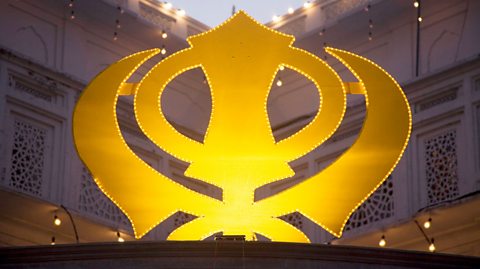
The symbol for Sikhism is the Khanda which reflects the fundamental beliefs of Sikhism. The double-edged sword is very prominent in this symbol and represents the two swords set out by Guru Hargobind Singh. Miri portrays worldly power and Piri portrays spiritual power.
The belief of Miri encourages Sikhs to understand the need to physically defend their faith and religion as a whole:
To fight and accept death for a righteous cause is the privilege of the brave and truly religious.”
Guru Nanak 579
The belief of Piri reminds Sikhs of the spiritual authority of the Gurus and current living leaders who teach that living in peace is important. Guru Arjan wrote:
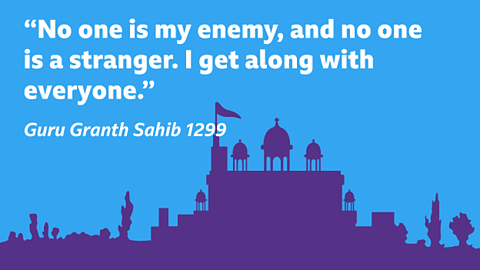
No one is my enemy. No one is a foreigner. With all, I am at peace. God within us renders us incapable of hate and prejudice."
Guru Granth Sahib 1299
Many Sikhs believe that this is encouraging them to see the light of God in all creation, and therefore seek to live in peace with others.
The two beliefs of Miri and Piri form the basis of the Sikh requirement to be a Sant-Siphahi, which is to become spiritually mature and choosing to not be part of any conflict.
However, if their faith is under threat then being a means a Sikh should defend the righteous cause. Many Sikhs recognise that working for peace is the ideal.
How did Guru Nanak lay the foundations for the justified use of force in Sikhism?
From the founding stages of Sikhism, the development of the principles under which the use of physical force is necessary and the limits that should be imposed in the use of such force can be seen. Guru Nanak condemned the Lodhi Dynasty in failing to defend the people they ruled over from the onslaught of Babber’s army. He also criticised the brutality and suffering that Babbar's army caused to non-fighting people like women and children during his invasion.
The tenth Guru, Guru Gobind Singh, formed the Khalsa, which was to build a group of devoted Sikh’s who were prepared to fight, or even die to protect freedom, truth and justice.
Question and answer
What does the Sikh symbol, the Khanda, represent?
The Sikh symbol, the ‘Khanda’, comprises three symbols in one: the double edged sword running top to bottom at the centre is the blade with which devoted Sikhs are initiated into the Khalsa; the two curved swords at the left and right respectively represent the Miri-Piri doctrine to balance temporal power with spiritual power; and finally the circular chakkar at the centre of the symbol embodies the Oneness of Divinity.
GCSE exam-style question
Explain two religious beliefs about war.
In your answer you must refer to a source of wisdom and authority.
Answers could include:
Whilst the belief of Miri encourages Sikhs to understand the need to defend their faith and religion as a whole because of teachings such as: "Death is a privilege of the brave, if they die for a noble cause.“ (Guru Nanak 579). Most Sikhs would agree that war is acceptable if their faith is under attack.
However, the belief of Piri reminds Sikhs of the spiritual authority of the Gurus who taught that war should be the last resort and to try to live in peace. This leads many Sikhs to believe that peace is best: “No one is my enemy, and no one is a stranger. I get along with everyone.” (Guru Granth Sahib 1299).
The Just War theory
There is a distinct Just War theory in Sikhism known as dharam yudh, which sets out rules for a just and fair war.
The main criteria of the theory are:
- Just reason - the reasons for going to war must be fair and be morally justified, for example, in self-defence.
- Motive for going to war - the motive for the war should be that it is what God wants and be for selfless reasons such as defence or stopping persecution. It should never be motivated by greed.
- Committed fighters - all who contribute to the war effort must be committed to the cause and are expected to adhere to codes of conduct laid out according to Sikh principles, including those soldiers who are conscripts fighting for money.
- Last resort - Sikhism emphasises that going to war must be the last resort, and war should not be declared unless all peace seeking campaigns have been tried.
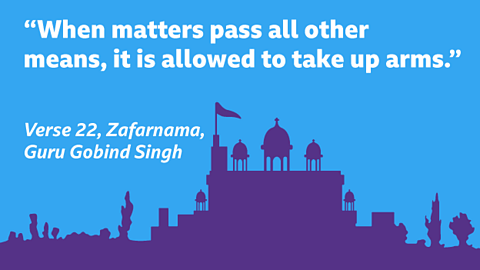
When matters pass all other means, it is allowed to take up arms.”
Verse 22, Zafarnama, Guru Gobind Singh
Further Sikh principles about behaviour for a Just War are:
- Proportional and appropriate force - only those who are fighting back should be attacked and use the minimum required amount of force, avoid harming civilians.
- Enemy challenge - enemy fighters should be allowed the opportunity to surrender and lay down their weapons and should be helped if they are not a risk. Anyone who surrenders should not be harmed. Bhai Ghanaiya, one of Guru Gobind Singh’s followers, commented that he “saw the Guru’s face in everyone,” so he was willing to look after fighters from both side of the conflict that he was involved in.
- Private property should not be destroyed.
- Women and children should not be abused.
- Treaties and concessions must be respected.
- Ceasefires should be accepted.
- Places of worship (of any faith) should not be attacked.
- Lying to the enemy is not permitted.
The crucial difference from the Christian Just War theory, which states that a war should only be entered into if there is a strong likelihood of success, is that Sikhs believe that, if a war is Just, it should be undertaken, even if it cannot be won.
Remember
Sikhism allows Just War, which must be fought honourably, but Sikhs must never be the first to draw their swords.
When all peaceful methods have failed to bring justice, it is righteous to draw the sword."
Dasam Granth
Terrorism
Terrorism is illegal and the UK’s Terrorism Act 2000 defines it as:
The use or threat of serious violence against a person or serious damage to property where that action is: designed to influence the government or an international governmental organisation or to intimidate the public or a section of the public; and for the purpose of advancing a political, religious, racial or ideological cause."
One of the main beliefs of Sikhism is the equality and freedom of all people. This means that all people should be able to live in peace and harmony, being tolerant of the beliefs of others. Therefore, any act of terrorism is seen as wrong as it is not seen as ‘truthful living’.
Truth is higher than everything; but higher still is truthful living.”
Guru Granth Sahib 62
Examples of modern terror attacks include:
- 11 September 2001, suicide attackers seized US passenger planes and crashed them into two New York skyscrapers, killing 2,977 people.
- 22 July 2011, Anders Breivik killed 77 people in Norway by firstly detonating a van bomb and then carrying out a mass shooting.
- 5 August 2012, six Sikhs were murdered while they worshipped in their gurdwara in Oak Creek, Wisconsin, USA.
- 14 October 2017, at least 587 people were killed in a truck bombing in Mogadishu, the capital of Somalia.
- 18 June 2023, Hardeep Singh Nijjar was shot and killed by two gunmen outside a Sikh temple in Vancouver.
Nuclear war and weapons of mass destruction
Weapons of mass destruction (WMDs) can kill lots of people and include chemical, biological, radiological and nuclear weapons.
Nuclear weapons are enormously powerful explosives that use a nuclear reaction. The explosions they produce are so powerful that one nuclear bomb can destroy a large city, which Does not show any careful thought, choice or planning. kills huge numbers of people.
No religion agrees with the use of weapons of mass destruction, and most Sikhs consider their use to be against the teachings of the Gurus. The dharam yudh states that civilians should not be harmed.
These weapons are deemed as collective punishment and target civilians.
The use of nuclear weapons is not morally justifiable in any situation given the far-reaching damage they cause without concern or consideration of those who are not directly involved."
Jaspreet Singh – Lawyer for United Sikhs, 2009
Jaspreet Singh also suggested that having nuclear weapons as a means of deterrence was not effective.
Most Sikhs believe that everyone has the right to life, therefore humans do not have the right to use weapons that cause death, especially weapons that are non-discriminatory in who is targeted.
Hiroshima and Nagasaki
On 6 August 1945, the USA dropped an atomic bomb on the Japanese city of Hiroshima. The blast devastated an area of five square miles, destroying more than 60 percent of the city’s buildings and killing around 140,000 people.
Three days later the USA dropped a second atomic bomb on the Japanese city of Nagasaki, killing around 74,000 people. The nuclear radiation released by the bombs caused thousands more deaths from radiation sickness in the weeks, months and years that followed.
Justice
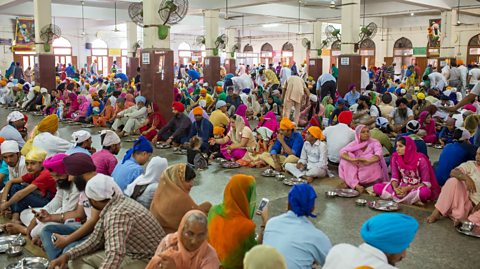
Based on teachings such as: "No one is my enemy, and no one is a stranger. I get along with everyone.” (Guru Granth Sahib 1299), Sikhs will care and serve all people in their local community. By doing this, Sikhs believe that this will help peace and justice flourish.
All members of the Sikh community are seen as equal. Sikhs’ belief in the oneness of humanity is highlighted through their actions within the gurdwara and the local community. It is out of this belief that the was developed. Justice should be built out of righteousness and forgiveness.
By allowing justice to grow in a community, most Sikhs believe that:
You shall be blessed with patience, forgiveness, truth and peace.”
Guru Granth Sahib 937
Many Sikhs believe that justice is important to prevent conflict and in dealing with the aftermath of war.
Attitudes to peace and pacifism
Peace means an absence of conflict and is the opposite of war. It can be a basis for greater happiness and harmony between all in society.
Sikhism is not a pacifist religion, although individually Sikhs may be pacifists.
Pacifism rejects all violence. Sikhism does not teach that war is always wrong, but it does teach that it is only acceptable as a final resort, and only after peaceful methods have failed.
Guru Granth Sahib 559 taught that "acting in ego, they lose and nothing comes into their hands" which many Sikhs take to mean that they should work for peace sake as opposed to anything they can gain from the peace-making process.
Guru Nanak has been described as a prophet of peace due to his beliefs of trying to do everything possible to reconcile all people and Guru Gobind Singh based this teaching on that example.
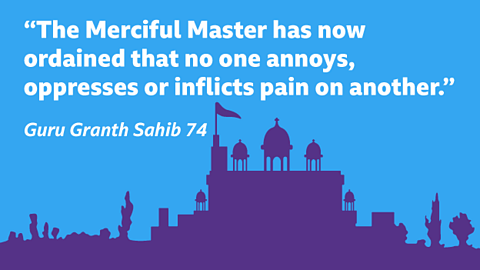
The Merciful Master has now ordained that no one annoys, oppresses or inflicts pain on another. All shall abide in peace in a regime.”
Guru Gobind Singh 74
During the struggle for Indian independence in the 1940s, many Sikh leaders led peaceful protests. Believing that whilst it was important to 'lay aside pride and attachment’ (Guru Granth Sahib 831) it is nevertheless important that justice prevails ‘in peace and tranquillity, doing acts of sublime purity.’
In the 1920s, the Akali Movement, known also as the Gurdwara Reform movement, brought together many Sikhs to peacefully protest the way the Gurdwaras were being governed in India.
GCSE exam-style question
Explain two religious beliefs about the importance of peacekeeping.
Answers could include:
Sikhs believe it is important to live in peace with everyone because they believe that there is a part of God in everyone and therefore being in conflict with others means also not being at peace with God. “No one is my enemy, and no one is a stranger. I get along with everyone.” (Guru Granth Sahib 1299).
Sikhism does not teach that war is always wrong, but it does teach that it is only acceptable as a final resort, and only after peaceful methods have failed. "The Merciful Master has now ordained that no one annoys, oppresses or inflicts pain on another. All shall abide in peace in abenign regime.” (Guru Gobind Singh 74)
Useful quotes about peace and conflict from Sikhism
1 of 5
Forgiveness and reconciliation
Sikhism teaches that forgiveness is essential to a person's vitality and that Sikhs should follow in the example of God who is all-forgiving.
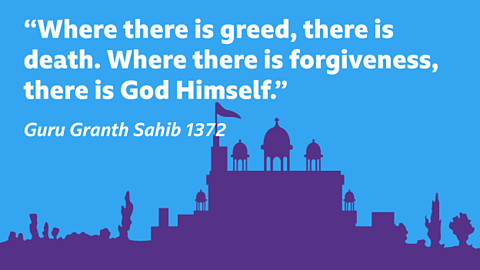
Where there is greed, there is death. Where there is forgiveness, there is God Himself.”
Guru Granth Sahib 1372
If a wrong is committed, Sikhs should recognise their responsibility in what they have done, seek forgiveness from God and also from the person that they have hurt.
Forgiveness does not mean that no action should be taken after a wrong deed, but rather that through forgiveness, peace is more likely to happen.
Forgiveness Case Study - Pardeep Kaleka

Pardeep Kaleka’s father was killed in a shooting at the local gurdwara in Oak Creek, Wisconsin in the USA on 12th August 2012.
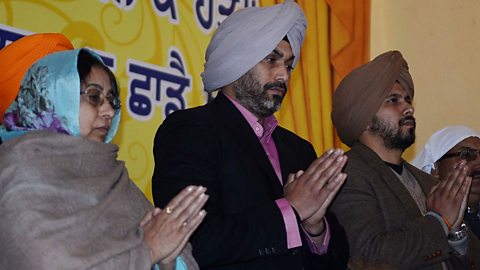
Pardeep was devastated but said: “I decided to respond to this tragedy with compassion. There is a saying in Sikhism, ‘Charhdi Kala,’ which means ‘we move in relentless optimism’. Regardless of hardships in life, I’m optimistic about the future. Charhdi Kala and compassion go hand in hand. Some people think of compassion as offering forgiveness and all is forgiven, but I think of it as a process…”.
Many Sikhs take this to mean that forgiveness is not easy but those who are able to do so need to work through it on a regular basis.
Reconciliation
Reconciliation is making up and rebuilding relationships between two sides after a conflict. It is more than just apologising, it is actively working towards peace and moving on from the situation.
The Merciful Master has now ordained that no one annoys, oppresses or inflicts pain on, another. All shall abide in peace in a benign regime.”
Guru Granth Sahib 74
As Sikhs believe that all humanity was created by one God, then humanity must not allow there to be hatred and bitterness between each other. Sikhs believe that being peaceful, united and reconciled are important qualities in all human relationships.
Gurmukh Singh OBE, in 2005 described reconciliation in Sikhism as being based on Guru Nanak’s approach, which was to:
Identify the root causes, and to show the way to a harmonious way of life.”
Religion as a cause of war and violence - holy war
A holy war is a war that is authorised by a legitimate religious authority.
As taught by Guru Arjan Dev, there have been examples of Sikhs involved in holy wars in order to protect and defend their faith. The principles of truth, justice and fighting for the common good, Sarbat da Bhalla, are part of the Bhai Nand Tankah Nama, the Sikh code of conduct.
Sikhs fought in holy wars in defence of the religion against the Mughal Empire during the 17th and 18th centuries.
The Khalsa was set up, by Guru Gobind Singh, making it obligatory for all initiated Sikhs, Khalsa, to carry a sheathed blade in recognition and as a reminder of the duty to stand up for injustice. This blade is known as the Kirpan, and is part of the 5Ks in Sikhism. Kirpan comes from two Punjabi words: ‘Kirpa’ means an act of kindness, a favour; and ‘Aan’ means honour and self-respect.
For these reasons, in Sikhism, the Kirpan can be used, and military action can take place, to promote justice and defend the faith. This was emphasised at the time of the Guru Arjan (the fifth Guru, and the first Sikh martyr) because of attacks being made against the Sikh faith.
However, Guru Gobind Singh emphasised that the Kirpan should never be raised in anger, oppression or as a way to gain power.
The true hero is the one who struggles for the poor and the helpless.”
Bhagat Kabir – Indian poet and saint
Sikhism scripture quiz
More on Sikhism
Find out more by working through a topic
- count1 of 2