Key points
A force is a push or pull that causes a change in speed, direction or shape.
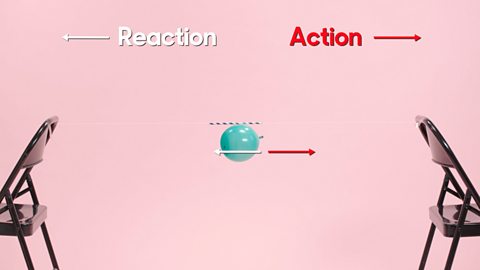
Newton’s third law says that for every action there is an equal and opposite reaction.
This means that when one object pushes on another with a force, the other object pushes back on the first object with the same force.
Video: How to explain forces
Ok guys, we're going to be talking about how to explain forces.
And for this one, we're going to make a rocket, even if it is a model.
To start, get yourself a balloon, some sticky tape, a long piece of thread (about 150 centimetres in length), and a straw.
Take the straw and put the thread through the middle.
Tape each end of the thread to a wall or between two chairs.Just make sure it's tight and secure.
Blow up the balloon and…I mean, let's try that again.Blow up the balloon and keep a hold of the end.
Tape the straw to the top of the balloon, still keeping hold of the end so no air escapes.
Move the balloon and straw to one end of the thread and let go.
And there you are, a balloon rocket.
But what has this got to do with forces and more specifically Newton's third law?
Well, Newton says that every action has an equal and opposite reaction.
In this instance, the action is the force by the balloon on the air inside it as it squeezes it out and goes back to its small shape,while the reaction is the force of the air on the balloon, causing the balloon to accelerate in the opposite direction to the motion of the air—just like the thrust from a real rocket.
Good old Newton, the guy knew his forces.
Have a go

Image caption, WHAT YOU NEED: Some sticky tape, a long piece of thread, a balloon and a straw.




1 of 5
Forces
Newton’s third law says that for every action there is an equal and opposite reaction.
In the case of the balloon in the video, the action is the balloon pushing the air backwards; the reaction is the air pushing the balloon forwards. It is this force that makes the balloon move.
How does Newton's Third Law apply to us?
We cannot move independently. We require a force acting upon us from elsewhere.
When we want to move, our feet try to push the ground backwards. But it is the A force which acts against the movement of an object. from the ground that pushes us forwards.
Who needs to know about forces?
Engineers designing transport need to consider forces. Something always needs to be pushed backwards if the vehicle is to move forwards.
An aeroplane’s The force which acts on a moving object to cause it to move. Thrust is often generated by an engine, for example in a car, rocket or aeroplane. depends on how much and how quickly its engines can push back the air. Boats need to consider how much and how quickly water can be forced backwards.
Quiz - Test your knowledge
Solve the Story!
An exciting new series from the Other Side of the Story, designed to help young people strengthen their media literacy skills.

More on Forces and movement
Find out more by working through a topic
- count15 of 16
- count16 of 16

- count1 of 16