Key points
Water A measure of how concentrated (or spread out) a force is. Pressure is measured in pascals (Pa). at a particular point comes from the weight of water above it.
Pressure in One of the three states of matter. Liquids, like water or oil, do not have a fixed shape and can flow.increases with depth, so the deeper you go the greater the pressure.
Pressure exists on surfaces, in air and in liquids.
It is calculated by force ÷ area.
How does water pressure increase with depth?
This short demonstration will show that water pressure increases with depth
This experiment is all about how to show pressure exists in water, and it's not the pressure of exams or homework.
First, you'll need the following items: an empty drinks bottle, some sticky tape, a pin, a pencil, some water and a large container to catch the water in, like a sink or a bath.
Take your bottle and make three holes down the side at different heights.
You can do this with a pin initially and then use a pencil to widen the holes. Watch your fingers though. Try and make sure the holes are a similar size.
Cover each of the holes with one long piece of sticky tape.
Fill the bottle with water to the top. Get all of that water in there.
Take the bottle to the sink and remove the piece of tape quickly in one go like a plaster. Unsurprisingly, you'll see the water starts to spill out through the holes.
But why does the water at the top come out at a different speed to the water at the bottom?
Well, that's because of water pressure. Water pressure increases with depth.
The weight of the water above the hole pushes the water out. The less water above, the less pressure there is. Equally, because there is more water above the second and third holes, the water comes out with more force.
As the water level lowers, the force of all the jets decreases because there is less weight of water above each hole.
It's the same reason your ear starts to hurt when you swim down to the bottom of a pool. The more water above you, the greater the pressure.
So next time you're thinking of taking a dip, don't let the pressure get to you.
Have a go
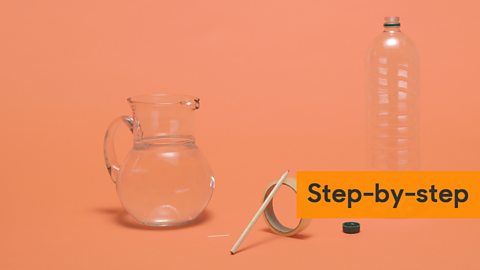
Image caption, Click to see a step-by-step slideshow.

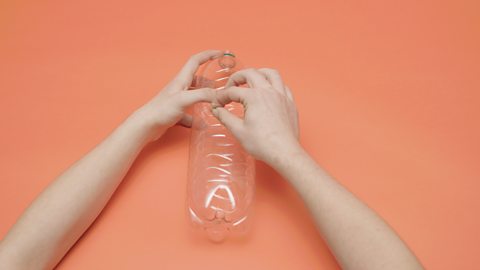
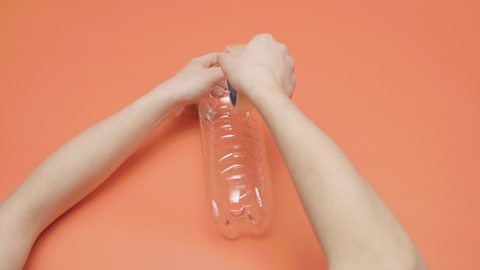
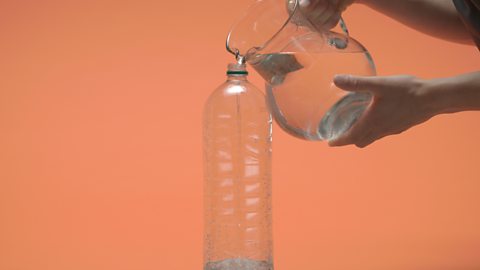
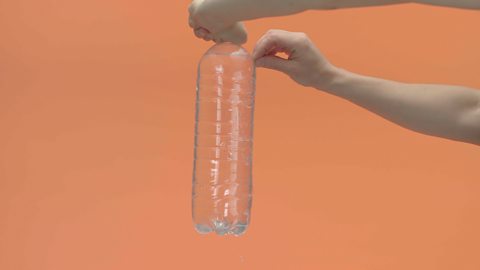
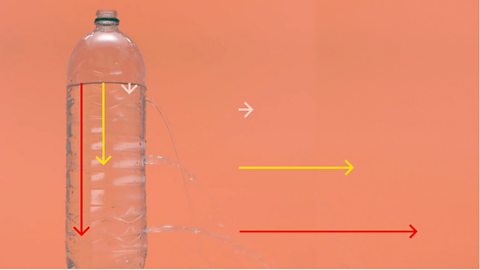
1 of 7
How does water pressure work?
The demonstration shows that the water pressure at each hole, depends on the The amount of space an object occupies, usually measured in m³ or cm³.of water above it. The bottom hole has a greater amount of water above it, meaning there is greater pressure there.
As the water comes out of the holes, the water level falls, meaning the jets of water from all of the holes slow down.
Air pressure works in a similar way. The air pressure where you are, is determined by the weight of the atmosphere above you.
If you climb a tall mountain, the air pressure decreases because there is less air above you.
Who needs to know about water pressure?
Divers need to be aware of pressure in water. If you dive to the bottom of a swimming pool, your ears may start to hurt. This is due to the extra pressure around you.
Deep sea divers train themselves to go many times deeper and need to know how to cope with this extra pressure.
Submarines can go very deep. They must be designed carefully to handle the enormous water pressure at those depths.
At the bottom of the ocean the pressure is equivalent to an elephant standing on your finger, so submarines have to be very strong indeed!
Test your knowledge
Play the Atomic Labs game! game
Try out practical experiments in this KS3 science game.

More on Forces and movement
Find out more by working through a topic
- count1 of 16
- count2 of 16
- count3 of 16

- count4 of 16