What are the key themes?
Three of the main themes in My Name is Leon are belonging, responsibility and loss and grief.
The author, Kit de Waal, creates the theme of belonging by exploring Leon’s sense of identity and loyalty.
Ideas about responsibility are used to explore the relationships in the novel.
Loss and grief is a key theme of the novel, and affects several characters throughout.

Remember
A theme is a big idea that can be found throughout the text. It is created by repeating images and ideas.
Belonging
My Name is Leon is about a child trying to make sense of the world and his place in it. This means that the theme of belonging runs throughout and is the major theme of the novel.
There are also more minor themes such as loyalty, family and race.
Loyalty
A large part of Leon’s sense of belonging comes from his loyalty to his mother and brother. From the start of the novel, he sees the three of them as a close-knit family unit and does everything he can to keep them together.
Despite being unable to rely on Carol, Leon’s love for her remains Never changing or becoming weaker.: he interprets every small physical gesture from Carol as evidence of her love and tries to comfort her when they are both grieving Jake’s adoption.
When Leon reads the social worker’s negative report on Carol, his response is to act out angrily.
Maureen encourages Leon’s loyalty to his family, for example in the importance she places on Leon having a photo of Jake.
Leon in turn starts to show loyalty to Maureen because of her honesty and the way she respects Leon’s feelings. Leon is comfortable with Maureen because he believes that "she is the only one who has never lied".
Family and friends
The novel also explores what belonging to another family might be like.
Leon feels angry when he thinks he might be mistaken for Maureen or Sylvia’s child. However, Kit de Waal presents Maureen’s family life in a positive light: there are lots of family photos on display throughout Maureen’s home, and Maureen treats both her biological and fostered family the same.
Despite their different personalities, Maureen and Sylvia have a strong family bond.
Friendships are important to creating the theme of belonging in the narrative. Leon’s unlikely friendship with Tufty and Mr Devlin makes all three less lonely, and Leon feels pleased to be a part of the wider community at the allotment.
The belonging that comes from friendships also ensure that someone is ready to help in emergency situations, such as when Leon runs into the riots or when Tina calls for help.
This is contrasted with what happens when there is an absence of friendships: for example, Sylvia’s concerns that Leon has no school friends to invite to his birthday party. Unusually for a child of his age, school is rarely in Leon’s thoughts and it is clear that he feels like an outsider there.
Race and identity
Leon is mixed-race and points out the physical differences between himself and his white brother Jake from the start: Leon is "light brown", but Jake has "dusty blue" eyes and "blonde hair". He observes that they have similar eyebrows and fingers as a way of linking them together.
There are some flashbacks in the novel where Leon remembers meeting his Linked or related to a father. grandmother, and an awkward Christmas Eve when his father briefly turns up at Leon’s house with presents. In both memories, there is an emphasis on Leon’s physical resemblance to his father.
Much to Maureen’s anger, Jake’s whiteness is Mentioned as proof or a reason why something has happened. as the partial reason why he was adopted quickly and separately to Leon.
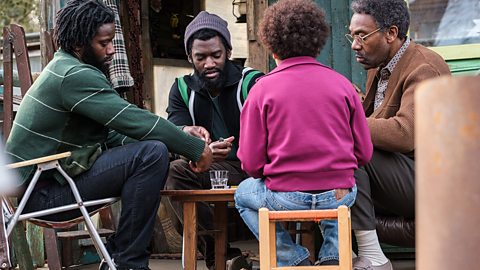
At the allotments, the gatherings with Tufty, Castro and other Black men make a huge impression on Leon. They talk like Leon’s dad used to, "except they are laughing all the time and making jokes", which makes Leon feel at home with them.
Although some of these discussions the men have around race and violence are political and difficult, the men also share their connection in more joyous ways, such as Tufty’s use of poetry to bring the group together.
The historical events featured in the novel also highlight the different ways that identity can shape the characters’ experiences. Tufty and Castro are targeted because of their race and political beliefs, and there is A strong feeling of dislike or hatred. towards the Black and working-class protesters in the riots.
By contrast, Sylvia’s A natural liking for and understanding of someone or something. to the Royal Family is more socially accepted and gives her a positive experience of leading the community on her street in planning celebrations.
Question
What is Kit de Waal trying to convey about belonging?
Characters who are isolated, like Carol and Leon, are the ones who suffer the most.
Loyalty is an important part of keeping relationships together, but blind or unquestioning loyalty can be very damaging.
Building a sense of identity does not have to come from a biological family: it can be created and supported by being part of a wider community.
Responsibility
Responsibility is a major theme in the novel and De Waal uses several minor themes, such as duty and growing up, to show its importance.
Relationships
We see how responsibilities are shared across different relationships in the novel.
Carol has a parental responsibility towards Leon and Jake.
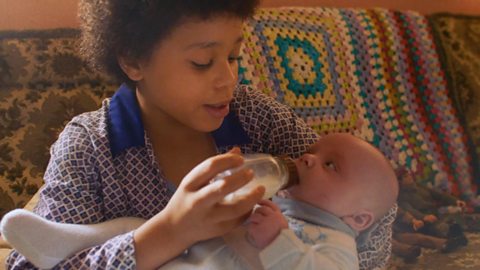
Throughout the novel, Leon takes on the responsibility of an older sibling towards Jake.
Both Leon and Jake’s fathers reject their parental responsibilities.
Zebra takes responsibility for keeping Carol and Leon in contact with each other.
Later in the novel, Maureen and Sylvia share caring responsibilities for Leon.
Duty
Several of the characters act out of a sense of duty, taking on responsibility even when they might not be expected to.
Sylvia
The main example of this is Sylvia taking in Leon after Maureen is admitted to hospital. Despite her initial lack of a relationship with Leon, Sylvia becomes an immediate 'safety net' for him to avoid Leon going to a care home or another foster family. At first, Sylvia does this out of duty to her sister, until she forms her own bond with Leon.
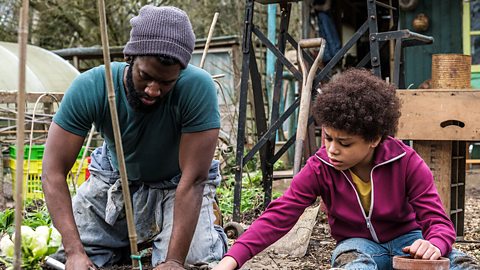
Tufty and Mr Devlin
Tufty and Mr Devlin both act as In this context, someone who takes the place or role of someone else. parents to Leon. For most of the novel they do this separately, but they both sense that they are acting as role models for Leon, who needs guidance and care.
Tina
Even though she has a minor role in the novel, Tina is a character that de Waal uses to explore ideas about duty and responsibility.
Tina is Carol’s neighbour. She is not a close friend, but she does visit Carol in hospital and Leon is told to call her "Auntie Tina".
We learn that Tina has taken care of Leon repeatedly in the past when Carol was finding things difficult.
Tina alerts the ambulance and social services when she finds Carol in danger, and feels a duty to also look after Leon and Jake that night.
Growing up
The novel also explores how Leon’s responsibilities change as part of his growing up.
In their meetings after he is taken into foster care, Leon takes the responsibility of being aware of his mother’s needs. He offers to be more like Jake if it will help Carol feel better, and he is quiet and Someone who follows the rules or always agrees with others. when Carol is upset. Leon holds in his feelings until after Carol has left.
Leon believes he cannot rely on other adults, so he takes on responsibility for reuniting his family. Leon lies for Carol and steals for Jake, and he does these things believing it is in their best interests rather than for his own gain. Leon plans as carefully as he can to find a new home for Jake and Carol. For most of the novel, Leon is convinced that he is the only person able to look after Jake successfully.
Sometimes Leon is given the responsibility of having to behave in a way that keeps the adults happy, and this is usually Introduced before something more important. by comments on how he looks and acts older than he is. This is sometimes known as Treating or considering a child as if they are an adult, usually in a way that is wrong or harmful..
Leon’s responsibilities as he grows up can be positive: for example, he has a great sense of accomplishment as he learns to take care of the plants at the allotment.
Context: the foster care system
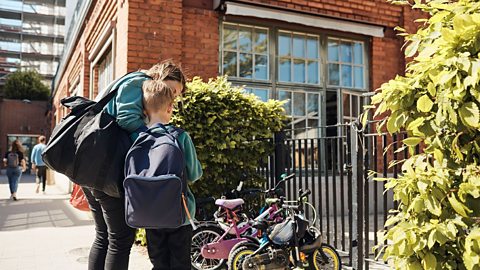
In the novel, Maureen and Sylvia take responsibility of Leon as foster carers. This is how the system works in the UK.
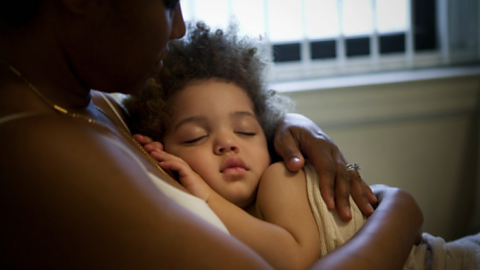
Image caption, Fostering is when children live with another family because they are no longer able to live with their own family. The arrangement might be temporary or more permanent and can happen for a variety of reasons. It is the foster carer’s job to look after and care for the child during this time.
1 of 3
Loss and grief
Many of the characters’ most difficult moments in the novel are emphasised by loss and grief.
Leon’s stealing is Representing an idea or quality. of his loss. It is a way for him to reclaim what has been taken from him, although the stolen items have a practical value too. His grief is also expressed through intense frustration and a desire to ‘swallow’ his words down.
Many of Carol’s behaviours in the novel are To have made something that is already bad, worse. by her illness, but she also grieves what she has lost: care of Leon and Jake; Jake in his adoption; love and commitment from Leon and Jake’s fathers. These losses could explain her varying emotional responses to Leon, which in turn affect other characters in the novel.
Maureen's illness forces the separation of Maureen and Leon just as their bond has formed, which becomes another, temporary, loss for Leon. Sylvia's grief about Maureen’s illness leads to her becoming overprotective of both Leon and Maureen.
Mr Devlin has also experienced traumatic loss and grief, and his secrecy causes Tufty to act suspiciously towards him. Tufty is able to show Devlin compassion once he discovers the real reasons behind Devlin’s actions.
By the end of the novel, the characters have found ways to deal with their losses and feelings of grief. Even though there is no reunion with Jake at the end, Carol and Leon are more hopeful and know that he is in a safe place.
Mini quiz
Quiz
Test your knowledge of the themes in Kit de Waal's novel My Name is Leon by taking this multiple-choice quiz.
GCSE English literature revision podcasts. audio
Whether you're at home or on the go, listen to these podcasts by Bitesize and BBC Sounds to refresh your memory of key texts.

More on My Name is Leon
Find out more by working through a topic
- count1 of 5
- count2 of 5