Who are the key characters?
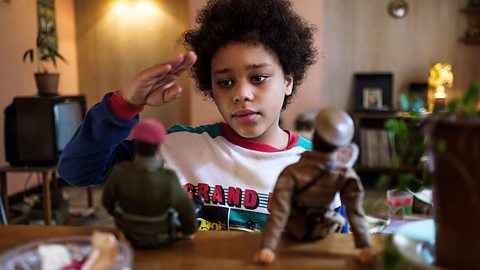
My Name is Leon has one main character: Leon, a 9-year-old boy from Birmingham.
There are a number of secondary characters in the novel: Carol, Maureen, Sylvia and Tufty.
All of the characters in the novel are fictional, even though the writer, Kit de Waal, based some of the events on her own experiences.

Remember
In your exam you will be asked to write about a character or a theme. If writing about a character, you should include:
Key moments for the character
If and how the character changes throughout the novel
de Waal’s intentions and message relating to the character
How an audience might respond to the character.
Leon
Learn about the character of Leon in My Name is Leon by Kit de Waal
Narrator: ‘The empty sound in the house is louder than Jake crying for his bottle.
It's louder than his laugh. Louder than his baby drums.’
Presenter: This pivotal moment in Kit de Waal’s My Name is Leon sees Leon struggle to come to terms with the fact that his brother, Jake, has been adopted - but he hasn’t.
The ‘empty sound’ echoes Leon’s emotional state in Jake’s absence, and the oppressive silence juxtaposes Jake’s loud drums - all setting up the sense of loss and grief that he will struggle with throughout the rest of the book.
At the start of the book, loyal, independent Leon is shown caring for Jake whilst his mother is in bed, ill.
Both boys soon find themselves living with Maureen, a foster-carer.
The book is written from Leon’s perspective - so whilst most of the adults around him see Leon as vulnerable, the reader is shown how he sees himself as strong and independent; he struggles with the difference between how he views himself and how he’s treated.
Soon enough, Leon finds himself separated from his brother - a key moment that explores the theme of identity.
Maureen says to Leon that Jake is being adopted because he is 'a baby, a white baby.’
Leon - an older boy from a mixed heritage background, remains in foster care with Maureen, who says that the situation is 'not fair at all' for him.
For Leon, the care system, and his family circumstances, bring a lot of frustration, leading to moments where he struggles to manage his emotions.
Like when his biological mum comes to visit and he fears being let down by her.
Narrator: ‘lots and lots of words, most of them bad, come into his mouth and he has to swallow them down as usual.’
Presenter: Later, hearing 'half a conversation' that leads him to fear that Maureen plans to leave, Leon runs away from home, only to find himself caught up in a city riot.
There he begins to realise that the issues he faces as a boy of mixed heritage aren't only experienced by him in the care system, but by others too - including his friend Tufty from the allotments.
In the aftermath of the riots, Maureen reveals that she wants to adopt him and Leon realizes he has stability with her and Sylvia, alongside a wider sense of community at the allotments - all helping him to begin to process his grief and understand his identity.Author Kit de Waal's mother was a foster carer.
What do you think she could be saying - through Leon's story - about the care system in the UK and its effects on young people within it?
Loyal
Vulnerable
Observant
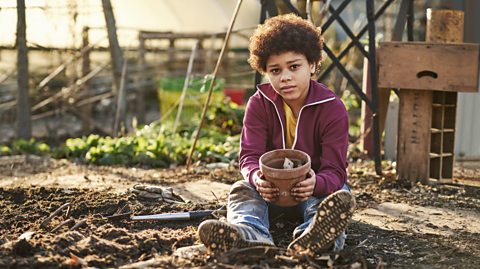
Leon is a 9-year-old boy from Birmingham. The story is presented from his perspective. This means that the reader does not discover anything unless it is seen or heard by Leon.
Leon is loving and loyal to his mother, Carol, and baby brother, Jake. He tells Jake everything and is the only person who can make Jake laugh. Leon is gentle with his mother and forgiving: he does everything he can to avoid other people finding out about her depression.
Leon does not see himself as vulnerable, although most of the adults around him do. He finds it difficult to To find a way of making two different ideas exist or be true at the same time. his view of himself as strong and independent with other people’s attempts to take care of him. He is often frustrated when he feels that he is not in control.
However, there are times when Leon is treated as older than he is. He is called a "little man" and "little soldier" when adults are trying to praise him, give him responsibility or smooth over a difficult conversation. Although Leon longs to be seen as grown-up because he thinks that he will be taken more seriously, this attitude from some adults means that his needs as a child are sometimes ignored.
- Leon is also curious and observant.
He learns a lot about the adults around him when they assume he isn’t paying attention.
Sometimes he misinterprets what he hears, like when he thinks that Maureen and Sylvia will move away without him.
At other times he is Skilful at understanding behaviour and situations., for example: "The Zebra sounds annoyed and Leon realises that she’s in charge of Bob and Bob doesn’t like her".
- He has a clear A set of personal rules for behaviour..
He knows that Jake’s needs should be prioritised, and he feels that his family should be kept together.
He knows right from wrong, and despite his young age he tries to behave in ways that will help him avoid unwanted attention.
Sometimes he is successful at keeping his emotions under control, like when "lots and lots of words, most of them bad, come into his mouth and he has to swallow them down as usual".
At other times, this is too hard, and the emotions come through as a dramatic incident, like when he makes a deliberate mess in Sylvia’s bathroom.
He also steals a number of items over the course of the novel. His A good reason or explanation for something. is that “Everyone steals things from me”. Stealing gives Leon a feeling of control as well as power in the form of money to buy things for his planned reunion with Jake.
After the dramatic events towards the end of the novel, Leon feels more secure. He keeps his interest in gardening at the allotment, is surrounded by adults who he can trust and who treat him well and is on a path to Two people or groups becoming friendly again after an argument or separation. with Carol.
Question
What evidence could be used to show how Leon’s thoughts and feelings are presented throughout the novel?
| Quote | What this says about Leon |
|---|---|
| "She says it’s the same basket Moses had but it looks new." | This is an example of Leon’s child-like misunderstanding: he does not realise that the generic name of a Moses basket, a small cot for babies, does not mean that the basket once belonged to the Moses in the Bible. |
| “I’m the one in charge of my baby when Mum’s not there.” | This highlights Leon’s protectiveness towards Jake. His use of "my baby" rather than ‘brother’ suggests that he sees his caring role as equal to Carol’s. |
| "She squeezes his fingers and he can feel her love travelling all the way down from her heart into his." | This shows how Leon is desperate for physical affection and displays of love from Carol. He imagines their tiny contact is proof of a secret yet powerful love that bonds them together. |
| “I could be him, Mum.” | This moment shows how observant Leon is about his mother’s feelings and how much he wants to share his grief about Jake with Carol. Leon is naively willing to give up his own identity and imitate Jake if that is what will make Carol happy. |
Carol
Fragile
Unwell
Unreliable
Carol is Leon’s mother. She is in her early 30s. At the start of the novel, she lives with Leon and Jake, but when the boys are taken into Temporary care for a child who can’t live with their own family. her time with Leon becomes much more Happening occasionally, at random times..
Like the other characters in the novel, everything the reader learns about Carol is something we have seen or heard through Leon, and Leon is devoted to her. Despite this Preference for or against one person or group., the reader is able to To work something out from evidence and logic instead of explicit statements. that many of her actions are not helpful for Leon or Jake, and sometimes even hurt them.
Carol’s actions can seem frustrating and sometimes distressing to the reader, especially when she seems to be helpless and unaware of her children’s needs. She also appears unable to look after herself.
The reader learns more about Carol’s background through different snippets in the text, like an overheard phone conversation or when Leon steals a file on her from a social worker. We learn that Carol’s actions have been influenced by drug and alcohol dependency and mental health problems.
Carol expresses feelings of both love and guilt later in the novel. Like Leon, the expression of her emotions can be intense. At one visit with Leon, she opens up about her diagnosis of A type of depression that some parents experience after having a baby. and cries so loudly about Jake’s adoption that Maureen has to ask her to stop scaring Leon. When Leon visits Carol at the Family Centre, she treats Leon like he is a baby, and then openly grieves Jake’s adoption again.
At the end of the novel, there is a suggestion that Carol is trying to successfully rebuild her relationship with Leon. She acknowledges her inability to care for Leon and is supportive of Maureen.
Question
A year after her children were taken into foster care, Carol reveals to Maureen that she was diagnosed with post-natal depression.
What is post natal depression and how does it affect Carol's character?
Post-natal depression affects more than one in ten women within a year of giving birth. It can also affect fathers and partners.
Symptoms might include feelings of anxiety and hopelessness, not wanting to see friends and family, loss of appetite, sleep problems and frightening thoughts. Doctors can offer a range of treatments to help treat these symptoms. Post-natal depression can affect any parent.
In the novel, Carol's post-natal depression makes her become helpless and distant which causes her to struggle to look after Leon and Jake. Carol is so unwell that she does not feel able to ask for help or visit a doctor.
Maureen
Caring
Trustworthy
Principled
Maureen is Leon’s foster parent. She later adopts Leon. Maureen is an experienced foster carer and grandmother who is caring and protective of Leon.
Maureen works hard to gain Leon’s trust through showing him love and care. She is patient and listens to Leon. At the same time, her rules and routines are clear and non-negotiable. Maureen respects the bond Leon has with Jake and she does not To speak or behave towards someone in a way which seems friendly, but which shows that they think they are superior to them in some way. Leon like some of the other adults in his life.
It is clear to the reader that Maureen is trusted by many others and that therefore Leon can trust her too. Maureen’s affection and the language she uses with Leon help to show him that he is in a safe and stable home with her.
Maureen uses honesty and humour to help build this trust with Leon, like in their discussion about the existence of Father Christmas. When Jake is adopted, Maureen gives Leon the chance to process his grief about their separation.
Maureen is also very Someone who acts in a moral way with a clear sense of right and wrong.. She is devoted to her role as a foster carer and is outraged at the decision to split up Leon and Jake. Maureen puts Leon first and believes in always acting in his best interests. A good example of this is Maureen’s relentless approach to getting Leon a photo of Jake from Jake’s new parents.
Unlike most of the other characters, Maureen does not change over the course of the narrative. She has had physical health challenges, but her loving and caring attitude remains stable. Maureen is consistent in her love for Leon and adopts him at the end of the novel.
Activity: Maureen’s appearance
Look at this description of Maureen from Chapter Six.
Maureen’s house smells of sweets and toast and when she stands near the kitchen window with the sun behind her, her fuzzy red hairstyle looks like a flaming halo. She’s got arms like a boxer and a massive belly like Father Christmas. On the kitchen wall there is a giant wooden spoon and it says ‘Best Mum’.
What might each part of her appearance symbolise?
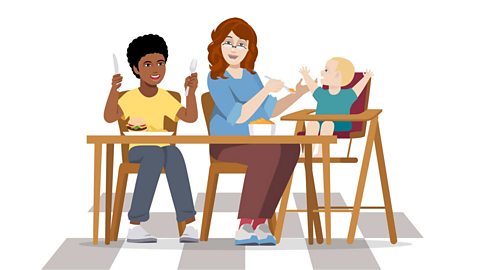
Some ideas you might have come up with are:
The smell of sweet food represents nourishment and that Leon will be taken care of
The "flaming halo" symbolises Maureen’s role as a powerful angel in Leon’s life
The "arms like a boxer" suggest safety and security
The comparison to Father Christmas suggests joy and generosity
The giant "Best Mum" spoon represents the love and respect Maureen’s children have had for her and the role Maureen will take on for Leon.
Sylvia
Cynical
Relentless
Honest
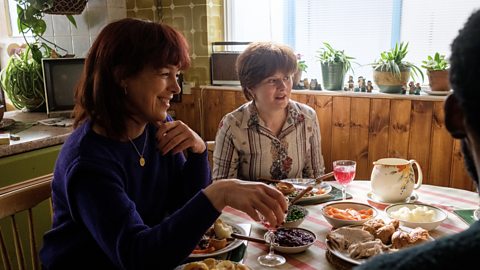
Sylvia is Maureen’s sister. She takes care of Leon while Maureen is in hospital so that he does not have to go to another foster carer.
Sylvia is very different to her sister. She does not have any children and works part-time at a supermarket. On the outside, Sylvia is Not trusting other people’s motives.. For example, she does not celebrate her birthday, saying its just “one bloody number for every year I’ve been alive”. She is wary of Leon when she first meets him.
However, Sylvia has got a caring and Doing things in a careful and fair way. side. She is very protective of Maureen and will do anything for her, including taking care of Leon.
Sylvia can be Doing something in an intense and determined way. in her interactions with others. She has a natural curiosity and asks a lot of questions; she is talkative and direct. She takes an interest in all of Leon’s activities, although doesn't always "leave him any space to answer".
Sylvia spends a lot of time planning a local street party for the wedding of Prince Charles and Lady Diana, getting many of her neighbours involved.
Sylvia and Leon eventually develop a trusting bond through their shared love of Maureen and she is often able to make him laugh. In the final chapter, it is clear that Sylvia is happier now that Maureen is living with her and she is enjoying her new relationship with Mr Devlin.
Mini quiz
Tufty
Sociable
Protective
Knowledgeable
Tufty, also known as Linwood or Mr Burrows, is a man who Leon meets at the allotment. Tufty is part of a group of Black men who meet to play dominoes and discuss political events, including police To unfairly treat someone or a group of people differently..
Although he shares some of the same ideas, Tufty has a much more optimistic attitude than some of the other members, believing that words are better than violent protests. This optimism is also visible in his interactions with Leon and his patience in teaching him about plants. He tells Leon:
You can manage in the sun what you can't manage in the rain.
Tufty is one of several adults who are protective towards Leon in the novel. When he first meets Leon, Tufty is clearly aware of Leon’s youth and his vulnerability, but like Maureen he does not patronise Leon.
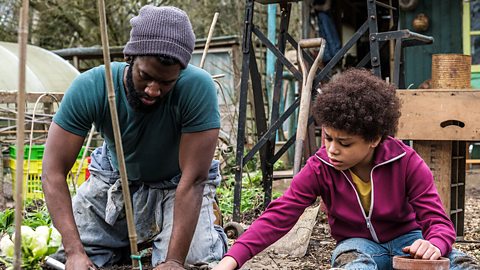
Tufty introduces Leon to other people at the allotment and teaches him how to care for various plants and use a range of gardening tools. He is, wrongly, suspicious of Mr Devlin’s motives in befriending Leon and starts a fight with Mr Devlin with the intention of keeping Leon safe.
Later, Tufty and Mr Devlin put themselves in danger trying to save Leon when they get caught up in the riots, showing Tufty’s selflessness.
Tufty is another trustworthy adult role model for Leon to look up to. Leon describes him in awe, saying Tufty ‘moves like a cross between a ballet dancer and a soldier, graceful and dangerous’. He has several interests beyond the allotment, including martial arts, reggae music and writing and performing poetry.
Activity
Other characters
Zebra/Judy
Zebra is the name Leon gives to his social worker, Judy, because of her hair. Zebra is the person who finds and gives the bicycle to Leon.
She is professional and honest with Leon, and appears to go above and beyond her role to help Leon, for example when she makes a long early-morning journey to collect Carol so that Leon can see her.
It takes a long time for Leon to trust Zebra because he has had difficult experiences with other social workers.
Mr Devlin
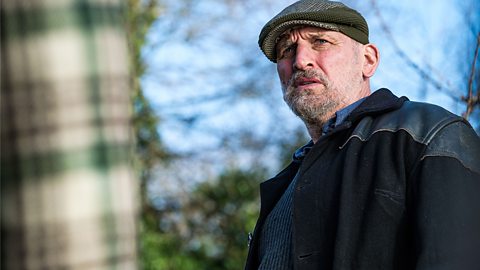
Mr Devlin is an older Irish man who has a shed at the allotment.
For most of the novel, Tufty is suspicious of Devlin’s photographs and wooden carvings, and his relationship with Leon. It is later revealed that when he lived in Brazil, Devlin experienced some family tragedies and this explains a lot of what Tufty had misinterpreted.
Devlin is strong-willed and puts himself at risk to save Leon during the riots. At the end of the novel, it seems that Devlin is in a romantic relationship with Sylvia.
Castro
Castro is one of the men who plays dominoes with Tufty. He is very vocal at the meetings in the allotment and he leaves a lasting impression on Leon, who sees him as powerful and intelligent. However, he gets angry with the police when they arrive to search the allotment and the police threaten him.
Castro later hides in Tufty’s shed when he is on the run from the police after being charged with resisting arrest. The writer uses Castro to express some of the political ideas about the events that lead to the riots.
Question
There are many minor characters in the novel. Most of them are adults and Leon doesn’t know all of their names. What is their purpose in the story?
Leon does not have many friends of his own age and he is often surrounded by adults who sometimes ignore or patronise him. The anonymity of these adults represents how lost Leon can feel when trying to speak to them. At the same time, some of these adults are there to show that there is plenty of kindness towards Leon beyond those people who know him well: for example, Mr and Mrs Arwal at the allotment.
Quiz
Test your knowledge of the characters in My Name is Leon by taking this multiple-choice quiz.
GCSE English literature revision podcasts. audio
Whether you're at home or on the go, listen to these podcasts by Bitesize and BBC Sounds to refresh your memory of key texts.

More on My Name is Leon
Find out more by working through a topic
- count3 of 6
- count6 of 6