Transformations
Transformations change the size or position of shapes.
The 4 transformations of 2D shapes that you should know are covered in M5, M6 and M7:
- translation – moving a shape in a straight line
- reflection – flipping. a shape to create a mirror image
- rotation – turning a shape
- enlargement – changing the size of a shape by a scale factor
In the exam you may be asked to draw and/or describe transformations.
In Module 8 (M8), there may be questions on any of the transformations work at M5, M6 and M7 as well as:
- enlargement using a negative scale factor
- combined translations
Enlargement with a negative scale factor
An enlargement with a negative scale factor produces an image on the other side of the centre of enlargement. The image appears upside down.
Example
Enlarge triangle G by a scale factor of −2 about the centre (−2, 3).
Solution
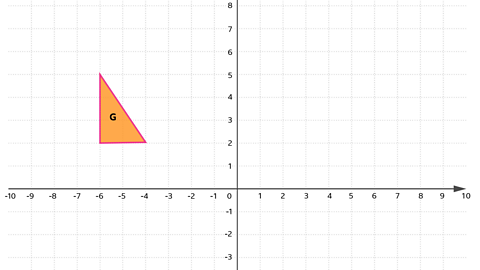
Image caption, Step 1
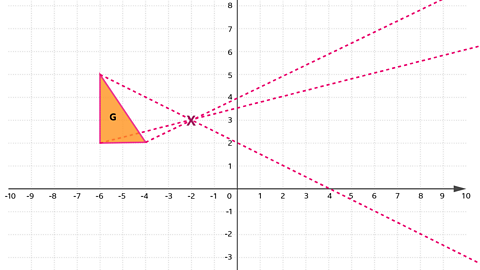
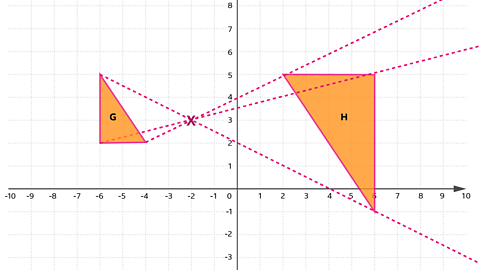
1 of 3
The rectangle ABCD has been enlarged by a scale factor of \(–\frac{1}{2}\).
The lengths in rectangle A'B'C'D' are \(\frac{1}{2}\) times as long as rectangle ABCD. The distance from O to A'B'C'D' is half the distance from O to ABCD.
Question
Describe the transformation which maps triangle Q onto triangle P.
Draw from each point on the triangle Q to the corresponding point on triangle P.
The centre of enlargement is where they cross \((-1, 5)\) which is between the two shapes so it must be a negative scale factor.
All of the sides in P are 3 times as long as the sides in Q making the scale factor \(–3\).
Combining transformations
Transformations can be combined by doing one transformation and then another.
Example
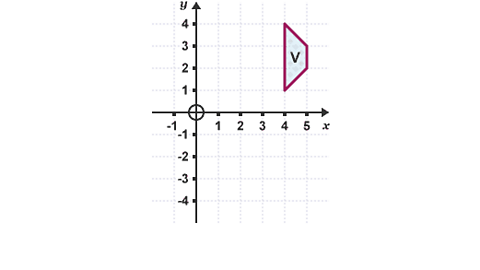
Image caption, Reflect the shape V in the line x = 2, followed by a rotation through 180° about the point (1,0).
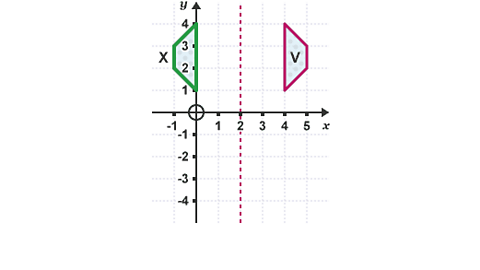
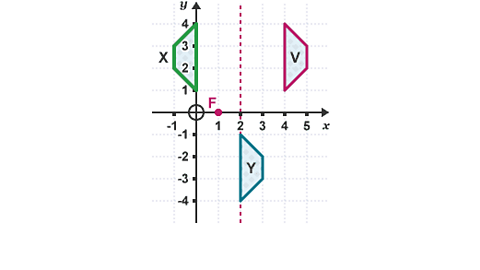
1 of 3
Example
Question
Reflect triangle M in the line \(x = –2\) and then rotate the image 90° ACW about the point \((–2, 2)\).
- Draw the final image after the two transformations
- Describe the single transformation that maps the final image back onto triangle M.
Solution
– The single transformation which maps the final image back to M is a reflection in the line \(y = –x\).
Test yourself
Question
Describe a single transformation that is equivalent to a reflection in the \(x\)-axis followed by a reflection in the\(y\)-axis.
First, drawing a diagram will help.
The shape has been rotated 180° about the origin.
More on M8: Geometry and measures
Find out more by working through a topic