Watch: What is a biography?

A biography is a non-fiction text about someone's life.
Biographies are true pieces of text, based on fact, so biographers (the people who write biographies) have to do a lot of research. They use websites, letters, photographs, diaries and newspapers to help them.
Because biographies are written by someone else, they are written in the third person(he/she/they).
They are usually written in chronological order (the order in which events actually happened).
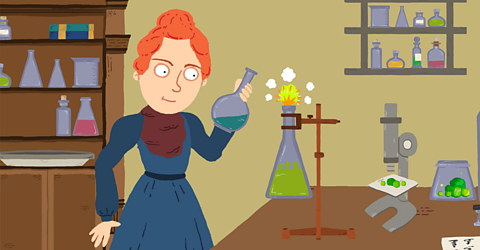
For example, watch this clip. It gives a biography of the scientist Marie Curie.
Marie Curie lived over 100 years ago and was a world-famous scientist.
There was a time when people didn't think that women were clever enough to work in science.
We know today this is nonsense, but not then.
One woman, Marie Curie, helped change the lives of people all over the world and showed that girls are as good at science as boys!
When Marie lived in Poland girls were not allowed to go to university, so her parents had to send her in secret.
She later moved to Paris to study.
Marie married another scientist, Pierre. They worked together to find out about the tiny parts, called elements, that make up everything in our Universe.
They discovered a new element that gave off rays of heat and light - they called this radium. They studied the light and heat it gave off and called this radioactivity.
They were given the most important prize in the world for science: the Nobel Prize. Marie was the first woman ever to receive this!
Marie and Pierre found that radium could help the body fight cancer cells.
Sadly Pierre died when he was just 46. Marie took over his teaching job at the University of Paris - she was so good they made her a professor. The first woman professor the university ever had!
A few years later, Marie won another Nobel Prize and the university built her a laboratory.
Marie worked hard to find a cure for cancer - nobody knew that working with radium was dangerous. But it was and because of this Marie became very ill and died.
Marie Curie inspired others to continue her work.
Over time, this has saved the lives of many people all over the world and, of course, showed people that women are just as able to study science as men!
Watch: Biography of Stephen Hawking
Even though biographers do lots of research, they can only guess at what it was like to be that person, or the thoughts and feelings the person had.
If the person they want to write about, or anyone who knew them, is still alive, biographers sometimes carry out an interview to ask lots of questions about the person's life.
Here's another biography of a scientist, this time Professor Stephen Hawking.
The life and achievements of Professor Stephen Hawking
In the 20th century, Professor Stephen Hawking made a huge difference to the world by solving some of the biggest mysteries of the universe and helping ordinary people to understand science.
STEPHEN HAWKING: Black holes are stranger than anything dreamed up by science fiction writers but they are firmly matters of science fact.
Born in 1942, Stephen was clever, curious and loved mathematics!
He studied and worked at two of the world's most famous universities, Oxford and Cambridge.
He said his goal was to have a complete understanding of the Universe.
But when he was 21, Stephen’s body developed a disease. His brain stopped sending messages to his body properly. He was told he only had two years to live. Nevertheless, he carried on with his work. After a few years, he couldn't walk or talk and needed a special wheelchair. But he had lived longer than anyone expected. Over 50 years longer!
To help ordinary people understand science, Stephen published a book called A Brief History Of Time in 1998. Then in 2007, he wrote a book for children. Now everyone could understand more about the Universe!
Despite his disease, Stephen had a great sense of fun and was determined to do as much as he could. He had three children, wrote 15 books and even flew like an astronaut!
Stephen Hawking died, aged 76 in 2018.
He said, "Remember to look up at the sky, and not down at your feet. However difficult life may seem, there is always something you can do and succeed at. It matters that you don't give up."
Because Stephen didn't give up, we can all understand more about the Universe!
Who are biographies about?

Often biographies are about people who are famous because of something they have done. Scientists, artists, sports stars or world leaders often have biographies written about them.
But you don't have to be famous to have a biography written about you. You just need to have a life story that someone else could find interesting or want to find out about.
People in the future will be interested in lives being led right now!
Activity 1
Biographies should be based on fact. How many facts do you remember about the biographies of Marie Curie and Stephen Hawking? Try this true or false quiz to find out!
Activity 2
Time to become a biographer! Write a short biography of someone you are interested in.
It could be a famous person from history, a sports star, a scientist or an artist. It could even be your favourite TV star!
1. Make a list of questions. Aim for at least eight.
2. Look for information in books or online.
3. Write up your biography. Aim to write about three to five paragraphs (200 to 300 words in total).

Top tip!
You could use subheadings like ‘Early years’ or ‘Achievements’ to split up information.
Don’t forget to write in the third person, in chronological order and to stick to the facts!
You could illustrate the biography with your own drawings when you’ve finished.
Activity 3
The video clip biography of Marie Curie tells you a lot about her - but there's still more to find out!
Click on the image to the right to see a fact sheet that contains extra information about Marie Curie.
Using what you know from the video and the new facts in the sheet, write a biographical paragraph (around 8 sentences) about Marie Curie's life that begins with these words:
Marie Curie changed the world in important ways…
Marie Curie
Fact sheet

Top tip!
Remember, biographies should be written in chronological order and in the third person.
Use time prepositions to help you order your writing, for example:
next, afterwards, later, during, until
Challenge!
Is there anything else you’d still like to know about Marie Curie? Write down your questions. For example:
What kind of person was she?
Look online or in information books to find out the answers to your questions.
Ask for help from an adult when looking online so you can find the information you need most effectively.
Play our fun English game Crystal Explorers! game
Use grammar, punctuation and spelling skills to explore jungles, caves and tombs on your mission.

More on Non-fiction
Find out more by working through a topic
- count13 of 18

- count14 of 18

- count15 of 18

- count16 of 18