Watch: Key features of a speech
A speech is an informative talk given to an audience.
Watch this video to learn about the key features of writing a powerful speech.
Find out how to write a speech
Lights. Camera. Action.
A good speech may look easy but you know making it look effortless has taken hours of work behind the scenes. So, today I’ll be giving a speech entitled "How to Write a Speech."
Start your speech with a snappy opening to hook your audience. Humour is good but just make sure the joke is right for your audience.
"You can take my advice … I’m not using it."
Throughout the speech, directly address your audience. You, I’m talking to you. I’m making you feel that I’ve written this speech just for you.
Use emotive language to make your audience feel sadness, joy or anger. Which emotion is up to you, just make sure they feel it.
"It is with great sorrow that I illustrate this point with words such as innocence, loss and regret."
Connect your point to real-life experiences by telling anecdotes; short amusing stories.
"Like the time I had a nightmare: there was a stage, a bright light; I was giving a speech in front of a thousand people, brilliantly in fact, until I looked down. I’d forgotten to put my trousers on! So embarrassing."
Repeat key points for emphasis – three times is a good general rule, just make sure you don’t repeat them the same way each time.
Repetition makes your points stick. It makes audiences remember them. They’ll never forget your main points with repetition.
Relevant statistics will make your speech more believable. Use statistics that are easy to understand and remember and that help tell your story.
"Confusing, forgettable statistics ruin 25 per cent of all speeches."
Quoting an expert in your speech can make it more convincing because the audience may already trust their expertise.
"Abraham Lincoln once said, ‘It is a pleasure to be able to quote lines to fit any occasion.’"
Rhetorical questions and questions that don’t need to be answered, but they make your audience stop and think.
"Is using them in speech-writing a good idea? Why else would I mention them?"
For effect, try alliteration, or repeating similar sounds in a sequence.
"Alliteration makes fantastic feelings flow from your spectacular speech."
I’ve come to the end, so use some of these tried and tested techniques and play around with some of your own. Be creative and emotive. And remember, practice makes perfect.
"As Mark Twain once said, ‘It usually takes me more than three weeks to prepare a good impromptu speech.’"
Thank you and good night.
Using powerful language

The language used in a speech should be interesting for the listeners.
The acronym A FOREST is an easy way to make sure your language is powerful. It stands for:
- A - alliteration
- F - facts
- O - opinion
- R - rhetorical questions
- E - emotive language
- S - statistics
- T - triples (repeating your point three times, but in different ways)
Watch this informative speech by Greta Thunberg to get you in the mood for speech writing.
Examples from Greta's speech
- Alliteration: Protect our peaceful, pleasant planet.
- Fact: Greenhouse gas levels are at an all-time high.
- Opinion: I believe it is important to care for our planet because…
- Rhetorical questions (questions that don’t need an answer): Wouldn’t you want to help?
- Emotive language: Atrocious destruction of our wildlife
- Statistics: In 2019 13,000 hectares of trees were planted in the UK.
- Triples: We must act now! The time to act is here! We have no option but to act!
Activity 1
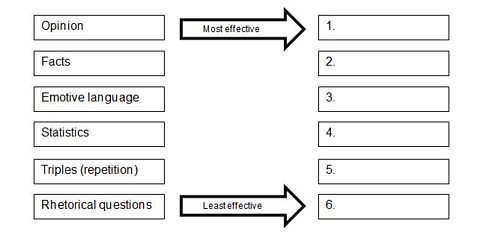
Think about these different features of a powerful speech. Can you order them from most to least effective?
Top Tip!
Think carefully. If you were listening to a speech, what technique would make the key points stick in your mind?
For example, some people might find that hearing the key message repeated three times will help them to remember it.
Activity 2
Read this article all about the world’s top plastic polluters.
Imagine you are giving a short speech to one of the top plastic polluters. You want to persuade them to use less plastic and make changes more quickly.
Use some of the statistics from the article as well as the techniques in the acronym A FOREST to support your opinion.

Top tip!
Think about:
- Who you are addressing
- Your purpose for being there
- How you will open your speech
- Which A FOREST features you will use
- What your closing line will be
Activity 3

This is part of a speech by former president of the USA John F. Kennedy about the decision to go to the moon.
Read it out loud and think carefully about where you place expression and emphasis to make it sound as meaningful as you can.
We choose to go to the moon. We choose to go to the moon in this decade and do the other things, not because they are easy, but because they are hard, because that goal will serve to organize and measure the best of our energies and skills, because that challenge is one that we are willing to accept, one we are unwilling to postpone, and one which we intend to win, and the others, too.
John F. Kennedy
Play our fun English game Crystal Explorers! game
Use grammar, punctuation and spelling skills to explore jungles, caves and tombs on your mission.

More on Non-fiction
Find out more by working through a topic
- count16 of 18

- count17 of 18

- count18 of 18
- count1 of 18