Key points
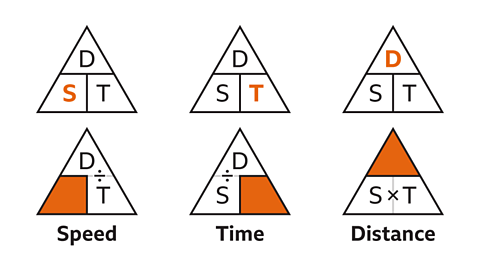
If two of the three variables A measure of how the distance travelled by a moving object changes with time. The average speed of a moving object is defined as the total distance travelled/time taken to travel that distance. The units of speed are length/time, eg kilometres per hour, or metres per second., distance or time are known, the third can be worked out.
A One or more rectangular bars drawn to represent information. is one way to decide what calculation is needed to solve a speed, distance and time problem. Multiplication and division skills are useful when solving speed, distance and time problems.
It may be useful to review how to calculate speed, distance and time.
Drawing a bar model to help work out the distance travelled
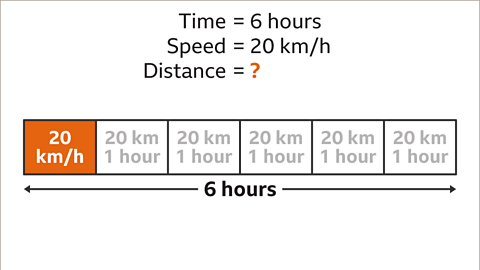
A One or more rectangular bars drawn to represent information. can be used as a way of understanding speed, distance and time calculations.
The total length of the bar represents both the total distance and the total time taken.
The bar is divided into parts. Each part represents the speed as a distance per unit of time.
The number of parts gives the number of units of time.
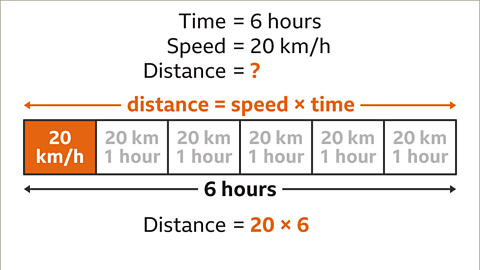
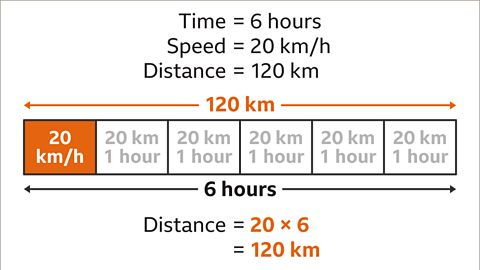
Once the bar is drawn, use the bar model to help with the calculation. To work out distance, multiply speed by time.
Examples
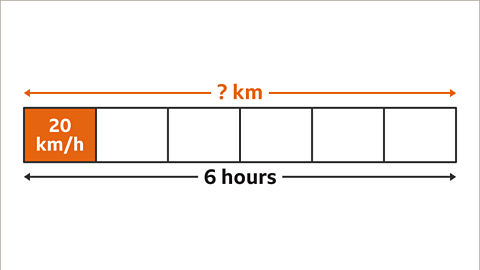
Image caption, A bar model can represent speed, distance and time.
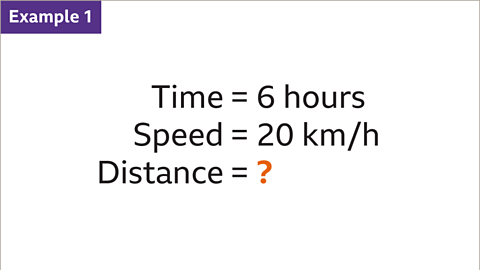
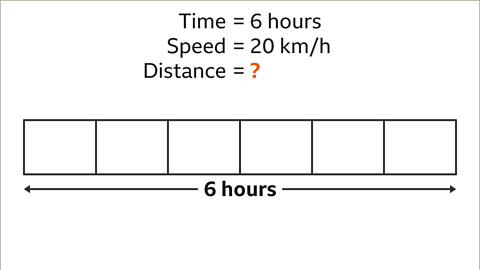
1 of 6
Drawing a bar model to work out speed or time
Bar models can be used to work out speed and time.
Remember:
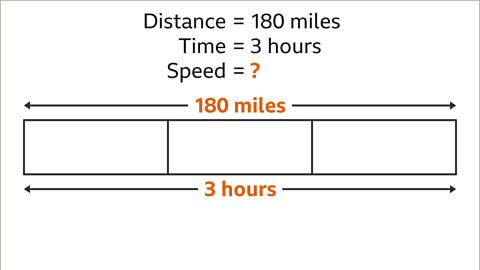
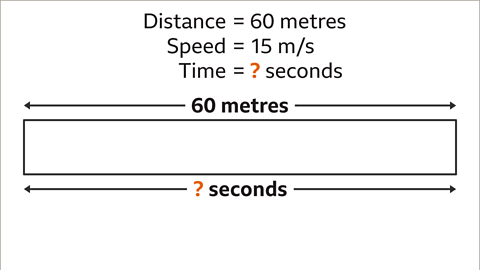
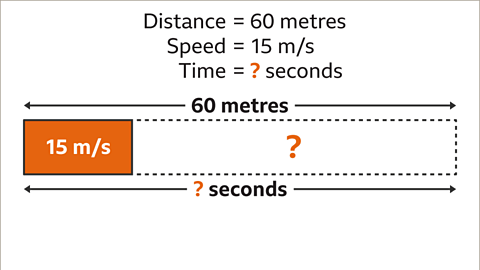
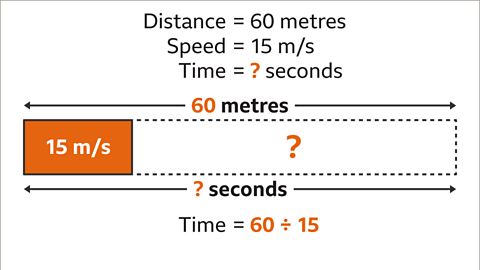
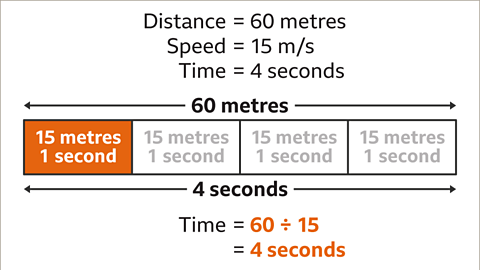
The total length of the bar represents both the total distance and the total time taken.
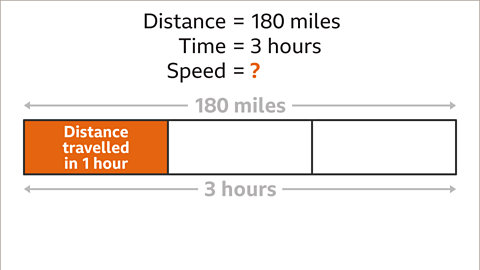
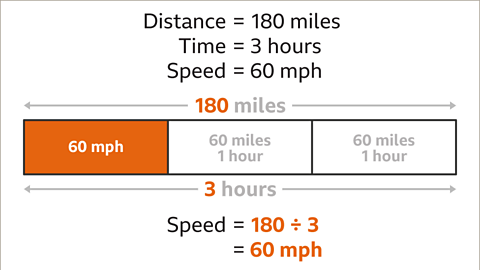
The bar is divided into parts. Each part represents the speed as a distance per unit of time.
The number of parts gives the number of units of time.
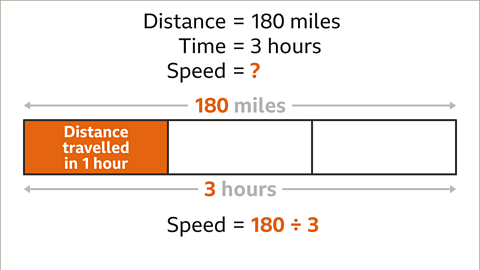
To work out the speed, divide distance by time.
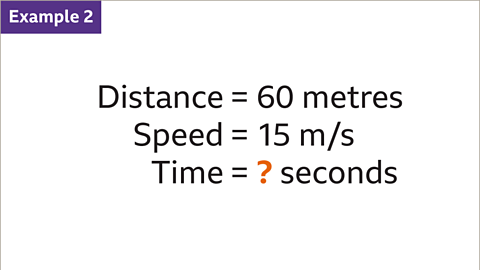
To work out the time, divide distance by speed.
Examples
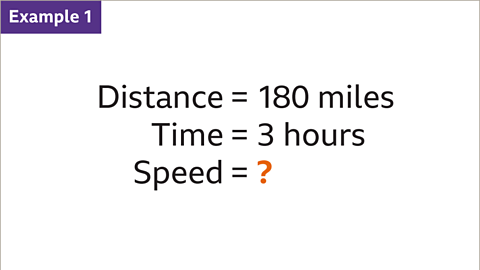
Image caption, Work out the speed of an object that travels 180 miles in 3 hours.
1 of 10
Question
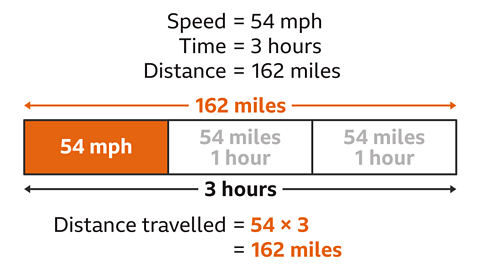
How far does a lorry travel if it is driven at an average speed of 54 mph for 3 hours?
Draw a bar model. The bar model is split into 3 parts for 3 hours.
Each part represents the speed of 54 miles per hour.
This is 54 miles for each hour.
The distance travelled is the speed multiplied by the time.
54 × 3 = 162
The lorry travels 162 miles.
Practise calculating distance, speed and time using a bar model
Practise calculating distance, speed and time using bar models. You might need a pen and paper to help with your answers.
Quiz
Play Sudoku with BBC Bitesize!
Every weekday we release brand new easy, medium and hard Sudoku puzzles. Perfect for testing your skill with numbers and logic.

More on Distance, speed and time
Find out more by working through a topic
- count1 of 2