Key points about percentages of an amount
- A percentage represents a Used to show how quantities and amounts are related to each other. When one amount changes, the other also changes, as set by proportion rules, eg if 1 item costs 10p, then 5 items cost 50p. of a whole using parts out of 100.
- A percentage of an amount can be found by using the Using the four key percentages (50%, 25%, 10% and 1%), in combination, as building blocks to find a percentage of an amount., A method that works out the value of one unit. Once the value of one unit is known, the value of any number of units can be calculated. or the A decimal that multiplies an amount. The decimal has usually been converted from a percentage. For example, in the calculation 80 × 0∙2, the multiplier is 0∙2. method.
- 50%, 25%, 10% and 1% are the four key percentages, used as building blocks, to work out percentages in the build-up method.
When working with percentages, make sure you are confident in handling equivalent fractions and converting between fractions, decimals and percentages.
Check your understanding
The decimal multiplier method involves converting the percentage to a decimal and multiplying this by the amount.
Writing one number as a percentage of another
A percentage is a Used to show how quantities and amounts are related to each other. When one amount changes, the other also changes, as set by proportion rules, eg if 1 item costs 10p, then 5 items cost 50p. that shows a number as parts per hundred. The symbol '%' means 'per cent', eg 9% means 9 out of every 100, or \(\frac{9}{100}\) as a fraction, or 0·09 as a decimal.
Example
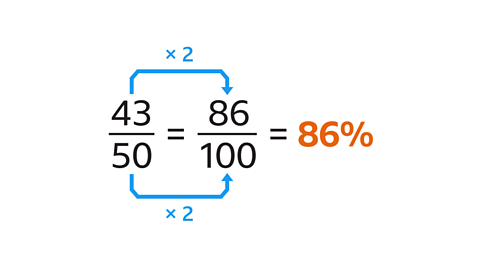
A student scores \(\frac{43}{50}\) on a test. To convert the score to a percentage, express \(\frac{43}{50}\) as an A fraction with the same value as another. Each fraction represents the same proportion, eg ½ and ¹⁰⁄₂₀. out of 100.
By keeping the numerator and denominator in the same proportion, if the amount of questions were doubled to 100, the number of correct answers would double to 86.
43 out of 50 is the same proportion as 86 out of 100, which is 86%.
Follow the working out below
GCSE exam-style questions
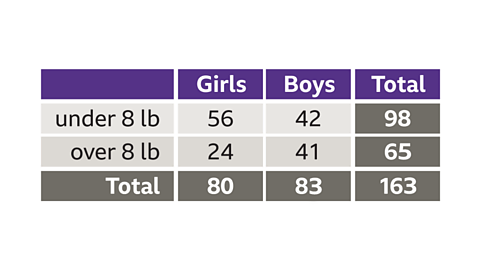
- The two-way table shows information on a group of newborn babies.
What percentage of the girls are under 8 lb?
The answer is 70%
Only consider the column for girls.
There are 80 girls altogether.
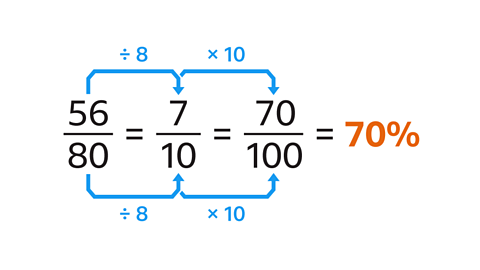
56 of the girls are under 8 lb.Write 56 out of 80 as a fraction.
Simplify to make the denominator 10:
\(\frac{56}{80}\) = \(\frac{7}{10}\)Multiply the numerator and denominator by 10 to give a fraction out of 100.
\(\frac{70}{100}\) is equivalent to 70%
- What is 88 as a percentage of 110?
The answer is 80%

Write as a fraction: \(\frac{88}{110}\).
Simplify the fraction as far as \(\frac{8}{10}\) by dividing the numerator and denominator by 11. Creating a denominator of 10 rather than simplifying fully to \(\frac{4}{5}\) makes the next step easier.
Multiply the numerator and denominator by 10 to give a fraction out of 100.
\(\frac{8}{10}\) is equivalent to \(\frac{80}{100}\).\(\frac{80}{100}\) is the same as 80%.
- A 60 g snack contains 33 g of carbohydrates, 10 g of fat and 3 g of fibre.
What percentage of the snack is carbohydrates?
The answer is 55%
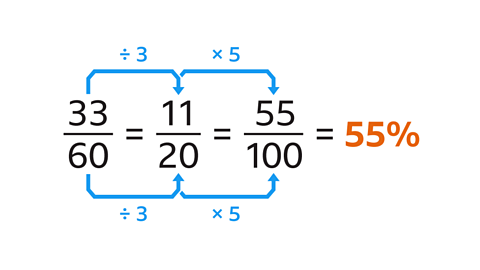
Write 33 g out of 60 g as a fraction: \(\frac{33}{60}\).
Simplify the fraction to \(\frac{11}{20}\).
Multiply the numerator and denominator by 5 to give a fraction out of 100.
\(\frac{11}{20}\) is equivalent to \(\frac{55}{100}\).\(\frac{55}{100}\) is the same as 55%.
Finding a percentage of an amount
There are three main methods to find a percentage of an amount:
- The build-up method is useful when a calculator is not available. It involves working out and combining lots of 50%, 25%, 10% and 1%.
- The unitary method is where 1% of the amount is found, and then multiplied by the number in the percentage.
- The decimal multiplier method involves converting the percentage to a decimal and multiplying this by the amount.
Follow the working out below
GCSE exam-style questions
- A set of game figures contains 60 monsters and 25 heroes.
- 12% of the monsters are painted.
- 44% of the heroes are painted.
How many figures are painted altogether?
Use a calculator.
The answer is 16
- Convert the percentages to decimal multipliers by dividing by 100:
- 12% = 0·12
- 44% = 0·44
- Multiply the decimal multipliers by the amounts:
12% of 60 = 0·12 × 60 = 5 monsters are painted.
44% of 25 = 0·44 × 25 = 11 heroes are painted. - Add the two answers.
Altogether, 5 + 11 = 16 figures are painted.
- Find 37% of £600.
Do not use a calculator.
The answer is £222
Find the key percentages of £600:
50% of £600 = half of £600 = £300
25% of £600 = half of £300 = £150
10% of £600 = £600 ÷ 10 = £60
5% of £600 = half of £60 = £30
1% of £600 = £600 ÷ 100 = £6
There are lots of ways to build up to 37%. The two most common ways are shown below:
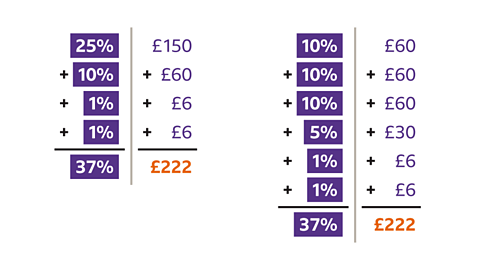
- Find 8% of 1600 kg.
Use a calculator.
The answer is 128
Convert 8% to a decimal by dividing 8 by 100.
- The decimal multiplier is 0·08.
- 0·08 × 1600 = 128
Alternatively, find 1% by dividing by 100, then multiply the result by 8.
- 1600 ÷ 100 = 16
- 16 × 8 = 128
Quiz – Percentages of an amount
Practise what you've learned about percentages of amounts with this quiz. The questions change each time you try, so keep testing your knowledge.
Now you've revised percentages of an amount, why not try looking at adding, subtracting, multiplying and dividing fractions?
Play Sudoku with BBC Bitesize!
Every weekday we release brand new easy, medium and hard Sudoku puzzles. Perfect for testing your skill with numbers and logic.
More on Ratio, proportion and rates of change
Find out more by working through a topic
- count5 of 8
- count7 of 8
- count8 of 8