Would, could, should
The conditional form of the modal verbskönnen (to be able) and sollen (to be supposed to) can be used to describe what could or should happen.
| können | sollen |
| ich könnte – I could | ich sollte – I should |
| du könntest – you could | du solltest – you should |
| er/sie/es/man könnte – he/she/it could | er/sie/es/man sollte – he/she/it/one should |
| wir könnten – we could | wir sollten – they should |
| ihr könntet – you could | ihr solltet – you should |
| Sie könnten – you could | Sie sollten – you should |
| sie könnten – they could | sie sollten – they should |
| können | ich könnte – I could |
|---|---|
| sollen | ich sollte – I should |
| können | du könntest – you could |
|---|---|
| sollen | du solltest – you should |
| können | er/sie/es/man könnte – he/she/it could |
|---|---|
| sollen | er/sie/es/man sollte – he/she/it/one should |
| können | wir könnten – we could |
|---|---|
| sollen | wir sollten – they should |
| können | ihr könntet – you could |
|---|---|
| sollen | ihr solltet – you should |
| können | Sie könnten – you could |
|---|---|
| sollen | Sie sollten – you should |
| können | sie könnten – they could |
|---|---|
| sollen | sie sollten – they should |
These verbs are very useful for making suggestions and giving advice.
Hilfsvokabeln– Helpful vocabulary
- fettig – fatty
- gründen – to establish
- Obst und Gemüse – fruit and vegetables
- sich strecken – to do stretches
- spazieren gehen – to go for a walk
- vermeiden – to avoid
- weniger – less
Question
Read the advice below about living a healthy lifestyle and match the German with the English translations.
| German | English |
| 1. Du solltest jeden Tag spazieren gehen. | A. You should be active. |
| 2. Du solltest fettiges Essen vermeiden. | B. You could do more sport. |
| 3. Du könntest zu Fuß zur Schule gehen. | C. You should go for a walk every day. |
| 4. Du solltest nicht rauchen. | D. You should never take drugs. |
| 5. Du solltest jeden Tag Obst und Gemüse essen. | E. You should avoid fatty food. |
| 6. Du könntest mehr Sport treiben. | F. You should not smoke. |
| 7. Du könntest weniger Süßigkeiten essen. | G. You could walk to school. |
| 8. Du solltest aktiv sein. | H. You could eat fewer sweets. |
| 9. Du solltest nie Drogen nehmen. | I. You should eat fruit and veg every day. |
| German | 1. Du solltest jeden Tag spazieren gehen. |
|---|---|
| English | A. You should be active. |
| German | 2. Du solltest fettiges Essen vermeiden. |
|---|---|
| English | B. You could do more sport. |
| German | 3. Du könntest zu Fuß zur Schule gehen. |
|---|---|
| English | C. You should go for a walk every day. |
| German | 4. Du solltest nicht rauchen. |
|---|---|
| English | D. You should never take drugs. |
| German | 5. Du solltest jeden Tag Obst und Gemüse essen. |
|---|---|
| English | E. You should avoid fatty food. |
| German | 6. Du könntest mehr Sport treiben. |
|---|---|
| English | F. You should not smoke. |
| German | 7. Du könntest weniger Süßigkeiten essen. |
|---|---|
| English | G. You could walk to school. |
| German | 8. Du solltest aktiv sein. |
|---|---|
| English | H. You could eat fewer sweets. |
| German | 9. Du solltest nie Drogen nehmen. |
|---|---|
| English | I. You should eat fruit and veg every day. |
- Du solltest jeden Tag spazieren gehen. – C. You should go for a walk every day.
- Du solltest fettiges Essen vermeiden. – E. You should avoid fatty food.
- Du könntest zu Fuß zur Schule gehen. – G. You could walk to school.
- Du solltest nicht rauchen. – F. You should not smoke.
- Du solltest jeden Tag Obst und Gemüse essen. – I. You should eat fruit and veg every day.
- Du könntest mehr Sport treiben. – B. You could do more sport.
- Du könntest weniger Süßigkeiten essen. – H. You could eat fewer sweets.
- Du solltest aktiv sein. – A. You should be active.
- Du solltest nie Drogen nehmen. – D. You should never take drugs.
Did you know?
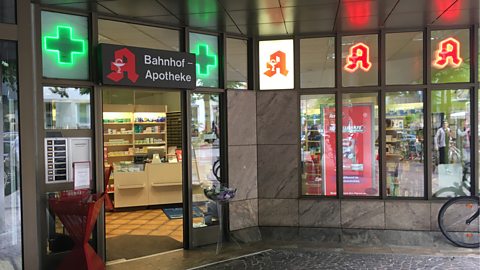
Many German towns have several pharmacies which are easy to spot thanks to the distinctive red ‘A’ logo, which stands for Apotheke.
Because only trained pharmacists are permitted to sell medications in Germany, staff members in pharmacies are always very knowledgeable and an excellent source of advice on all sorts of remedies.
Under German law, all TV and radio adverts for medicines must end with a spoken disclaimer advising consumers to consult their doctor or pharmacist about any health risks or side effects – „Zu Risiken und Nebenwirkungen bitte fragen Sie Ihren Arzt oder Apotheke”. The sentence is always spoken as quickly as possible to keep airtime to a minimum. How quickly can you say it?