Irish migrants
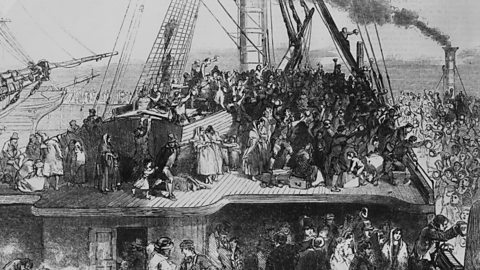
In the 1840s, the potato crop in Ireland was wiped out by a disease. This led to widespread famine among the poor tenant farmers as the potato was a stable of their diet. To escape the famine many left Ireland in waves of mass migration. Ireland was then a part of Great Britain, ruled from London. The majority came to work in the factories of the North West of England, especially Liverpool, which was easily reached by boat from Dublin and Belfast. Many families arrived in a poor state - hungry, weak and sick - and found themselves living in overcrowded, unhealthy ‘Low quality housing for poor people in cities such as Liverpool and Manchester. Built around a central court area, they were dark and unhealthy with poor sanitation.’. Death rates were high. We know of this from reports written by Liverpool’s Medical Officer of Health. However, conditions were much the same for the English working classes at that time.
Many Irish families joined equally poor migrants from all over Britain, working in harsh conditions in the textile factories of the north west of England. Another common employment for Irish men was to work as ‘Labourers, in particular someone who builds roads, canals or railways.', digging the earth to build canals, roads, railways and docks. This work took them all over the country. Irish seamen and dock workers settled in port communities such as South Shields and Cardiff.
The very hard life experienced by hundreds of thousands of poor Irish migrants was made far worse by extreme racism. In cartoons, newspaper articles, speeches by politicians and popular jokes, Irish people were portrayed as savage, violent, drunken and animal-like. Anti-Irish racism was widespread and nasty. Other reasons for divisions between English and Irish workers included:
- politics, because many Irish migrants supported the idea of Home Rule (Ireland should have its own government)
- pay, because many English workers felt that the Irish were undercutting their wages by accepting lower pay
- religion, because most Irish A person who arrives from another country. were Christians whose religious leader is the Pope.
There were sometimes anti-Irish and anti-Catholic riots and sometimes violence between Irish Catholics and Christians who broke away from the Roman Catholic Church during the Reformation. They believe in the teachings of the Bible but reject the authority of the Pope., for example in the 1840s and 1850s in Cardiff, Greenock, Stockport and towns in north-west England.
However, Irish people also mixed with the English population and intermarriage was common. There was also a large number of middle-class Irish immigrants, including artists, writers and business people. Many soldiers and officers in the British Army were Irish. By 1900, most Irish families were seeing an improvement in their lives.
Liverpool Mercury report on Irish migrants
More guides on this topic
- Migration to Britain c1000 to c2010 overview - OCR A
- Medieval 1000-1500 overview - OCR A
- Reasons for immigration in the Medieval era - OCR A
- Experiences of immigrants in the Medieval era - OCR A
- Impact of immigration in the Medieval era - OCR A
- Immigration in the Early Modern era, 1500-1750 overview - OCR A
- Reasons for immigration in the Early Modern era, 1500-1750 - OCR A
- Experiences of immigrants in the Early Modern era, 1500-1750 - OCR A
- Impact of immigration in the Early Modern era, 1500-1750 - OCR A
- Immigration in the Industrial era, 1750-1900 overview - OCR A
- Reasons for immigration in the Industrial era, 1750-1900 - OCR A
- Impact of immigration in the Industrial era 1750-1900 - OCR A
- Immigration in the Modern era 1900 - present overview - OCR A
- Reasons for immigration in the Modern Era 1900 - present - OCR A
- Experiences of immigrants in the Modern era, 1900 - present - OCR A
- Impact of immigration in the Modern Era 1900 - present - OCR A
- Migration to Britain c1000 to c2010 - exam preparation - OCR A
