Reasons for circumnavigation
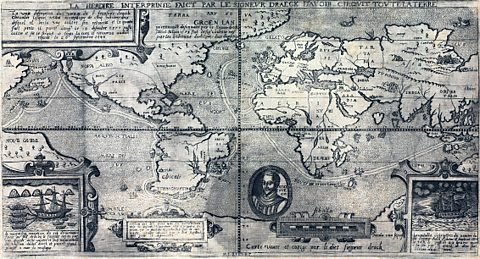
Exploration - Drake was part of a generation of English sailors who were fascinated by the possibilities of exploring parts of the world that were unknown to them. For them, exploration offered the potential for massive rewards through trade and conquest. A particular focus was the idea of finding new routes for trade.
Like many sailors at the time, he was intrigued by the possibility of a Northwest Passage, also called the Strait of Anian, a sea route that would connect the Atlantic and Pacific Oceans across the top of North America.
If found, this passage would dramatically shorten the journey to East Asia, where highly valuable goods like spices, silk and precious metals could be traded.
Wealth - Drake and his backers were motivated by the opportunity to seize Spanish gold, silver and valuable goods. The earlier raids in Panama in 1572 had proven that great wealth could be captured, making further expeditions extremely attractive financially. Important figures such as the Earl of Leicester, Sir Francis Walsingham, Sir Christopher Hatton, and even Elizabeth I, secretly invested in the voyage, seeking profit and strategic advantage.
Political power - At the time of Drake’s voyage, Anglo-Spanish relations were deteriorating due to Spain's actions in the Netherlands. Attacking Spanish interests overseas was a way to weaken Spain’s power without officially declaring war. Drake didn’t like the Spanish partly due to an incident in 1568. Drake and Hawkins anchored in the Spanish port of San Juan de Ulúa to resupply and make repairs but, despite having negotiated a truce, they were attacked by Spanish warships. Only two English ships, those of Drake and Hawkins, escaped. As a result and with encouragement from English politicians, Drake raided Spanish colonies in Panama, Chile and the Spanish mainland at Cadiz.
Imperialism - There was growing English interest in establishing trade routes, settlements, and colonies in South America, particularly in Brazil and Peru. As opportunities in Central America declined in the 1560s, English attention shifted to North America for influence.
More guides on this topic
- The Elizabethans overview - AQA
- The early rule of Queen Elizabeth I - AQA
- QUIZ: Elizabeth's court and parliament
- Elizabethan Religious Settlement - AQA
- Challenges to the rule of Queen Elizabeth I - AQA
- QUIZ: Troubles at home and abroad
- QUIZ: Life in Elizabethan times
- The Elizabethans - exam preparation - AQA
