Testing for negatively charged ions
The formation of different precipitates allows us to identify different negatively charged Electrically charged particle, formed when an atom or molecule gains or loses electrons. in solution.
Testing for carbonate ions
Carbonate ions, CO32-, are detected using a dilute Substance producing more hydrogen ions than hydroxide ions when dissolved in water. . Bubbles are given off when an acid, usually dilute hydrochloric acid, is added to the test A substance formed by the chemical union of two or more elements..
The bubbles are caused by carbon dioxide. Calcium hydroxide solution. It turns milky in the presence of carbon dioxide. is used to confirm that the gas is carbon dioxide. It turns milky/cloudy when carbon dioxide is bubbled through it.
Unlike the other tests described on this page, the test for carbonate ions works whatever acid is added.
Testing for sulfate ions
Barium ions react with sulfate ions, SO42- to form Unable to dissolve in a particular solvent. For example, sand is insoluble in water. white barium sulfate:
Ba2+(aq) + SO42-(aq) → BaSO4(s)
To test for sulfate ions:
- add a few drops of dilute hydrochloric acid to the sample
- add a few drop of dilute barium chloride solution
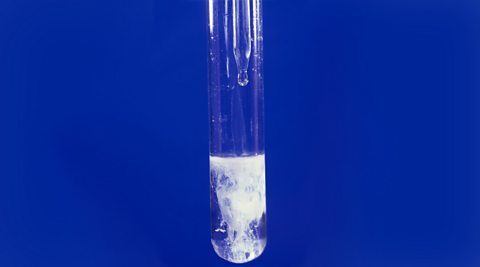
A white A suspension of particles in a liquid formed when a dissolved substance reacts to form an insoluble substance, eg in a precipitation reaction. forms if sulfate ions are present.
Worked example
Explain why, in a test for sulfate ions, the sample is acidified with hydrochloric acid first.
Carbonate ions also produce a white precipitate with barium chloride solution. The acid reacts with any carbonate ions present. This removes them, so stopping them giving a false positive result.
Question
Explain why, in a test for sulfate ions, dilute sulfuric acid cannot be used to acidify the sample.
Sulfuric acid, H2SO4(aq), contains sulfate ions. These would react with barium ions in the test, giving an incorrect positive result.
Testing for halide ions
Silver ions react with A halide ion is an ion formed when a halogen atom (an atom from group 7) gains one electron. Halide ions have a single negative charge. Ionic compounds containing halide ions may be called halides. ions (Cl-, Br- or I- ions) to form insoluble precipitates. The table shows the colours of these silver halide precipitates.
| Halide ion | Precipitate colour |
| Chloride, Cl- | White |
| Bromide, Br- | Cream |
| Iodide, I- | Yellow |
| Halide ion | Chloride, Cl- |
|---|---|
| Precipitate colour | White |
| Halide ion | Bromide, Br- |
|---|---|
| Precipitate colour | Cream |
| Halide ion | Iodide, I- |
|---|---|
| Precipitate colour | Yellow |
For example, when silver nitrate is added to a solution containing chloride ions:
Ag+(aq) + Cl-(aq) → AgCl(s)
To test for halide ions:
- add a few drops of dilute nitric acid to the sample
- add a few drop of dilute silver nitrate solution
Observe and record the colour of any precipitate that forms.
Worked example
Explain why, in a test for halide ions, the sample is acidified with dilute nitric acid first.
Carbonate ions also produce a white precipitate with silver nitrate solution. The acid reacts with any carbonate ions present. This removes them, so stopping them giving an incorrect positive result for chloride ions.
Question
Explain why, in a test for halide ions, dilute hydrochloric acid cannot be used to acidify the sample.
Hydrochloric acid, HCl(aq), contains chloride ions. These would react with silver ions in the test, giving a false positive result.
