Naturalism and realism
It can be quite difficult to work out the difference between naturalism and realism. But there are features which can help you understand the terminology. Realism was a 19th-century theatrical movement, seeking to portray real life on the stage. Stanislavski was a committed follower of realism throughout his working life.
Naturalism is often used to refer to the same things but it can also mean the belief that a human character is formed by what they’ve inherited from their family and environment. The literary naturalism movement is probably most associated with the work of the French novelist, Emile Zola.
Bear in mind that Stanislavski was committed to realism throughout his career and came to stand out against the scientific idea of naturalism. Remember too that experimentation was his key approach to theatre. There may be typical productions of Chekhov plays with extraordinarily realistic sets but Stanislavski also, for instance, explored The use of images or things (usually physical, like a flag) that stand for or represent something else, usually something abstract like a nation. . He undertook a much praised production of Shakespeare’s Othello, whose verse was, on the face of it, outside the realms of realistic production.
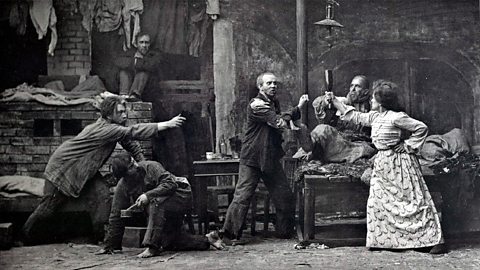
Make sure that you move beyond the broad brush generalisation when you discuss or consider Stanislavski as a practitioner on whom to model your work.
Henrik Ibsen’s play, Ghosts is a good example of a play that’s both realistic and uses powerful symbols such as the sun. In the play the sun rises and shines and casts an unattainable light on the characters. The characters are destroyed by A sexually transmitted disease which causes degeneration to the brain and body if untreated., a disease which is in itself a symbolic link to the father’s corrupt behaviour in the play. Never try to pigeonhole a dramatist or a theatrical practitioner too narrowly!
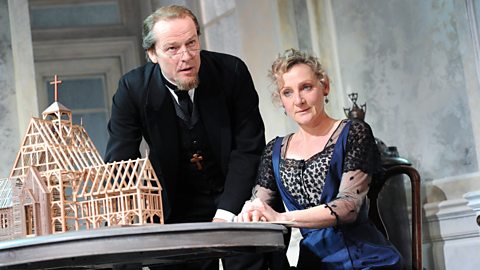
Our demands are simple, normal, and therefore they are difficult to satisfy. All we ask is that an actor on the stage live in accordance with natural laws.
