The impact of merchants, bankers and immigrants from the Low Countries
In the 14th and 15th centuries, Someone from Flanders in the region that is now part of Belgium. and Dutch craftspeople brought skills that helped move the economy from a The primary sector involves extracting raw materials, rearing animals and growing crops. one based on raw materials to a A type of industry where raw materials are made into something. Often called 'manufacturing'. manufacturing one. This brought new wealth to England based on woollen textiles. They had a huge impact on the fortunes of towns in southern and eastern England and even Manchester, where Flemish weavers began the textile business which would eventually become world famous.
The economic impact was huge. Thanks to the input of Flemish cloth workers, for example, cloth production rose rapidly. England was beginning to produce its own cloth and makers, merchants and the Crown profited from the trade. Woollen cloth would be England’s main source of wealth for several hundred years.
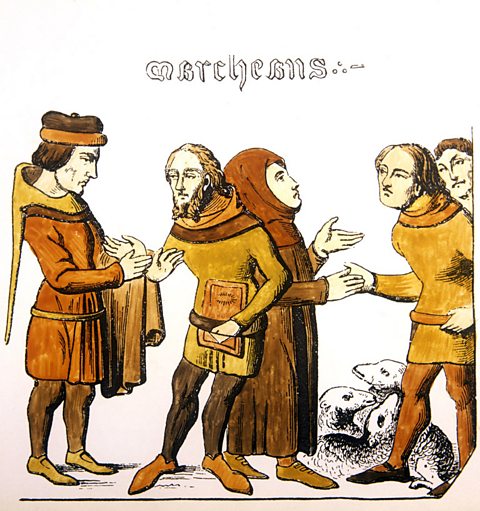
Immigrants brought many other skills, too. Dutch women taught brewers in East Anglia how to make beer using hops rather than with barley. Flemish brick makers were highly regarded and their styles influenced house construction.
Italian financiers had a significant impact on England’s military expansion. Italian money funded King Edward I’s campaign in Wales, the very first stage of English A wide area of territory that has been seized and is controlled by a foreign power. building. Loans to King Edward III helped fund English forces in the From 1337 to 1453, wars between the rulers of England and France over who controlled France.. Lombard banking families, such as the Bardis, helped create the beginnings of London as an international financial market; a position it still holds today.
The bases set up by Belonging to one of the northern German ports that formed an association to control and protect trade. merchants at the The walled communities which were trading bases where Hansa merchants lived and worked. There was one in London and others in King's Lynn and Boston. in London and Lynn enabled England to become a key European trading centre, with woollen cloth a major commodity. Trade with cities around the North and Baltic Seas increased, bringing money to the Crown through tax on imports and exports.
More guides on this topic
- Migration to Britain c1000 to c2010 overview - OCR A
- Medieval 1000-1500 overview - OCR A
- Reasons for immigration in the Medieval era - OCR A
- Experiences of immigrants in the Medieval era - OCR A
- Immigration in the Early Modern era, 1500-1750 overview - OCR A
- Reasons for immigration in the Early Modern era, 1500-1750 - OCR A
- Experiences of immigrants in the Early Modern era, 1500-1750 - OCR A
- Impact of immigration in the Early Modern era, 1500-1750 - OCR A
- Immigration in the Industrial era, 1750-1900 overview - OCR A
- Reasons for immigration in the Industrial era, 1750-1900 - OCR A
- Experiences of immigrants in the Industrial era 1750-1900 - OCR A
- Impact of immigration in the Industrial era 1750-1900 - OCR A
- Immigration in the Modern era 1900 - present overview - OCR A
- Reasons for immigration in the Modern Era 1900 - present - OCR A
- Experiences of immigrants in the Modern era, 1900 - present - OCR A
- Impact of immigration in the Modern Era 1900 - present - OCR A
- Migration to Britain c1000 to c2010 - exam preparation - OCR A
