President Kennedy and Vietnam, 1961-1963
The government of the Republic of Vietnam, led by President Ngo Dinh Diem in the South, faced opposition from the Viet Minh. In 1959, the Viet Minh decided to focus on defeating the Republic of Vietnam’s forces and uniting Vietnam under one A supporter of a classless society where all property is publicly owned. government.
It set up the National Liberation Front (NLF), which aimed to:
- organise the various resistance groups already in South Vietnam
- support the North Vietnamese Army (NVA)in the South
- assassinate South Vietnamese government officials
Before John F Kennedy was elected president, he had promised to prevent the spread of communism in places like Vietnam. After his election, he launched Operation Beef Up to help President Diem combat the Viet Minh. This operation had the following results:
- It increased the number of US troops in South Vietnam from just over 3,000 in 1961 to 17,000 in 1963.
- It established the Military Assistance Command, Vietnam, to coordinate US support for South Vietnam.
- It allowed US troops to secretly support the actions of the Army of the Republic of Vietnam (ARVN).
- It encouraged Diem to make social and political reforms to make his government more popular.
Securing South Vietnam
There were communist supporters of North Vietnam inside South Vietnam. Some of these supporters formed A type of warfare that involves frequent attacks on larger enemy forces. forces and they received support from North Vietnam. The Americans called the guerrillas the Viet Cong and took steps to help combat them. President Kennedy supported the establishment of Attempts to stop people or groups that are fighting against government control. groups and operations:
| Name | Details |
| Green Berets | They taught the ARVN how to deal with guerrilla tactics from communists in the South, who were nicknamed the Viet Cong. |
| Civilian Irregular Defense Groups | They tried to get the mountain tribes of South Vietnam to support President Diem’s government. |
| Operation Ranch Hand | This was a plan to spray the supply routes used by the Viet Cong with a defoliant (a chemical called Agent Orange that removes leaves from plants and trees) to make them easier to identify. |
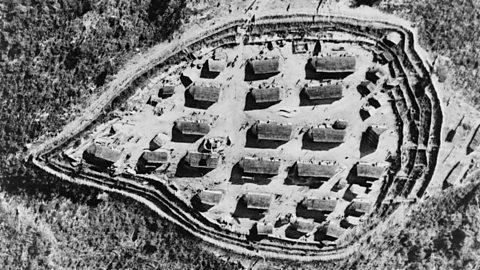
| Strategic Hamlet Program | This involved setting up fortified villages. Villagers were moved into these villages so that they could be kept ‘safe’ from the communists. In reality, their purpose was to stop villagers helping the Viet Cong. |
| Name | Green Berets |
|---|---|
| Details | They taught the ARVN how to deal with guerrilla tactics from communists in the South, who were nicknamed the Viet Cong. |
| Name | Civilian Irregular Defense Groups |
|---|---|
| Details | They tried to get the mountain tribes of South Vietnam to support President Diem’s government. |
| Name | Operation Ranch Hand |
|---|---|
| Details | This was a plan to spray the supply routes used by the Viet Cong with a defoliant (a chemical called Agent Orange that removes leaves from plants and trees) to make them easier to identify. |
| Name | Strategic Hamlet Program |
|---|---|
| Details | This involved setting up fortified villages. Villagers were moved into these villages so that they could be kept ‘safe’ from the communists. In reality, their purpose was to stop villagers helping the Viet Cong. |
The overthrow of President Ngo Dinh Diem
Despite the support of the USA, President Diem became increasingly unpopular in South Vietnam. There were many reasons for this:
- Although the majority of the Vietnamese people were Buddhists. Diem and his government openly discriminated against Buddhists.
- Diem carried out land reforms that took land away from local people and gave it to landlords.
- Diem gave government jobs to his family and was seen as a corrupt politician.
- The Strategic Hamlet Program was deeply unpopular because villagers were forced to move away from their ancestral homes. By 1962, there were around 3,000 Strategic Hamlets, but the policy did not last long because the Viet Cong targeted them and the people living in them hated them.
By 1963, it was clear to the USA that they were supporting a corrupt government that stood little chance of uniting South Vietnam with the communist North. Diem's anti-Buddhist measures and the persecution of Buddhists in the country led to Buddhist monks setting themselves on fire to protest about his government’s policies. At that point, President Kennedy decided to cut off the aid it was giving Diem.
In November 1963, a A sudden shift in government control, usually brought about by violent or illegal action by a small group. Often shortened to coup. was launched against Diem by South Vietnamese generals, and he was assassinated. The government of South Vietnam remained under unstable military rule until Nguyen Van Thieu took over as president in 1967.
