Segregated education - the Brown v Topeka case
Learn more about segregated education in this podcast.
Listen to the full series on BBC Sounds.
After the American Civil War in the 1860s, the 14th Amendment to the US A set of laws by which a country is governed. was supposed to give black Americans legal equality with white Americans. However, the Plessy v Ferguson case, heard by the The ultimate court of appeal in the USA. It makes the final decision on whether a law is permitted by the US Constitution. in 1896, challenged this.
‘Separate but equal’
In 1890, Louisiana passed a law to Laws separating black and white people in public places in society. train carriages. When a black man named Homer Plessy took a seat in a white carriage in 1892, he was arrested. His case eventually reached the Supreme Court. However, the court ruled that Louisiana’s law was legal, because the black carriages were of an equal standard.
Brown v Topeka
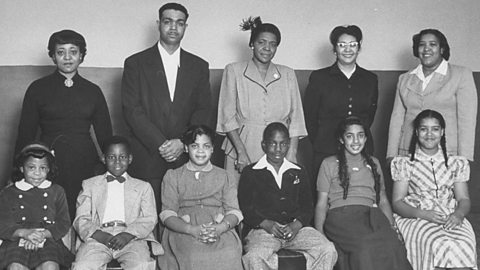
The Plessy v Ferguson ruling meant that schools in the South continued to be segregated, as the authorities argued that the facilities were ‘separate but equal’. In 1954, Thurgood Marshall, a lawyer from the National Association for the Advancement of Colored People The National Association for the Advancement of Colored People was created in 1909 to eliminate race-based discrimination across the United States of America., took up the case of an eight-year-old black schoolgirl called Linda Brown, who lived in Topeka. Linda lived near a school for white children and yet she had to travel a mile to a school for black children.
Acting on behalf of Linda’s father, Oliver Brown, Marshall argued that the Topeka Board of Education was acting incorrectly because education could not be treated as ‘separate but equal’. He said that the education available to black children was not, in reality, equal to that available to white children. Marshall stated, using arguments supported by psychologists, that segregation had a harmful effect on black students. In court, he said segregation created a feeling of inferiority that undermined their motivation to learn and deprived them of educational opportunities that would be available to them in integrated schools.
The Supreme Court ruled in Brown’s favour. The ruling was based on the idea that black people had a right to equal educational opportunities. However, the court did not set a timescale for school Removal of laws that separate people from different races in public places and day-to-day life. because:
- racism was a core feature of southern society and could not be wiped out overnight
- this was the first challenge to legal segregation of education, so the court was worried about how people would react
- the court was concerned that its judgement might be ignored by state governments and that this would make it look weak
So, in this first ruling, the court did not say how desegregation would be put into practice. It was not until 1955, in a second ruling, that the court said desegregation should happen with ‘all deliberate speed’. This phrase was so vague that opponents took it as meaning desegregation could happen slowly.
Reactions in the South
Some southern states, such as Missouri and West Virginia, began the process of desegregation, but several were deeply resistant to it. By mid-1955, around 60,000 white people had joined the Groups of white supremacists, who worked together to stop desegregation. in Mississippi to stop desegregation.
The White Citizens’ Councils were supported by most southern politicians, who also tried to prevent desegregation through various measures. For example, a law was introduced allowing a state A person who is elected to lead a state’s government in the USA. to close desegregated schools. This shows that some politicians opposed to civil rights were willing to take strong measures to maintain segregation in southern society.
Long-term significance
Although the ruling in Brown v Topeka created a large degree of opposition, it was still important in the long term.
- It was the beginning of the end of the principle of ‘separate but equal’.
- For the first time, the Supreme Court was seen to be supporting black people.
- After much resistance, schools in the South did desegregate.
- It marked the beginning of the desegregation process.
- It showed how national media coverage was important in raising awareness of the civil rights movement.
