The purpose and practice of the Five Pillars of Islam
Muslims follow the The five observances which must be followed by all practising Muslims. They are Shahadah, Salah (or Salat), Zakat, Sawm and Hajj. to show their submission to the will of Allah. The Five Pillars are visible signs of the Muslim way of life and of Muslims' unity with other members of Islam worldwide.
1. Shahadah - the declaration of faith
“There is no God butThe name of God for Muslims.; The Arab prophet who founded the religion of Islam. is the messenger of Allah.” Muslims may say this five times a day as part of their daily prayers.
2. Salah - prayer
It is compulsory that Muslims pray five times a day. The prayers include verses from the The sacred book in Islam, it is believed that it contains the word of God, dictated by Angel Jibril and written in Arabic. in which praise is given to Allah, or guidance is requested.
3. Sawm - fasting
This fasting takes place during the month of The month of fasting and prayer in Islam, the ninth month of the Islamic calendar. during the hours of daylight. It is the time when Muhammad received the revelation of the Qur’an and it is a period for prayer and good deeds.
4. Zakat - the practice of giving
Each year, Muslims are expected to donate 2.5 per cent of their disposable income. Wealth is regarded as a gift from Allah which should be shared among humankind. It frees people from their greed, and also helps others.
5. Hajj - pilgrimage
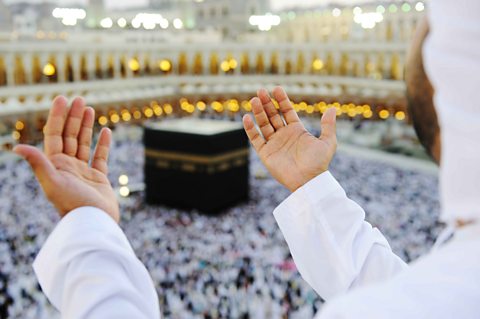
This refers to the pilgrimage to City in Saudi Arabia. Birthplace of the Prophet Muhammad. which all Muslims must complete at least once in their lifetime if their situation allows (if they can afford it, if they are healthy etc). This includes a visit to the The cube-shaped building in the centre of Makkah (Mecca), which is the most sacred site in Islam., the place where Muslims believe that Widely regarded as the father of Christians, Jews and Muslims. He was the first person to teach that there is only one God. His story is told in the biblical book of Genesis and also in the Qur’an, where he is named Ibrahim. showed willingness to offer his son Ishmael as a sacrifice.