Gear types and trains
A wheel with teeth that can change the speed of a mechanism. are wheels with Projecting part of a component such as a gear. around the outside. When several wheels are interlocked, they can transfer motion from one place to another, eg in some hand whisks or on bikes.

Gears can change the direction or the speed of movement. As there are teeth around the edge of the gears they grip together and so can withstand a greater force, enabling them to move large items such as cars or bicycles.
Gear trains
Two or more gears interlocking together. are when two or more gears are joined together. In a simple gear train, the The starting gear in a gear train that causes all other movement. causes the Transfers motion from the drive gear. to turn in the opposite direction.
Smaller gears with fewer teeth turn faster than larger gears with more teeth. This difference in speed is called the The number of turns the driven gear will make for every turn of the drive gear..
Example - Gearing down
The drive gear has 15 teeth and the driven gear has 60 teeth.
The gear ratio is calculated by
Teeth on driven gear ÷ Teeth on drive gear
= 60 ÷ 15
= 4
This means that every time the drive gear turns four times, the driven gear would rotate once.
Gear ratio = 4:1
This is known as A gear arrangement where the driven gear rotates fewer times than the drive gear. because the driven gear rotates fewer times than the drive gear
Example - Gearing up
The reverse of A gear arrangement where the driven gear rotates fewer times than the drive gear. is called A gear arrangement where the driven gear rotates more times than the drive gear.. Here, the driven gear rotates more than the drive gear.
The drive gear has 60 teeth and the driven gear has 15 teeth.
Gear ratio = Teeth on driven gear ÷ teeth on drive gear
= 15 ÷ 60
= 0.25
This means that every time the drive gear turns a quarter (0.25), the driven gear turns once.
The gear ratio is then expressed as:
Rotations of a drive gear : Rotations of a driven gear
0.25:1
Multiply both sides of the ratio by four to avoid having a decimal in our ratio. The ratio is then 1:4.
Question
If a cyclist is pedalling with a driven gear of 50 teeth and a drive gear of 25 teeth, what is the gear ratio?
Gear ratio = 50 ÷ 25
= 2
Gear ratio = 2:1
Gear types
If the drive gear and the driven gear are separated by another gear, called the A gear that can be placed between two other gears to ensure the input and output gears rotate in the same direction., they will move in the same direction.
Bevel gears
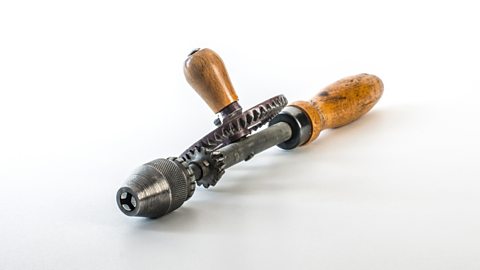
A Two gears placed at an angle to each other, this rotates the direction of the turning motion - one gear will drive the other. is a special gear that can transfer rotary through 90 degrees. The diagram below shows two gears of the same size - the name given to this arrangement is a mitre-gear.
However, the two gears can vary in size to achieve a different gear ratio. An example of this is in a hand drill, where the drive gear is larger than the driven gear.
Rack and pinion
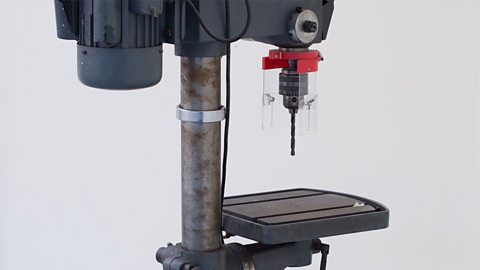
A A rack is a horizontal rail with teeth that fit the teeth of the round pinion. This arrangement turns rotary motion into linear. is an arrangement of a gear wheel and a rack which allows the rotary motion to be converted to linear motion. An example this is in a pillar drill, where the table bed is moved up and down.
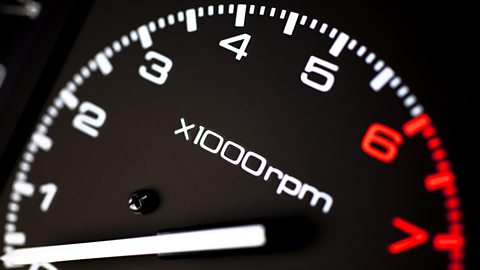
The speed at which a gear or wheel rotates is measured in revolutions per minute (rpm). Many cars have a rev counter that tells the driver how fast the engine is spinning.
Example
A driver gear rotating at 60 rpm is connected to a gear arrangement with a ratio of 60:20.
Calculate the output speed.
Gear ratio = number of teeth on driven gear ÷ number of teeth on the drive gear
= 60 ÷ 20 = 3
Output speed = input speed ÷ gear ratio
= 60 (rpm) ÷ 3 = 20 rpm
In this arrangement the output speed is three times slower compared to the input speed.
Question
A driver gear rotating at 120 rpm is connected to a gear arrangement with a ratio of 6:12. Calculate the output speed.
Gear ratio = number of teeth on driven gear ÷ number of teeth on the drive gear
= 6 ÷ 12 = 0.5
Output speed = input speed ÷ gear ratio
= 120 ÷ 0.5 = 240 rpm
In this arrangement the output speed is two times faster compared to the input speed.
More guides on this topic
- New and emerging technologies - Edexcel
- Energy generation and storage - Edexcel
- Developments in modern materials - Edexcel
- Electronic systems - Edexcel
- Material categories and properties - Edexcel
- Design contexts - Edexcel
- Environmental, social and economic challenges - Edexcel
- Investigating past work - Edexcel
- Design strategies - Edexcel
- Communication of ideas - Edexcel
