Pure substances and mixtures
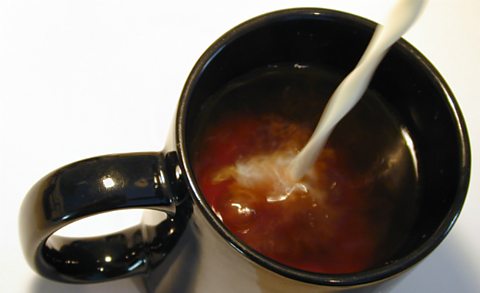
Many different particles may be found in a perfect cup of coffee. All the ingredients; coffee, milk, water and sugar, add their own particles into the Two or more substances that are not joined together. The substances can be elements, compounds, or both..
Milk is a mixture of many different particles; fat, protein, water, sugar and minerals.
Pure bottled water should contain only H2O A group of two or more atoms held together by covalent bonds. (the particles that make up the water). In reality, it is unlikely that any sample of water stays pure for very long as things will very quickly dissolve in the water. For example, gas particles in the air or particles from the walls of the water pipes are often found in 'pure' water.
It is often easy to distinguish whether a material is pure by finding the temperature at which it changes state. The presence of an impurity usually changes the melting and boiling point.
Pure water will boil at 100°C and freeze at 0°C. If the water has something dissolved in it, eg salt, it will boil at a temperature higher than 100°C and freeze at a temperature lower than 0°C. Putting salt on a wet road means that the temperature has to get colder before the water freezes into ice.
Scientists can measure the melting or boiling point of a substance to determine if it is a pure substance or not.
More guides on this topic
- States of matter: interactive activity - AQA Synergy
- Atomic structure - AQA Synergy
- Cells in animals and plants - AQA Synergy
- Transport into and out of cells - AQA Synergy
- Cell division - AQA Synergy
- Mitosis: interactive activity - AQA Synergy
- Waves - AQA Synergy
- Sample exam questions - building blocks - AQA Synergy
